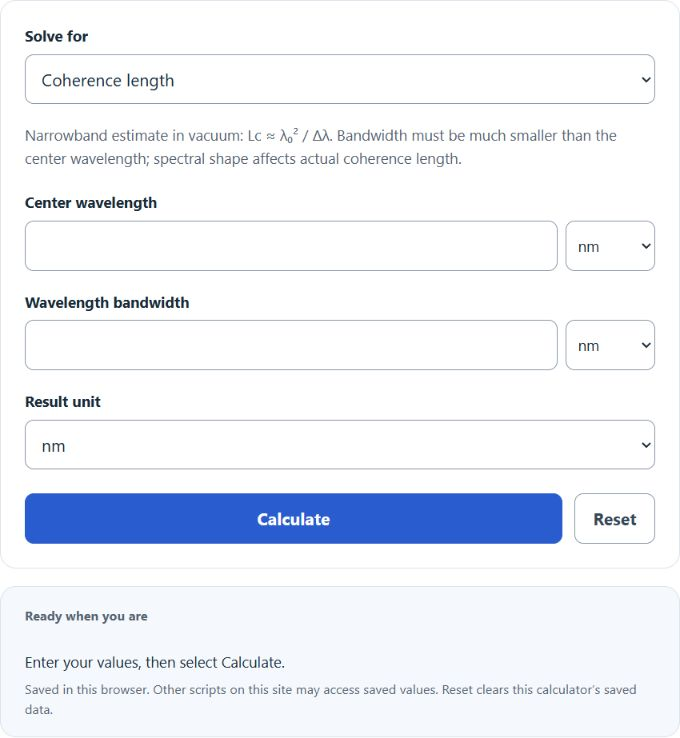
Calculate coherence length, center wavelength, or wavelength bandwidth from two values using Lc ≈ λ0²/Δλ with metric or imperial units.
- All Physics Calculators
- All Length Calculators
- Wavelength to Energy Calculator
- Energy to Wavelength Calculator
Coherence Length Formula
This calculator uses a narrowband estimate in vacuum with coefficient 1. The bandwidth must be much smaller than the center wavelength; spectral shape and the definitions of bandwidth and coherence length affect precise values:
It can also rearrange the same relationship to solve for wavelength bandwidth or center wavelength:
- Lc = coherence length
- λ0 = center wavelength of the light source
- Δλ = wavelength bandwidth used in this estimate
The coherence length function calculates how far the light remains predictably phase-related using the entered center wavelength and bandwidth. The bandwidth function finds the wavelength spread needed for a given coherence length. The center wavelength function finds the wavelength that matches a known coherence length and bandwidth.
All entered values are converted to meters before calculation, then converted back to the selected result unit.
Common Wavelength Units
These conversions are useful when checking the calculator result or comparing values from optics references.
| Unit | Equivalent in meters | Common use |
|---|---|---|
| 1 nm | 1 × 10⁻⁹ m | Visible and near-infrared wavelength bandwidths |
| 1 µm | 1 × 10⁻⁶ m | Infrared wavelengths and short coherence lengths |
| 1 mm | 1 × 10⁻³ m | Longer coherence lengths |
| 1 cm | 1 × 10⁻² m | Very long coherence lengths |
Illustrative Coherence Length Estimates
These are arithmetic examples of the coefficient-one model, not typical specifications for a source type. A device-specific result requires its spectral shape and width convention.
| Center wavelength | Bandwidth | Estimated coherence length |
|---|---|---|
| 850 nm | 10 nm | 72.25 µm |
| 1550 nm | 0.4805 nm | 5 mm |
Example Problems
Example 1: Find coherence length
You have a light source with a center wavelength of 850 nm and a bandwidth of 10 nm.
The coherence length is about 72,250 nm, which is 72.25 µm.
Example 2: Find wavelength bandwidth
You want a coherence length of 5 mm from a source centered at 1550 nm.
Convert 5 mm to nanometers:
Then solve for bandwidth:
The wavelength bandwidth is about 0.48 nm.
FAQ
What does coherence length mean?
Coherence length describes a characteristic optical path difference over which light remains correlated and interference visibility decreases. It is not a universal abrupt cutoff. This calculator returns a vacuum-equivalent estimate, rather than physical distance inside a material or OCT axial resolution.
Why does a smaller bandwidth give a longer coherence length?
A smaller bandwidth means the light contains a narrower range of wavelengths. Those wavelengths stay in phase with each other over a longer distance, so the coherence length increases. In the calculator formula, Δλ is in the denominator, so reducing Δλ increases Lc.
Is this formula exact for every light source?
No. The calculator uses the common approximation Lc ≈ λ02 / Δλ, which is most useful for narrowband sources where the bandwidth is much smaller than the center wavelength. Real sources can require correction factors depending on the spectral shape, such as Gaussian or Lorentzian linewidths.