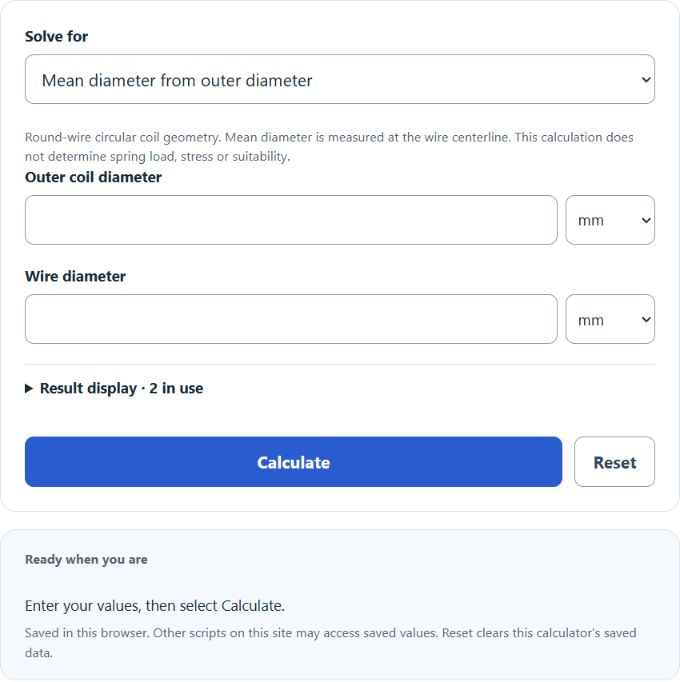
Calculate a round-wire coil’s mean diameter from its outer diameter, inner diameter, wire-centerline circumference, or spring index. Length inputs can use different supported units.
Coil Diameter Formula
The widget reports the mean coil diameter (D), measured at the wire centerline. Choose one of four geometric methods for a circular round-wire coil.
Variables:
- D is mean coil diameter; OD and ID are outer and inner coil diameters.
- C is circular wire-centerline circumference about the axis, not outside circumference or pitched helix length per turn.
- Spring index is mean diameter divided by wire diameter.
- d is round-wire diameter. Select a unit for each length input and the result.
For the outer-diameter method, subtract wire diameter to obtain mean diameter. For the inner-diameter method, add wire diameter. A nonnegative inner diameter requires OD ≥ 2d and index ≥ 1; zero inner diameter is allowed geometrically. This does not establish spring stress, load capacity or an appropriate design index.
What is Coil Diameter?
Coil diameter describes the size of a coil formed by winding wire (or another flexible material) around an axis or mandrel. In practice, “coil diameter” can refer to the inner diameter (ID), outer diameter (OD), or mean diameter (measured to the wire centerline). Coil diameter is an important parameter in the design of springs and solenoids because it affects stiffness, stress, fit/clearance, and the amount of space the coil occupies.
How to Calculate Coil Diameter?
The following steps outline how to calculate the Coil Diameter.
- First, choose the geometric method matching the measurements you have.
- Enter outer diameter and wire diameter, inner diameter and wire diameter, centerline circumference, or spring index and wire diameter.
- Choose units for each length input; the widget converts them to a common basis.
- Choose the result unit and optional decimal precision.
- Select Calculate to obtain mean diameter and the available related dimensions.
- After inserting the variables and calculating the result, check your answer with the calculator above.
Example Problem :
Use the following variables as an example problem to test your knowledge.
wire diameter (WD) = 1 mm
wire-centerline circumference (C) = 10 mm
Choose the circumference method in the widget.
Mean diameter D = 10 / π ≈ 3.1831 mm. With wire diameter 1 mm, ID ≈ 2.1831 mm and OD ≈ 4.1831 mm. These values also correspond to 100 mm of wire over 10 turns when the axial pitch contribution is ignored; a pitched helix requires its actual turn length instead.