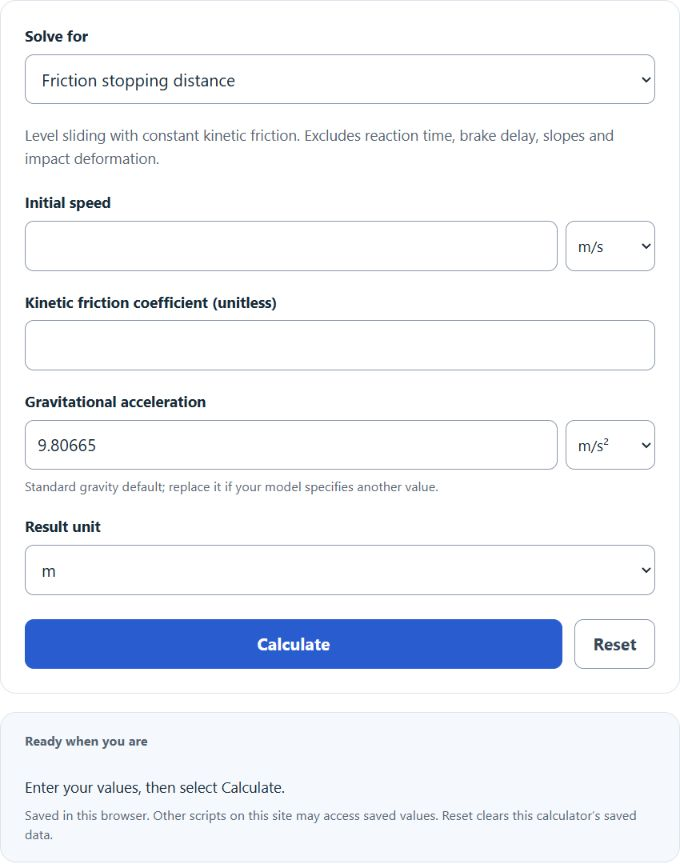
Select friction stopping distance, initial speed, kinetic friction coefficient or gravity to solve. Enter the three known values with metric or imperial units; the disclosed standard-gravity default is editable.
Collision Distance Formula
The formula models sliding to rest on a level surface under constant kinetic friction: ½mv² = μmgd. Select a solve mode to rearrange it. It excludes reaction time, brake delay, slopes, rolling/ABS braking, drag and impact deformation; it cannot establish a safe driving distance. See OpenStax work–energy and kinetic friction.
- d = sliding friction stopping distance, not impact crush distance
- v = nonnegative initial speed before sliding deceleration
- mu = constant kinetic friction coefficient, unitless
- g = acceleration due to gravity
The collision distance calculation solves for d when you know velocity, friction, and gravity. The initial velocity calculation solves for v when you know the distance needed to stop. The coefficient of friction calculation solves for mu when distance, velocity, and gravity are known. The gravity calculation solves for g, which is useful when checking the same relationship under a different gravitational acceleration.
The calculator converts feet, yards, mph, and ft/s into base metric units before applying the formula, then converts the result back into your selected unit.
Illustrative Friction Intervals
The intervals below are illustrative numerical examples, not verified tire, road or material ratings. Supply a coefficient appropriate to the actual sliding conditions. Real friction depends on contact materials, surface condition and other factors; rolling and ABS braking are outside this model.
| Illustrative interval | Example coefficient range | Notes |
|---|---|---|
| Example A | 0.7 to 0.9 | Not a road braking rating |
| Example B | 0.4 to 0.6 | At fixed speed and gravity, distance increases as μ decreases |
| Example C | 0.05 to 0.15 | Lower illustrative coefficient range |
| Example D | 0.2 to 0.5 | Not a wood-contact rating |
| Example E | 0.1 to 0.2 | Not a steel-contact rating |
Speed Conversion Values
| Speed | Meters per second | Feet per second |
|---|---|---|
| 10 mph | 4.4704 m/s | 14.6667 ft/s |
| 30 mph | 13.4112 m/s | 44.0000 ft/s |
| 60 mph | 26.8224 m/s | 88.0000 ft/s |
Example Collision Distance Calculations
Example 1: Find collision distance
You have an initial velocity of 20 m/s, a coefficient of friction of 0.70, and gravity of 9.81 m/s².
The modeled friction stopping distance is about 29.12 meters.
Example 2: Find initial velocity
You have a collision distance of 50 m, a coefficient of friction of 0.60, and gravity of 9.81 m/s².
The initial velocity is about 24.26 m/s, which is about 54.27 mph.
FAQ
What does collision distance mean in this calculator?
Collision distance means the distance required for an object to stop under frictional deceleration. In a road example, it is the braking or skid distance after slowing begins. It does not include driver reaction time, brake delay, or any distance traveled before braking starts.
Why does speed have such a large effect on collision distance?
The formula uses velocity squared. If speed doubles, the collision distance becomes about 4 times larger, assuming friction and gravity stay the same. This is why a small increase in initial velocity can produce a much longer stopping distance.
What value should you use for gravity?
The default is standard gravity, 9.80665 m/s² (about 32.17405 ft/s²), as defined in the NIST conversion guide. It is a conventional value, not a local measurement. Enter the value specified for your model; the examples above use 9.81 m/s². Positive speed with zero friction has no finite stopping distance. Zero speed gives zero distance; zero speed and zero distance do not determine friction or gravity uniquely.