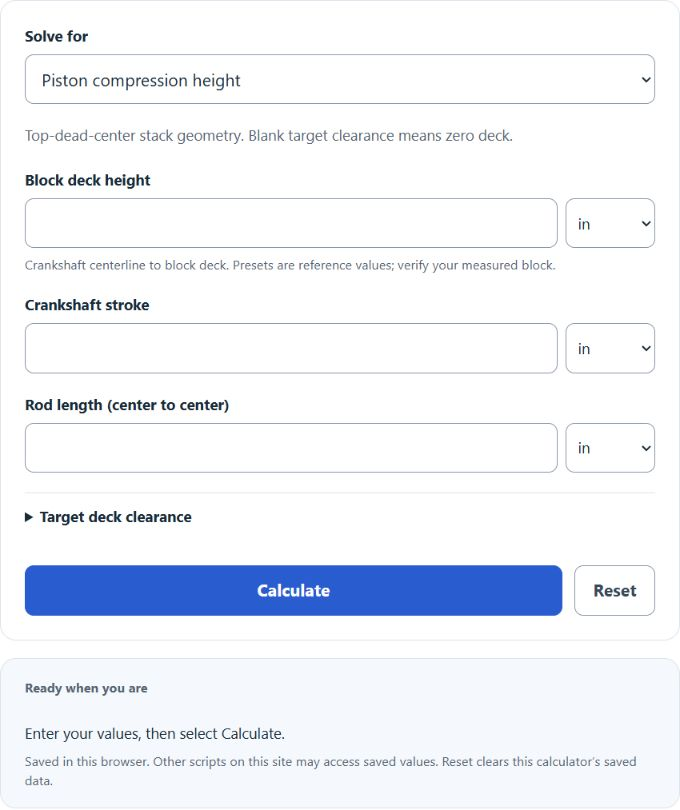
Calculate piston compression height or deck clearance from block deck height, crank stroke, rod length, and piston height in inches or mm.
Related Calculators
- Compression Ratio to PSI Calculator
- Boost To Compression Ratio Calculator
- Lobe Separation Angle Calculator
- Exhaust Diameter Calculator
- All Automotive Calculators
Compression Height Formula
The calculator uses the engine stack height at top dead center. Piston compression height is the distance from the center of the wrist pin to the piston crown.
Find Compression Height
- CH = piston compression height
- DH = block deck height
- S = crankshaft stroke
- RL = connecting rod length, measured center-to-center
- DC = target deck clearance. Leave the optional target blank, or use 0, for zero deck. Use a positive value for a piston below the deck and a negative value for one above it.
Find Deck Clearance
- DC = deck clearance
- DH = block deck height
- S = crankshaft stroke
- RL = connecting rod length, measured center-to-center
- CH = piston compression height
In the compression height mode, you enter the deck height, stroke, rod length, and the deck clearance you want. The result is the piston compression height needed to place the piston at that deck position.
In the deck clearance mode, you enter a known piston compression height. The result shows where the piston lands relative to the block deck. A positive result means the piston is below the deck. A negative result means the piston protrudes above the deck.
Reference Deck Heights and Result Meanings
These are reference values for selected engine families, not specifications for every block. Verify the actual block and machining dimensions before use. The calculator does not assign universal short or tall piston ratings.
| Engine family | Common deck height | Notes |
|---|---|---|
| Small-block Chevy | 9.025 in | Typical standard-deck SBC reference value. |
| Tall-deck small-block Chevy | 9.240 in | Often used where more stroke or rod length is needed. |
| Big-block Chevy | 9.800 in | Common standard-deck BBC reference value. |
| Tall-deck big-block Chevy | 10.200 in | Used in many tall-deck race and truck-style combinations. |
| Small-block Ford | 9.480 in | Common 351W-style deck height reference. |
| GM LS | 9.240 in | Common LS deck height reference. |
| Result | Meaning | What to check |
|---|---|---|
| Deck clearance = 0 | Piston is flush with the deck at TDC. | Head gasket thickness sets most of the piston-to-head clearance. |
| Deck clearance is positive | Piston is below the deck, also called in the hole. | Quench distance increases by this amount. |
| Deck clearance is negative | Piston sticks out above the deck. | Check piston-to-head, valve-to-piston, and gasket clearance carefully. |
| Very short compression height | Often caused by long stroke, long rod, or low deck height. | Verify ring pack space and pin location before ordering pistons. |
Compression Height Examples
Example 1: Find compression height for a zero-deck small-block
You have a 9.025 in deck height, 3.480 in stroke, 5.700 in rod length, and a target deck clearance of 0.
The required piston compression height is 1.585 in.
Example 2: Find deck clearance with a known piston
You have a 9.025 in deck height, 3.750 in stroke, 5.700 in rod length, and a 1.425 in compression height piston.
The piston is 0.025 in below the deck.
Compression Height FAQ
What is piston compression height?
Piston compression height is the distance from the centerline of the wrist pin to the top of the piston crown. It is one part of the stack that determines where the piston sits in the bore at top dead center.
Is deck clearance the same as compression height?
No. Compression height is a piston dimension. Deck clearance is the distance between the piston crown and the block deck at top dead center. Compression height helps determine deck clearance, along with deck height, stroke, and rod length.
Should deck clearance be positive or negative?
Positive deck clearance means the piston is below the deck. Negative deck clearance means the piston is above the deck. Either can be used in an engine build, but the final piston-to-head clearance must include head gasket thickness and should be checked physically during mockup.