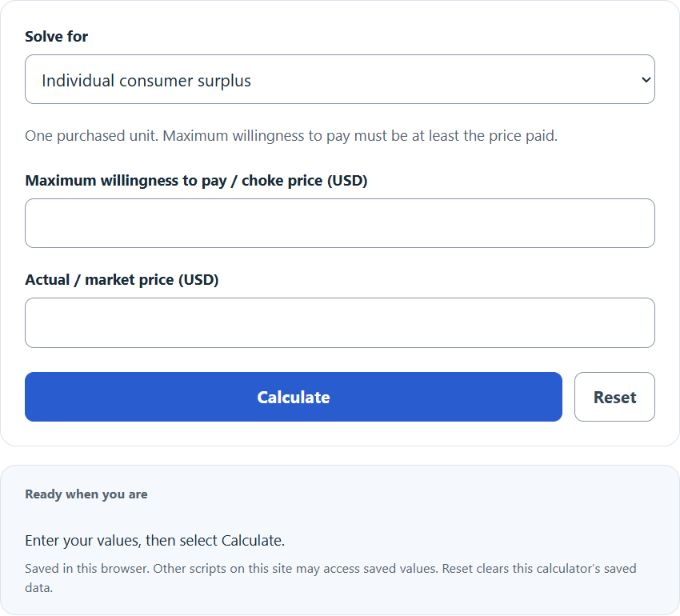
Calculate individual consumer surplus, actual price, or maximum willingness to pay for one purchased unit by selecting the quantity to solve for. Market mode calculates total surplus from a linear demand curve’s price intercept (choke price), market price, and the corresponding quantity demanded. The triangle formula does not apply generally to nonlinear demand.
- All Business Calculators
- Maximum Revenue Calculator
- Producer Surplus Calculator
- Real Price Calculator
Consumer Surplus Formula
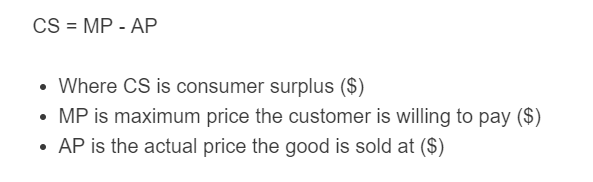
The following formulas can be used to calculate consumer surplus. The first is per-unit consumer surplus for an individual purchase (one unit). The second is market (total) consumer surplus when the demand curve is linear and you know the demand “choke price” (the price intercept), the market price, and the equilibrium quantity.
- Where CSper unit is consumer surplus for one unit purchased by one consumer ($ per unit)
- MP is the maximum price that consumer is willing to pay for that unit ($)
- AP is the actual price the good is sold at ($)
- Where CSmarket is total consumer surplus in the market (assuming a linear demand curve) ($)
- Q is the quantity demanded at the market (equilibrium) price (units)
- Pmax is the maximum price on the demand curve (the price-intercept / “choke price”) ($)
- Pmarket is the market (equilibrium) price ($)
For an individual purchase of one unit, consumer surplus is found by subtracting the actual price paid from the maximum price that buyer was willing to pay. For market consumer surplus, you typically estimate a demand curve (or willingness-to-pay distribution) and compute the area under the demand curve above the market price across all units sold.
The maximum willingness to pay can vary across consumers (and can also vary by unit for the same consumer). In practice it is commonly estimated using market data (observed demand at different prices), experiments (e.g., A/B testing), or surveys. It is not generally calculated as an “average of the highest amount” people would be willing to pay.
Consumer Surplus Definition
Consumer surplus is the difference between what consumers are willing to pay and what they actually pay. For a single consumer buying a single unit, it is the maximum price that consumer is willing to pay minus the actual price paid. In a market, total consumer surplus is the sum (area under the demand curve above the market price) across all units purchased.
How to calculate a consumer surplus
The following example is a step-by-step guide on how to calculate a per-unit (individual) consumer surplus:
- The first step is to look at the equation above and determine which variables need to be known before we can calculate the consumer surplus. In this case, the max price the consumer is willing to pay (for one unit) and the actual price the item is sold at.
- Next, the maximum price this consumer is willing to pay must be determined. This can be estimated through analyzing data or through surveys/experiments. For this example, we will assume that the maximum price is $1,000.00.
- Now we must determine the actual price the good is or will be sold at. Let’s assume this is an existing good and we have some data on its historical sale price. We will assume it is $200.00.
- Finally, enter the information into the formula to calculate the CS. CS = MP – AP = $1,000.00 – $200.00 = $800.00.
- Analyze the results. A CS of $800.00 means this buyer valued the item $800.00 more than the price paid (for that unit). Whether that is “good” or “bad” depends on context (pricing strategy, competition, goals, etc.).
What is the maximum price a consumer will pay?
This is the million-dollar question that business owners ask every year. There are complicated formulas and entire fields of economics dedicated to studying how much consumers will pay for something. One of the easiest ways to estimate willingness to pay is through the use of a survey or experiment. In general, more (high-quality) responses can improve precision, but the sample must accurately reflect the people you are trying to sell the good to. If you are selling a high-end watch, you want to survey people who buy high-end watches, and vice versa for low-end products.
Setting the price of a good at the maximum willingness to pay for some consumers is not always the best business decision. For most products with downward-sloping demand, higher prices tend to reduce the quantity sold. A common objective is to choose the price that maximizes revenue, i.e., where price × quantity is highest (or profit, if you also account for costs).