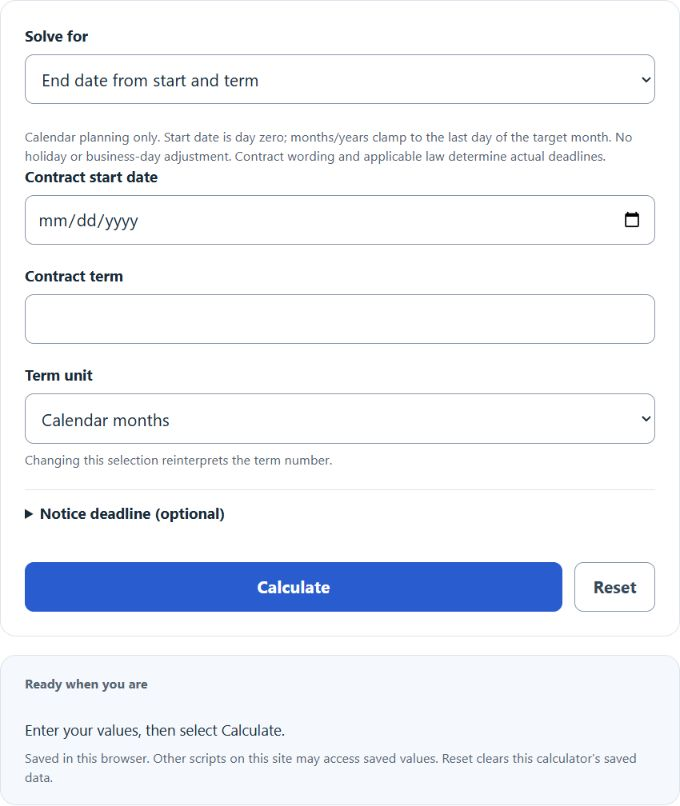
Calculate a contract end date by adding a duration in days, weeks, months, or years to a start date for clear agreement timeline planning.
Related Calculators
- Benefits Effective Date Calculator
- Prorated Fee Calculator
- Accrued Sick Leave Calculator
- Annual Merit Increase Calculator
- All Business Calculators
Calculator Functions
| Function | What it does | What it requires |
|---|---|---|
| End date from start and term | Finds the date a contract ends by adding its term to the start date | Requires the contract start date, the term as a whole number and its unit: calendar days, weeks, calendar months or calendar years. A notice period in days is optional |
| Notice deadline before an end date | Finds the last date to give notice by counting back from the end date | Requires the contract end date and the notice period in calendar days |
| Time between two dates | Counts the length of a contract between its start and end dates | Requires the contract start date and the contract end date |
All three functions count calendar days. Weekends and holidays are counted like any other day, and no date is moved to the next business day.
Contract Date Formulas
| End | Contract end date |
| Start | Contract start date, counted as day zero |
| Term | Length of the contract in days, weeks, months or years |
End date from start and term
The start date is day zero, so January 1 plus 1 day is January 2. This matches the usual rule for counting a period in days: leave out the day that starts the period, count every day after it and include the last one [1]. A term of 150 days from January 1, 2022 ends on May 31, 2022. A week counts as 7 days.
A term in months or years lands on the same day of the month as the start. A 1 year contract starting September 15, 2025 ends on September 15, 2026, and an 11 month contract starting June 1, 2026 ends on May 1, 2027. When the target month is too short to have that day, the last day of the month is used, so January 31, 2026 plus 1 month is February 28, 2026.
Many contracts treat the start date as the first day of the term. The term then finishes one day earlier, and the result lists that date as well: for the September 15 contract it is September 14, 2026. When a notice period is entered, the notice deadline is shown with the end date.
Notice deadline before an end date
N is the notice period in calendar days, and the end date itself is not counted as one of them. A contract that ends on December 31, 2026 with 60 days of notice has a deadline of November 1, 2026.
Time between two dates
The count is the number of calendar days from one date to the other, in either order. January 1, 2026 to December 31, 2026 is 364 days, or 52 weeks exactly. The result also gives whole years and months, counted by completed day-of-month anniversaries, which here is 0 years and 11 months because the 12th month is one day short.
Limits of This Estimate
- The contract wording and the law that governs it decide the real dates. A contract can count its first day, end at a set hour or define a month in its own way.
- Court deadlines that fall on a Saturday, Sunday or legal holiday run to the next working day [1]. Contracts often have a similar clause, and no such adjustment is made here.
- Using the last day of a shorter month is a common calendar convention, not a rule every contract follows. These estimates are based on the best available data and estimations.
- Dates are limited to the years 1 to 9999.
Sources
- Federal Rules of Civil Procedure, Rule 6(a)(1), Computing Time (Legal Information Institute): excluding the starting day, counting every day, including the last day, and moving a deadline off a weekend or holiday