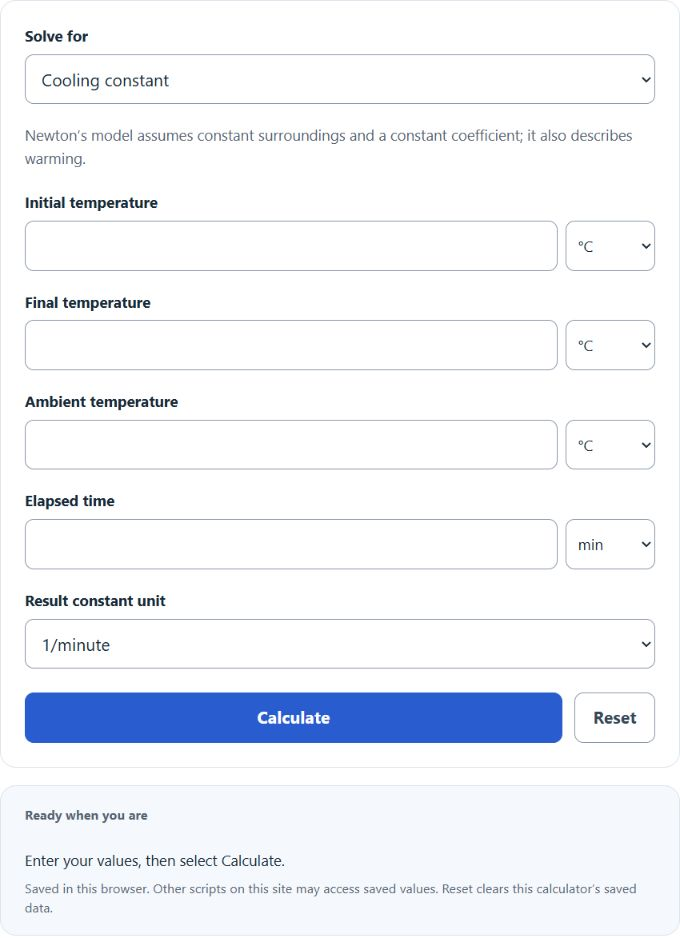
Calculate the cooling constant, time, or initial, final, or ambient temperature from the other four values in Newton’s law of cooling.
Cooling Constant Formula
The cooling constant calculator uses Newton’s law of cooling. With a constant positive coefficient and constant ambient temperature, the object approaches ambient exponentially. This is an approximation for suitable heat-transfer conditions; phase changes or changing surroundings can invalidate it.
To solve for the cooling constant:
To solve for time:
To solve for initial temperature:
To solve for ambient temperature:
- T_i = initial temperature
- T_f = final temperature after the elapsed time
- T_a = ambient temperature, or surrounding temperature
- t = elapsed time
- k = cooling constant
- e = Euler’s number, approximately 2.71828
- ln = natural logarithm
The calculator converts temperature inputs to Celsius internally and time inputs to minutes internally. Select the value to solve for and enter the displayed required inputs. The cooling constant must use the reciprocal of the time unit, such as 1/minutes, 1/seconds, or 1/hours.
If you calculate final temperature, the formula predicts the object’s temperature after a known time. If you calculate cooling constant, it finds how quickly the object approaches ambient temperature. If you calculate time, it finds how long the temperature change takes. If you calculate initial temperature or ambient temperature, it rearranges Newton’s law of cooling to solve for that missing temperature.
Cooling Constant Units and Reference Values
Use consistent time units with the cooling constant. A value in 1/minutes is not the same as the same number in 1/seconds or 1/hours. The constants below are illustrative: half-time = ln(2)/k, with no universal material classification.
| Quantity | Common units | Conversion used by the calculator |
|---|---|---|
| Temperature | °C, °F, K | Converted to °C before calculation |
| Time | seconds, minutes, hours | Converted to minutes before calculation |
| Cooling constant | 1/seconds, 1/minutes, 1/hours | Converted to 1/minutes before calculation |
| Cooling constant k in 1/minutes | Approximate half-time | Meaning |
|---|---|---|
| 0.01 | 69.3 minutes | Slow approach to ambient temperature |
| 0.05 | 13.9 minutes | Moderate cooling or warming |
| 0.10 | 6.9 minutes | Fast temperature change |
| 0.50 | 1.4 minutes | Very fast approach to ambient temperature |
Example Problems
Example 1: Find the cooling constant
An object starts at 90°C, cools to 60°C, and is in a room at 20°C. The elapsed time is 10 minutes.
The cooling constant is 0.0560 1/minutes.
Example 2: Find the final temperature
An object starts at 100°C in a 25°C room. The cooling constant is 0.08 1/minutes, and the time is 15 minutes.
The final temperature is approximately 47.59°C.
FAQ
What does the cooling constant mean?
The cooling constant measures how quickly an object approaches the ambient temperature. A larger cooling constant means the object changes temperature faster. A smaller cooling constant means it changes temperature more slowly.
Can the cooling constant be used for warming too?
Yes. Newton’s law of cooling also describes warming when an object is colder than its surroundings. In that case, the object warms toward the ambient temperature instead of cooling toward it. The same formulas apply as long as the temperatures stay on the correct side of the ambient temperature for the logarithm calculation.
Why do I get an invalid logarithm message?
The logarithm requires the ratio (T_i – T_a)/(T_f – T_a) to be positive. For finite nonnegative time and coefficient, initial and final temperatures stay on the same side of ambient and the final temperature cannot be farther from ambient. Equilibrium observations and zero time or coefficient can make inverse solutions nonunique; exactly reaching ambient from a different initial temperature requires an infinite limiting time. For example, if the ambient temperature is 20°C, both the initial and final temperatures must be above 20°C for cooling, or both must be below 20°C for warming.
Example Problem :
Use the following variables as an example problem to test your knowledge.
Initial temperature (Ti) = 90°C
Final temperature (Tf) = 30°C
Ambient temperature (Ta) = 20°C
Time (t) = 15 minutes