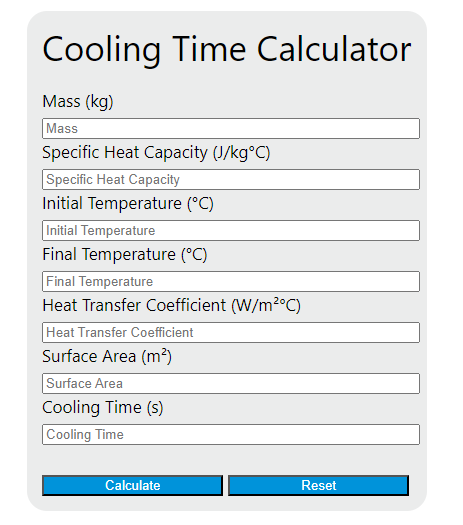
Calculate cooling time, final temperature, or cooling coefficient with Newton’s law using ambient, initial, and target temperatures in °C, °F, or K.
- All Physics Calculators
- Cooling Tower Cycles of Concentration Calculator
- Cooling Tower Capacity Calculator
- Heat Transfer Time Calculator
Cooling Time Formula
The following formula is used to calculate the cooling time for Newton’s law of cooling (lumped-capacitance model), assuming a constant ambient temperature and heat transfer coefficient (and that the object’s internal temperature is approximately uniform).
Formula source: A Heat Transfer Textbook by John H. Lienhard IV and John H. Lienhard V (5th ed., 2019)
Variables:
- Tc is the cooling time (s)
- m is the mass of the object or substance (kg)
- c is the specific heat capacity of the substance (J/kg·K)
- Ti is the initial temperature (°C or K)
- Tf is the target final temperature (°C or K)
- T∞ is the ambient (surrounding fluid) temperature (°C or K)
- h is the heat transfer coefficient (W/m²·K)
- A is the surface area of the object or substance (m²)
To calculate the cooling time, first compute the time constant τ = (m·c)/(h·A). Then compute Tc = τ · ln((Ti − T∞)/(Tf − T∞)). The logarithm requires that the target temperature is between the initial and ambient temperature (and Tf ≠ T∞).
What is a Cooling Time?
Cooling time refers to the period required for an object or substance to decrease in temperature to a desired level. This term is often used in various fields such as physics, engineering, and cooking. The duration of the cooling time can depend on several factors including the initial temperature, the desired final temperature, the properties of the substance, and the cooling method used.
How to Calculate Cooling Time?
The following steps outline how to calculate the Cooling Time using the given formula:
- First, gather the values of the variables: mass (m), specific heat capacity (c), initial temperature (Ti), ambient temperature (T∞), target final temperature (Tf), heat transfer coefficient (h), and surface area (A).
- Next, compute the time constant: τ = (m · c)/(h · A).
- Then, compute the cooling time: Tc = τ · ln((Ti − T∞)/(Tf − T∞)).
- After calculating the result, check that Tf is between Ti and T∞ (and that Tf ≠ T∞), otherwise the model does not apply as written.
Example Problem:
Use the following values as an example problem to test your knowledge:
mass (m) = 2 kg
specific heat capacity (c) = 500 J/kg°C
initial temperature (Ti) = 50°C
ambient temperature (T∞) = 10°C; target final temperature (Tf) = 20°C
heat transfer coefficient (h) = 100 W/m²°C
surface area (A) = 5 m²