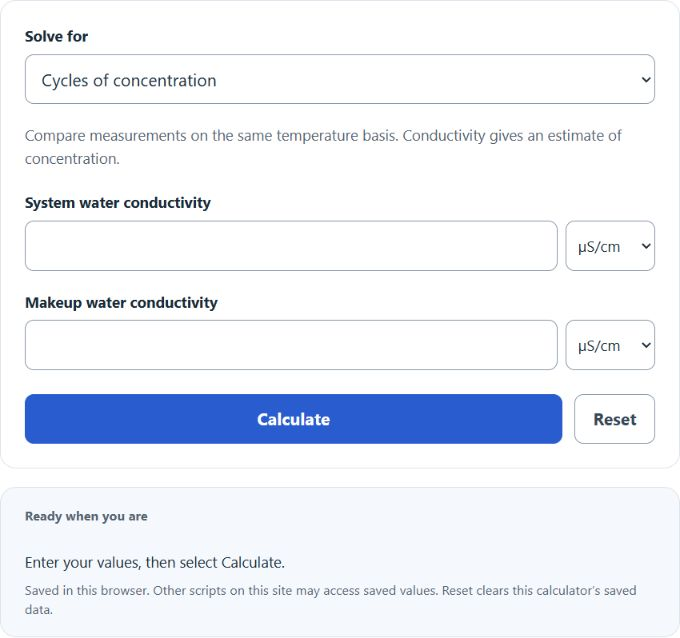
Calculate cooling tower cycles of concentration from system and makeup conductivity, or solve either conductivity value from the other two.
- All Chemistry Calculators
- Cooling Tower Performance Calculator
- Cooling Tower Capacity Calculator
- Newton’s Law of Cooling Calculator
Cooling Tower Cycles of Concentration Formula
The conductivity estimate of cooling tower cycles of concentration is the ratio of recirculating system water conductivity to makeup water conductivity. Compare values in the same unit and on the same temperature basis; chemical additions or changes in ion composition can affect this estimate.
- COC = cooling tower cycles of concentration, unitless
- C_s = conductivity of system water
- C_m = conductivity of makeup water
The same relationship can be rearranged to solve for either conductivity value:
The calculator supports three functions:
- Find cycles of concentration: enter system conductivity and makeup conductivity. The calculator divides system conductivity by makeup conductivity.
- Find system conductivity: enter makeup conductivity and cycles. The calculator multiplies makeup conductivity by cycles.
- Find makeup conductivity: enter system conductivity and cycles. The calculator divides system conductivity by cycles.
Conductivity inputs can be entered in µS/cm, mS/cm, or S/m. The calculation converts conductivity values to the same base unit before applying the formula.
Conductivity Unit Conversions for Cooling Tower Calculations
| Unit | Equivalent in µS/cm | Example |
|---|---|---|
| µS/cm | 1 µS/cm | 800 µS/cm = 800 µS/cm |
| mS/cm | 1 mS/cm = 1,000 µS/cm | 2.5 mS/cm = 2,500 µS/cm |
| S/m | 1 S/m = 10,000 µS/cm | 0.3 S/m = 3,000 µS/cm |
Illustrative Cycles of Concentration Ranges
These broad descriptions are not recommended operating targets. Determine acceptable cycles with a water treatment specialist using the makeup water chemistry, equipment and treatment limits.
| Cycles of concentration | General interpretation | Common note |
|---|---|---|
| Less than 2 | Low concentration | May indicate high blowdown or low reuse of makeup water. |
| 2 to 5 | Moderate concentration | Whether this range is suitable depends on the specific water chemistry and treatment limits. |
| 5 to 8 | Higher concentration | Usually requires closer control of scale, corrosion, and biological treatment. |
| Above 8 | Very high concentration | May be possible only with suitable makeup water and a controlled treatment program. |
Example Problems
Example 1: Calculate cycles of concentration
You have a cooling tower system conductivity of 2,400 µS/cm and a makeup water conductivity of 600 µS/cm.
The cooling tower is operating at 4 cycles of concentration.
Example 2: Calculate system conductivity
You have makeup water conductivity of 750 µS/cm and want to know the system conductivity at 5 cycles of concentration.
The expected system conductivity is 3,750 µS/cm.
FAQ
What are cycles of concentration in a cooling tower?
Cycles of concentration show how concentrated dissolved solids have become in the recirculating cooling tower water compared with the makeup water. If comparable system and makeup samples have a conductivity ratio of four, the conductivity estimate is 4 cycles.
Why is conductivity used to estimate cycles of concentration?
Conductivity rises as dissolved ions build up in the tower water. Since evaporation removes mostly pure water and leaves dissolved solids behind, conductivity is a practical field measurement for estimating concentration. Use the same temperature reference or compensation for both measurements. Treatment chemicals and changing ion composition can affect the estimate; conductivity alone does not determine a safe operating target.
Can cycles of concentration be too high?
Yes. Higher cycles reduce blowdown water use, but they also increase dissolved solids. If cycles are too high for the makeup water quality and treatment program, scale, corrosion, fouling, or biological issues can increase. The acceptable value depends on water chemistry, equipment, operating temperature, and treatment limits.