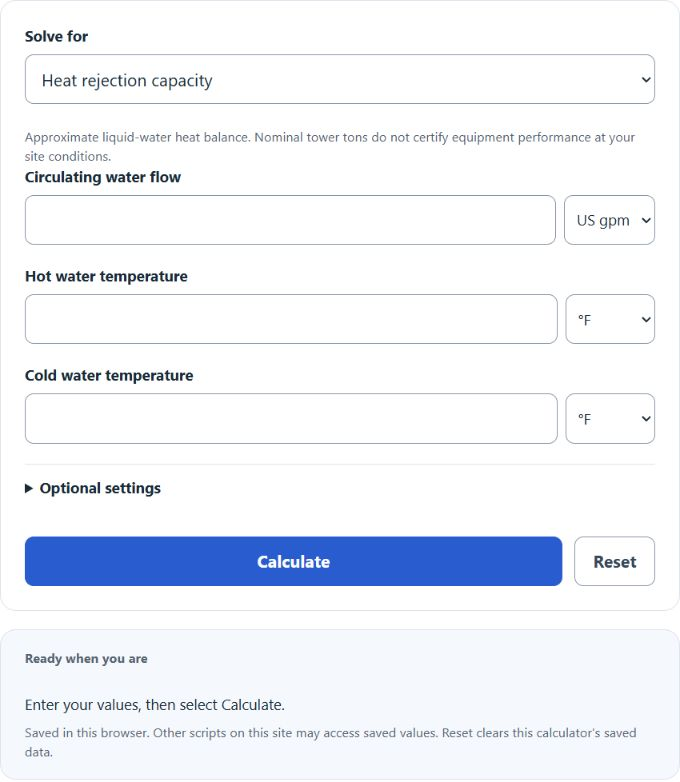
Calculate cooling tower heat rejection, nominal tower tons, required water flow, cooling range, and approach in US or metric units.
- All Construction Calculators
- Cooling Capacity Calculator
- Cooling Tower Cycles of Concentration Calculator
- Cooling Tower Performance Calculator
- Evaporative Cooling Calculator
- GPM Per Ton Calculator
- Water Flow Rate Calculator
Cooling Tower Capacity Formula
The calculator uses a water heat balance in three modes. Water-use formulas are background only.
Capacity mode converts water flow and temperature drop into heat load and tower tons.
Flow or Range mode rearranges the same heat balance to solve for the unknown.
Background water-use estimate illustrates evaporation, blowdown, and makeup; these inputs and outputs are not part of this calculator.
- Q: heat load in BTU/hr
- GPM: circulating water flow in gallons per minute
- T_hot: hot water temperature entering the tower (°F)
- T_cold: cold water temperature leaving the tower (°F)
- Range: T_hot − T_cold (°F)
- Approach: T_cold − wet-bulb (°F)
- 500: 8.33 lb/gal × 60 min/hr × 1 BTU/lb·°F for water
- Tower Tons: nominal cooling tower tons at 15,000 BTU/hr each
- E: evaporation rate (gpm)
- D: drift loss (gpm)
- B: blowdown rate (gpm)
- Cycles: cycles of concentration (dimensionless, > 1)
The Capacity tab takes flow and the two water temperatures, computes range, then heat load, then tons. If you add a wet-bulb temperature, it also returns approach. The Flow or Range tab accepts a heat load in BTU/hr, kW, nominal tower tons, or refrigeration tons, then solves for either flow or range using the value you supply for the other variable. The background water example assumes an empirical 0.00085 evaporation factor. Actual evaporation depends on climate and sensible versus latent heat transfer; a complete water balance also needs leakage and operating data.
Reference Tables
These are illustrative design conventions, not acceptance limits. Actual selection requires manufacturer performance data and site conditions.
| Parameter | Typical Range | Notes |
|---|---|---|
| Cooling range | 10 to 20 °F | HVAC design is often 10 °F; process can be higher. |
| Approach | 5 to 10 °F | Below 5 °F sharply increases tower size. |
| Flow per nominal ton | 3 gpm | CTI nominal: 3 gpm at 95/85/78 °F. |
| Cycles of concentration | 3 to 6 | Higher cycles need stronger water treatment. |
| Drift rate | 0.001 to 0.02 % | Modern drift eliminators target ≤ 0.005 %. |
| Heat Load Unit | Equivalent in BTU/hr |
|---|---|
| 1 nominal tower ton | 15,000 BTU/hr |
| 1 refrigeration ton | 12,000 BTU/hr |
| 1 kW | 3,412 BTU/hr |
| 1 boiler horsepower | 33,475 BTU/hr |
Worked Examples
Example 1: Capacity from flow and temperatures. A tower circulates 600 gpm with 95 °F hot water and 85 °F cold water. Range is 10 °F. Q = 500 × 600 × 10 = 3,000,000 BTU/hr. Nominal tower tons = 3,000,000 / 15,000 = 200 tons. With a 78 °F wet-bulb, approach is 85 − 78 = 7 °F, which matches the nominal rating condition; it does not by itself select or certify a tower.
Example 2: Background makeup-water estimate (not a calculator mode). Same 600 gpm tower, 10 °F range, 4 cycles, 0.005 % drift. Evaporation = 0.00085 × 600 × 10 = 5.1 gpm. Drift = 600 × 0.00005 = 0.03 gpm. Blowdown = 5.1 / (4 − 1) − 0.03 = 1.67 gpm. Makeup = 5.1 + 0.03 + 1.67 = 6.8 gpm, or about 9,792 gallons per day.
FAQ
Why is a tower ton 15,000 BTU/hr instead of 12,000? A refrigeration ton accounts for evaporator load only. A cooling tower also rejects compressor heat, so the industry uses 15,000 BTU/hr per nominal tower ton at the standard 95/85/78 °F rating.
What if my range is in °C? Pick °C in the unit dropdown. The calculator converts the temperature difference using a factor of 9/5 before applying the BTU/hr equation.
Can I use this for a closed-circuit or dry cooler? For liquid water the approximate heat balance can describe process-side duty. Closed-circuit evaporative towers still consume external spray water, while dry coolers do not use evaporative spray cooling. Glycol and other fluids require different properties.
What does negative blowdown mean in the background formula? Drift alone exceeds the liquid loss allowed by the assumed cycles. Negative blowdown is not physical, and simply setting it to zero would no longer achieve that exact target. This calculator does not calculate or floor blowdown.