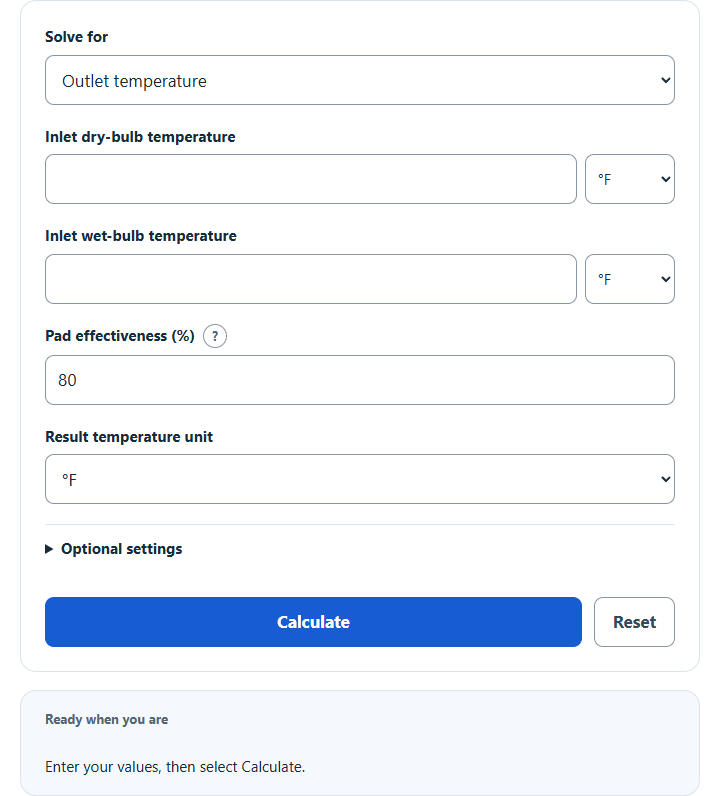
Calculate evaporative (swamp) cooler outlet temperature from inlet dry-bulb and wet-bulb temperatures, with a typical pad effectiveness, in °F or °C.
- Cooling Capacity Calculator
- Cooler airflow from room size and target ACH
- Cooling Tower Capacity Calculator
- Wet Bulb Calculator
- Dew Point Calculator
- Humidity Ratio Calculator
- Water Vapor Pressure Calculator
- Air Enthalpy Calculator
- All Physics Calculators
Evaporative Cooling Efficiency Formula
The following formula is commonly used to calculate the saturation effectiveness (often called “efficiency”) of a direct evaporative cooler—how close the outlet air temperature gets to the inlet wet-bulb temperature.
- Where eff is the evaporative cooler effectiveness (as a fraction; multiply by 100 to get percent)
- DB is the inlet (ambient) dry-bulb temperature
- OT is the outlet (supply air) dry-bulb temperature
- WB is the inlet (ambient) wet-bulb temperature
To calculate evaporative cooling effectiveness for a conventional single-stage direct cooler, subtract the outlet temperature from the inlet dry-bulb temperature, then divide by the available temperature drop (inlet dry-bulb minus inlet wet-bulb). The outlet lies between the inlet wet- and dry-bulb temperatures for effectiveness from 0 to 100%. At a saturated inlet, the denominator is zero and effectiveness cannot be measured by this ratio. This calculator assumes unchilled, unfrozen liquid water; effectiveness is not electrical efficiency or COP.
What is evaporative cooling?
Optional airflow estimates use fixed standard-air sensible heat capacity and approximate latent heat/water density. They describe sensible air-side temperature change and ideal evaporation, not net total room cooling capacity or total system water use. A solved required wet bulb still needs a separate pressure/humidity feasibility check.
Evaporative cooling is a process by which heat is transferred from an object or air through the evaporation of water. When water evaporates, it requires heat in order to do so. As a result, it takes heat away from whatever it was in contact with, which then causes cooling on that object.
How to calculate evaporative cooling efficiency?
Example Problem:
The following example outlines how to calculate the evaporative cooling effectiveness (“efficiency”) of a machine.
First, determine the inlet dry-bulb temperature. In this example, the dry-bulb temperature is measured to be 50 °F.
Next, determine the inlet wet-bulb temperature. In this example, the wet-bulb temperature is measured to be 35 °F.
Next, determine the outlet temperature. For this machine, the outlet temperature is measured to be 40 °F.
Finally, calculate the evaporative cooling effectiveness using the formula above:
eff = (DB – OT) / (DB – WB)
eff = (50 – 40) / (50 – 35)
eff = 10 / 15 = 0.667 = 66.7%