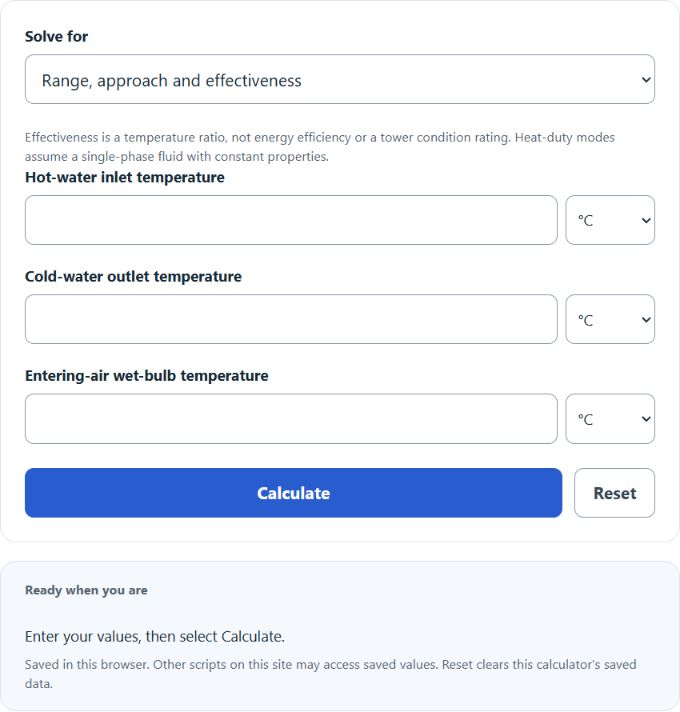
Calculate cooling tower range, approach, effectiveness, outlet target, and heat rejection from water temperatures, wet bulb, and flow.
- All Construction Calculators
- Cooling Tower Capacity Calculator
- LMTD (Logarithmic Mean Temperature Difference) Calculator
- Heat Exchanger Effectiveness Calculator
- COP (Coefficient of Performance Calculator)
- Cooling Tower Cycles of Concentration Calculator
Cooling Tower Performance Formulas
The calculator supports four modes: measured temperature effectiveness, target outlet, heat rejection and required fluid flow. The water-use example is background only.
Performance mode calculates range, approach, and temperature effectiveness:
Background water-use example estimates evaporation, drift, blowdown and makeup. This is not a mode in the calculator:
Heat-rejection and flow modes use mass flow, fluid specific heat and temperature difference. The following water-only shortcuts are approximate:
- T_hot: hot water temperature returning to the tower
- T_cold: cold water temperature leaving the tower basin
- T_wb: ambient wet-bulb temperature
- Range: temperature drop across the tower
- Approach: how close the cold water gets to the wet-bulb limit
- Flow: circulating water flow through the tower
- Cycles: cycles of concentration in the basin water
- DriftRate: percent of flow lost as droplets through the eliminators
Performance mode reports a temperature ratio, not energy efficiency or a condition grade. Target mode rearranges that ratio. Heat-rejection and flow modes use Q = mass flow × specific heat × temperature difference, with density for volumetric flow. The background water-use formulas do not add calculator inputs.
Reference Tables
The first table illustrates the relation between effectiveness and approach only when the inlet-to-wet-bulb span is fixed at 20 °F. It does not classify real equipment condition. The second table gives (blowdown + drift)/evaporation for an ideal steady water balance; actual chemistry and other losses matter.
| Effectiveness | Approach at 20 °F span | Interpretation |
|---|---|---|
| Above 75% | Under 5 °F | More than three quarters of the stated temperature span |
| 50–75% | 5–10 °F | One half to three quarters of the stated temperature span |
| Below 50% | Over 10 °F | Less than half of the stated span; no cause diagnosed |
| Cycles of Concentration | (Blowdown + drift) / evaporation | Notes |
|---|---|---|
| 2 | 100% | High water and chemical use |
| 3 | 50% | Illustrative water balance, not a universal target |
| 4 | 33% | Typical for treated systems |
| 6 | 20% | Requires good water quality control |
| 8 | ~14% | Limited by scaling and corrosion risk |
Example Problems
Example 1: Performance. A tower has hot water at 95 °F, cold water at 85 °F, and a wet-bulb of 78 °F. Range is 10 °F. Approach is 7 °F. Temperature effectiveness is 10 / (95 − 78) × 100 = 58.8%. This ratio alone does not establish an operating grade.
Example 2: Capacity and water use. A 1,000 gpm tower with a 10 °F range rejects about 500 × 1000 × 10 = 5,000,000 Btu/hr, or roughly 417 refrigeration tons (not nominal tower tons). Evaporation is 0.00085 × 1000 × 10 = 8.5 gpm. At 4 cycles with 0.005% drift, drift is 0.05 gpm and blowdown is 8.5 / 3 − 0.05 ≈ 2.78 gpm. Total makeup is about 11.3 gpm.
FAQ
Why can’t the cold water be colder than the wet-bulb? The wet-bulb temperature is the thermodynamic limit for evaporative cooling. The cold water can approach it but not cross it.
Is the 0.00085 evaporation factor exact? No. It is an empirical water-loss approximation per US gpm and °F range. Evaporation depends on latent versus sensible heat transfer and operating conditions; the factor does not imply that all heat rejection is evaporative.
What drift rate should I pick? Modern towers with high-efficiency drift eliminators run around 0.001% to 0.005% of circulating flow. Use 0.02% only for older equipment or worst-case estimates.
How do I increase cycles of concentration? Improve makeup water quality, add chemical treatment for scale and corrosion control, and verify that conductivity-based blowdown is set correctly. Higher cycles cut blowdown but raise dissolved solids in the basin.