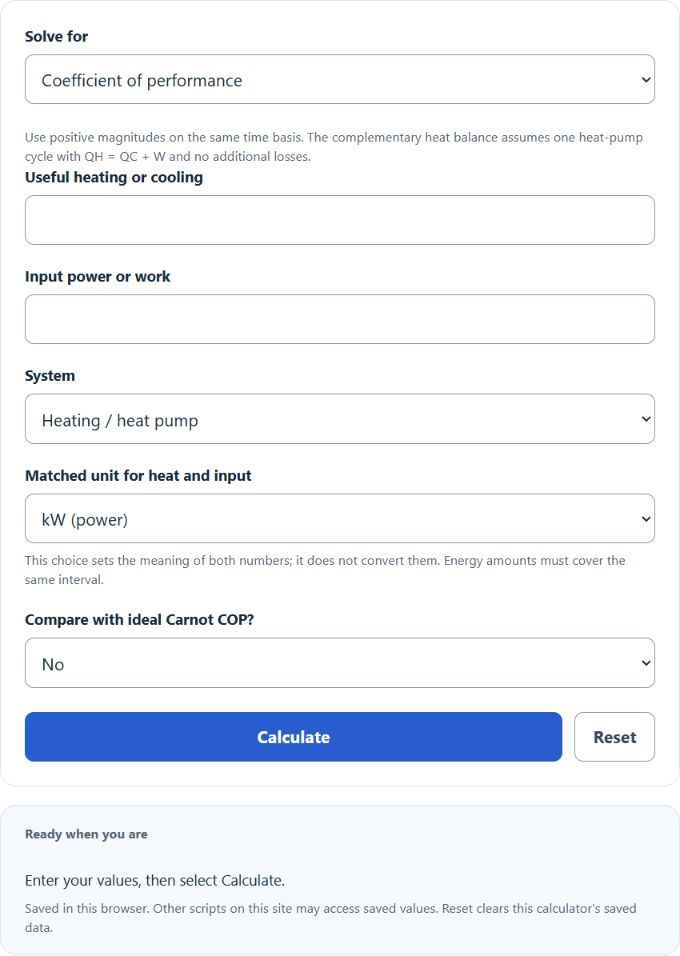
Calculate heating or cooling COP, useful output, or input power, then compare EER, energy balance, Carnot COP, and second-law efficiency.
- All Physics Calculators
- Heat Dissipation Calculator
- SEER Rating Calculator
- U Value of Ground Floor Calculator
- Energy Performance Index Calculator
- Heat Pump vs. Furnace Running Cost Calculator
COP Formula
The following formula is used to calculate the coefficient of performance of a heat pump.
- Where COP is the coefficient of performance
- Q is useful heat delivered at the condenser in heating mode or removed at the evaporator in cooling mode (energy, such as kWh)
- W is input work over the same interval (energy, such as kWh). Alternatively, use heat-transfer rate and input power in matching units such as kW.
Divide useful heat by input work, or useful heat-transfer rate by input power, using matching units and the same measurement boundary.
COP Definition
What is COP?
COP stands for coefficient of performance. This is a term used to describe the ratio of useful heat output or removal by a heat pump and the work or power supplied by the compressor to the heat pump.
Example Problem
How is COP calculated?
COP is calculated by dividing the absolute value of the total heat output or removal of a heat pump by the work or power supplied to the pump.
How to calculate COP?
- First, determine the work supplied to the heat pump over a stated interval.
For this example, the input work over that interval is 20 kWh.
- Next, determine the useful output or removal of heat by the pump.
In this case, the heat pump removes 30 kWh of heat.
- Finally, calculate COP.
Using the formula above, the COP is calculated to be:
COP = | Q | / W
COP = 30 / 20
COP = 1.5