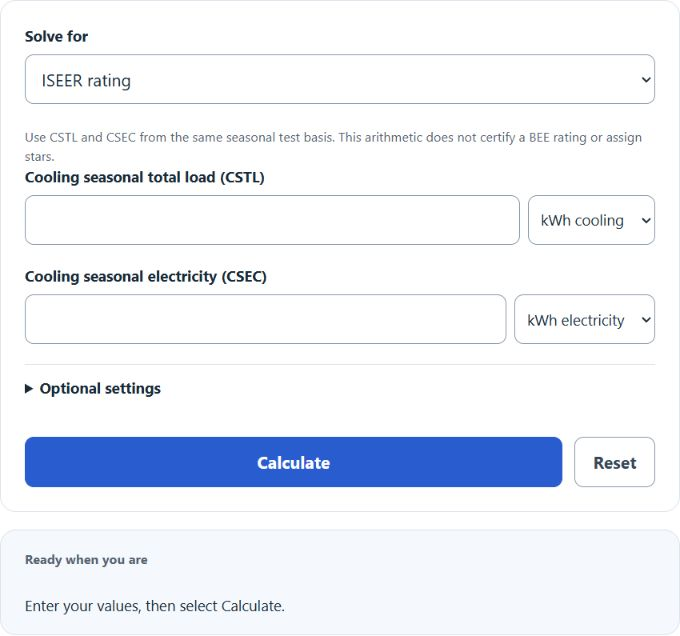
Calculate ISEER from cooling seasonal total load and energy consumption, or solve for CSTL or CSEC with multiple energy units and efficiency comparison.
- SEER Rating Calculator
- CFM Per Ton Calculator
- Cooling Capacity Calculator
- All Construction Calculators
- U Value of Ground Floor Calculator
- U Value to RSI Calculator
- Energy Performance Index Calculator
ISEER Rating Formula
ISEER measures how much total seasonal cooling an air conditioner delivers for the electricity it uses over that same season. It is a practical efficiency metric because it reflects performance across changing conditions instead of only one operating point.
- ISEER = seasonal cooling efficiency ratio
- CSTL = cooling seasonal total load, or the total cooling delivered during the period
- CSEC = cooling seasonal energy consumption, or the total electrical energy used during that same period
Both inputs must represent the same seasonal test basis. A formal BEE ISEER uses the applicable standardized conditions and method; an arbitrary measured ratio alone does not certify a label or star rating.
| Term | Meaning | Typical Input Units |
|---|---|---|
| Cooling seasonal total load | Total heat removed or cooling delivered over the season | kWh cooling, MWh cooling, BTU, kBTU |
| Seasonal energy consumption | Total electricity used over the same operating period | kWh, Wh, MWh |
| ISEER | Cooling delivered per unit of electricity used | Dimensionless when both sides are in equivalent energy units |
What the ISEER Rating Tells You
A higher ISEER means the system provides more seasonal cooling for the same electrical input. In simple terms, higher values indicate better seasonal efficiency and usually lower operating cost for the same cooling demand.
- Higher ISEER = less electricity required for the same cooling output
- Lower ISEER = more electricity required for the same cooling output
- Best use case = comparing air conditioners expected to serve a similar cooling load
Because ISEER is seasonal, it is better suited to long-run performance comparisons than a single-condition efficiency value. Actual utility cost still depends on climate, thermostat setting, runtime, occupancy, maintenance, insulation, and part-load operation.
How to Calculate ISEER
- Determine the total seasonal cooling delivered.
- Determine the total electrical energy consumed over the same period.
- Divide the seasonal cooling output by the seasonal electrical input.
If a system delivers 500 kWh of cooling over a season and uses 200 kWh of electricity during that same period, the calculation is:
An ISEER of 2.5 means the unit delivered 2.5 units of seasonal cooling for every 1 unit of electrical energy consumed.
How to Use This Calculator
Select ISEER, CSTL, or CSEC in Solve for, enter the two known values, and select Calculate. Optional reference ISEER compares electricity for the same cooling load.
- ISEER rating: divide seasonal cooling by seasonal electricity, using equivalent energy units
- Seasonal cooling load: multiply ISEER by seasonal electricity
- Seasonal electricity: divide seasonal cooling by ISEER
- Reference ISEER: compare electricity and percentage change at the same seasonal cooling load
Annual Electricity Use and Cost Estimate
When you know the system capacity and expected usage pattern, yearly energy use can be approximated from the average cooling load and the ISEER value. A practical estimate is:
- Pinput = average electrical input power
- Qrated = rated cooling capacity
- L = average load fraction, such as 0.60 for 60%
- Pextra = any added electrical draw from accessories or supporting equipment
- H = hours of operation per day
- D = operating days per year
- R = electricity rate per kWh
This estimate is especially helpful when comparing an older air conditioner to a newer, more efficient model under the same usage assumptions.
Comparing Two ISEER Ratings
If two systems have the same cooling capacity and similar operating conditions, the higher-ISEER option will generally use less electricity across the year. A simple savings comparison is:
Where:
- EA = annual electricity use for option A
- EB = annual electricity use for option B
- R = electricity rate
This is useful when estimating whether a more efficient unit can justify a higher purchase price through lower running cost.
ISEER vs. Other Efficiency Metrics
ISEER is a seasonal metric, so it should not be treated as identical to every other efficiency rating. In practice:
- ISEER focuses on seasonal performance
- COP is usually expressed as cooling output divided by power input at a given condition
- EER is another single-condition style efficiency measure often used for quick comparisons
For rough reference, COP and EER are commonly related by:
That relationship can help with quick comparisons, but it should not replace a true seasonal efficiency calculation when you want a realistic picture of long-run energy use.
Common Input Mistakes
- Using cooling data and electricity data from different time periods
- Entering instantaneous capacity instead of total seasonal cooling when using the base ISEER formula
- Mixing power units with energy units
- Comparing two systems with different usage assumptions and expecting a fair result
- Ignoring extra electrical loads such as fans, pumps, or controls when estimating annual cost
If the output looks unrealistic, first check that your cooling and electricity inputs refer to the same season and that unit conversions are consistent.
Example Applications
- Estimating the seasonal efficiency of an installed AC system from measured cooling and energy data
- Comparing an existing unit with a replacement model before purchase
- Projecting annual operating cost from expected runtime and local electricity rates
- Testing how changes in average load or daily runtime affect yearly energy consumption
Frequently Asked Questions
Is a higher ISEER better?
Yes. For the same cooling requirement, a higher ISEER means the system needs less electricity to provide that cooling over the season.
Can I use this calculator if I only know electricity use and seasonal cooling delivered?
Yes. Those are the two core inputs needed for the direct ISEER calculation.
Can this calculator estimate annual cost?
The calculator returns seasonal electricity when CSTL and ISEER are supplied. Multiply that kWh result by your electricity rate separately for an energy-only cost estimate. The capacity/runtime method above is an approximation, not an additional calculator mode.
Why is seasonal efficiency more useful than a single-point rating?
Air conditioners rarely operate at one fixed condition all year. Seasonal metrics better reflect real usage by accounting for changing loads across the cooling season.