Compare heat pump and furnace running costs for natural gas, propane, or oil, with equal-heat costs, break-even COP, and heating-demand savings.
Related Calculators
- COP (Coefficient of Performance) Calculator
- Furnace AFUE Savings Calculator
- Cost per kWh Calculator
- Cost per Therm Calculator
- All Bills, Utilities, and Costs Calculators
Heat Pump vs. Furnace Running Cost Formula
Compare both systems using the same amount of heat delivered by the equipment:
Variables:
- E is the electricity price in dollars per kWh.
- F is the furnace fuel price in dollars per therm for natural gas, or dollars per US gallon for propane or heating oil.
- H is fuel heat content in Btu per billed unit.
- η is furnace AFUE divided by 100. For example, 95% becomes 0.95.
- COP is the heat pump’s heat output divided by its electrical energy input, using equal energy units.
- Q is the heating requirement in MMBtu. One MMBtu is one million Btu; one kWh of heat is 0.003412 MMBtu.
The calculator uses EIA sample conversion factors: 3,412 Btu/kWh, 100,000 Btu/therm, 91,452 Btu/US gallon of propane, and approximately 138,500 Btu/US gallon of heating oil. Liquid fuel composition varies, so an optional heat-content override is provided. A therm is an energy unit fixed at 100,000 Btu.
For peak/off-peak pricing, E = peak price × peak share + off-peak price × (1 − peak share). The share must represent heat-pump electrical kWh, not hours or heat output. The calculator also shows separate peak and off-peak comparisons.
At a COP above break-even, the heat pump has a lower variable energy cost; below it, the furnace is cheaper. If fuel is free and electricity is not, there is no finite break-even COP. If both are free, their energy costs are equal. Percentage savings are undefined when the furnace total is zero.
What Is a Heat Pump vs. Furnace Running Cost Comparison?
This comparison estimates the energy cost of providing equal heating output with electricity or a combustion fuel. A heat pump moves heat and can deliver more heat energy than the electricity it consumes. A furnace’s AFUE describes the fraction of fuel energy converted into annual heating output. The U.S. Department of Energy definitions distinguish COP from AFUE and note that AFUE does not include furnace electricity.
Use rates that include variable delivery charges and taxes. The result excludes installation, maintenance, fixed service charges, and differences in distribution losses. Furnace blower electricity and heat-pump auxiliary electricity are not added separately. For a seasonal comparison, use a seasonal effective COP that accounts for the electricity included in your heat-pump estimate; a mild-weather COP alone does not represent a whole winter.
An estimated economic crossover temperature is available only when you supply the equipment model, data source, and at least two outdoor-temperature/COP points. Use a manufacturer’s performance table or equipment-specific heat-pump performance data at comparable conditions. The calculator linearly interpolates between points that bracket the break-even COP; it never extrapolates beyond them. Multiple crossings or equal-cost intervals are shown instead of inventing a single switchover temperature.
Economic crossover is not the temperature at which the heat pump can no longer meet the building’s heat demand. That requires heating-capacity and building-load data. Peak and off-peak rates can produce different economic crossovers, so a blended result is not an automatic thermostat recommendation.
How to Calculate Heat Pump vs. Furnace Running Cost?
Use the following steps to compare your heating options.
- Choose the furnace fuel and enter its price per therm or US gallon. Enter the furnace AFUE.
- Enter the heat-pump COP and electricity price. For time-of-use pricing, enter peak and off-peak rates and the share of heat-pump electrical kWh used at peak rates.
- Enter the delivered heating requirement for your chosen period in MMBtu or kWh of heat.
- Optionally enter liquid-fuel heat content and equipment-specific COP-versus-temperature data. Leave the equipment data blank if it is unavailable.
- Select Calculate to compare equal-heat costs, total costs, savings, and break-even COP. Inspect the calculation details for rate-specific costs and any supported economic crossover estimates.
Example Problem:
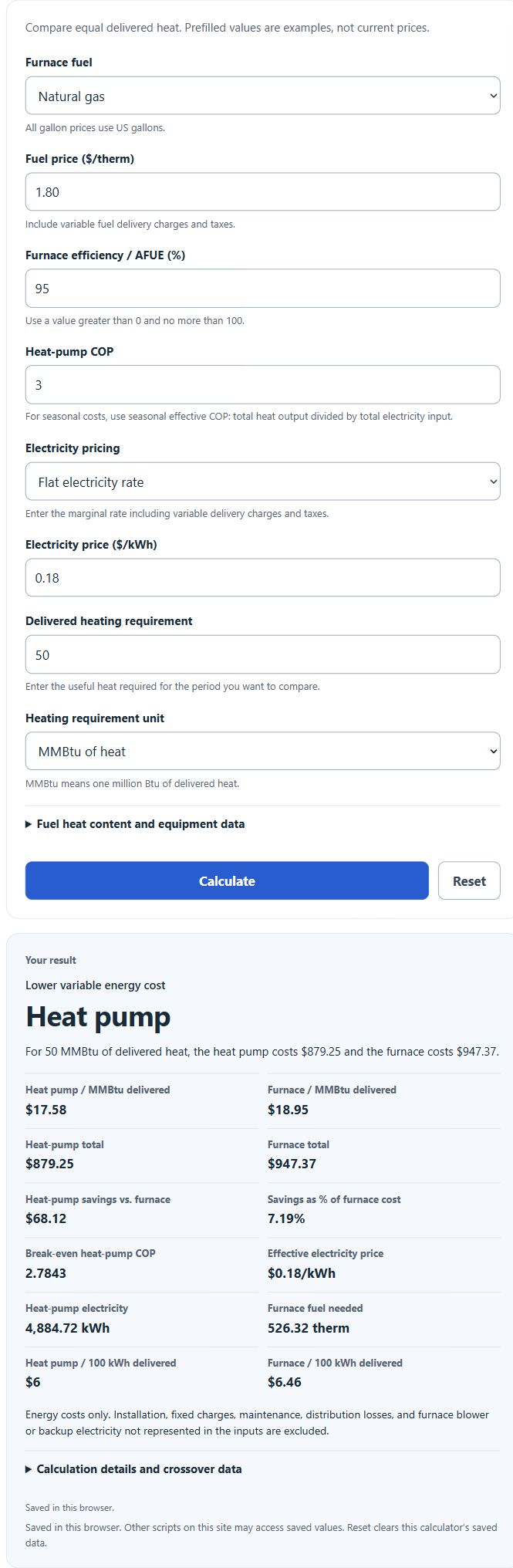
Suppose electricity costs $0.18/kWh, natural gas costs $1.80/therm, furnace AFUE is 95%, heat-pump COP is 3, and the heating requirement is 50 MMBtu. These are illustrative inputs, not current market prices.
Heat pump cost per MMBtu = 0.18 × 1,000,000 / (3,412 × 3) = $17.58. Furnace cost per MMBtu = 1.80 × 1,000,000 / (100,000 × 0.95) = $18.95.
For 50 MMBtu, the heat pump costs $879.25 and the furnace costs $947.37. Heat-pump savings are $68.12, or 7.19%. The break-even COP is 2.7843. Totals use unrounded intermediate values. No switchover temperature is inferred because no equipment performance curve was supplied.