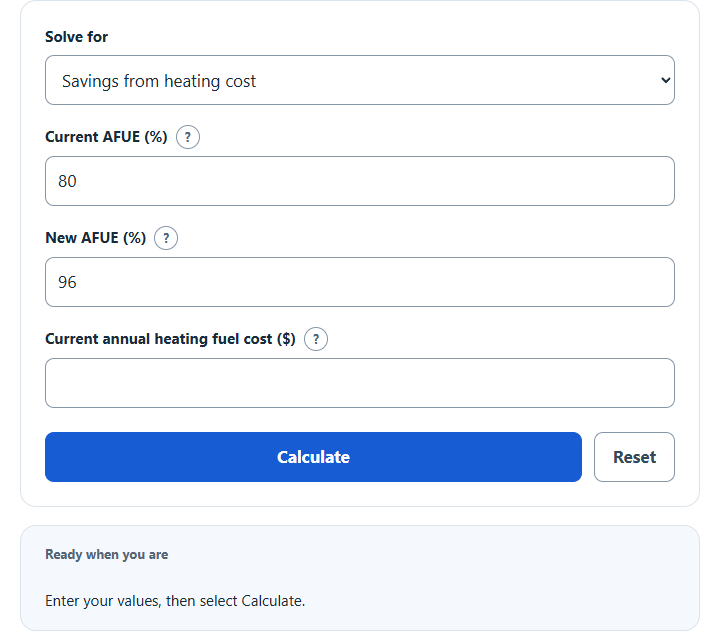
Estimate how much an 80% vs 96% AFUE furnace saves: enter your annual heating cost to see yearly savings, new fuel cost and simple payback.
- All Construction Calculators
- btu/h to cfm Converter
- cfm to btu Converter
- Heat Pump vs. Furnace Running Cost Calculator
Furnace AFUE Savings Formula
AFUE (Annual Fuel Utilization Efficiency) relates rated annual furnace heat output to fuel-energy input. Holding useful heating load, fuel and variable unit price constant gives new fuel use and variable cost equal to the current value times AFUEc / AFUEn. This simplified rating comparison does not model changes in weather, thermostat settings, equipment sizing, duct losses or auxiliary electricity. Exclude fixed utility fees and non-heating use from the entered heating cost.
AS = C * (1 - AFUEc / AFUEn)
If you know heating-fuel usage, the calculator projects new usage in the same unit and multiplies both usage values by the same entered price per unit. Therms, ccf, propane US gallons, heating-oil US gallons and electricity kWh are labels for separate like-for-like comparisons; no fuel or unit conversion is performed. The electricity option is for electric resistance furnaces, not heat pumps:
Un = Uc * (AFUEc / AFUEn)
In payback mode, divide the supplied nonnegative cost basis by positive modeled annual savings. Choose a consistent basis: for example, the incremental installed premium between alternatives, or the full installed cost if that is the comparison intended. The calculator does not infer that choice, incentives or a financial-worthwhile threshold:
P = IC / AS
Variables:
- AS is modeled annual variable heating-fuel cost savings in USD; a negative value means a cost increase.
- C is current annual variable heating-fuel cost in USD, excluding fixed fees and non-heating costs.
- AFUEc is the current furnace AFUE rating in percent
- AFUEn is the new furnace AFUE rating in percent
- Uc and Un are current and modeled new annual heating-fuel use in the same selected unit: therms, ccf, propane US gallons, heating-oil US gallons or resistance-heating kWh.
- P is undiscounted simple payback in years, defined here only when AS is positive. A zero supplied cost basis then gives zero years.
- IC is the supplied nonnegative installed-cost basis in USD, either the full cost or incremental premium chosen for the comparison.
Choose heating cost, fuel usage or simple payback. Both AFUE ratings start at typical values (80% and 96%); change them to match your furnaces, each greater than zero and no more than 100. Cost, usage and unit price may be zero. A lower proposed AFUE shows an increase, and equal ratings give zero modeled change. Heating cost mode retains 5-, 10- and 15-year constant-cost scenarios; these are undiscounted arithmetic totals, not service-life predictions. In payback mode, enter a nonnegative cost basis. An optional positive service horizon adds cumulative and net savings for that horizon; blank omits those outputs and does not assume 18 years. Positive annual savings are required for a finite simple-payback result.
Savings by AFUE Upgrade and How to Read a Payback Period
This table shows modeled annual savings for each $1,000 of current variable heating-fuel cost under the same-fuel, same-price and same-load assumptions. Values are rounded to whole dollars. For $2,500 of eligible annual fuel cost, multiply the listed amount by 2.5; do not include fixed utility fees or non-heating use.
| Current AFUE | To 90% AFUE | To 95% AFUE | To 98% AFUE |
|---|---|---|---|
| 60% | $333 | $368 | $388 |
| 70% | $222 | $263 | $286 |
| 80% | $111 | $158 | $184 |
| 85% | $56 | $105 | $133 |
| 90% | $0 | $53 | $82 |
For separate comparisons each starting at $1,000 of current variable fuel cost, 80% to 90% gives $111.11 per year and 90% to 98% gives $81.63. The first is about 1.36 times the second, not more than twice as much. These are model comparisons, not guaranteed bill reductions.
Simple payback states how long constant modeled savings would take to recover the entered cost basis. It does not by itself determine whether an upgrade is worthwhile. The following intervals describe arithmetic recovery times, without assuming a service life or recommending a purchase:
| Simple payback | What it means |
|---|---|
| Under 5 years | The entered cost basis is recovered in less than 5 years if the modeled annual savings persist. |
| 5 to 10 years | Modeled recovery takes 5 to 10 years; compare this with an explicitly supplied planning horizon and other relevant costs. |
| 10 to 15 years | Modeled recovery takes 10 to 15 years; the result does not evaluate financing, maintenance, incentives or other benefits. |
| Over 15 years | Modeled recovery takes more than 15 years. No equipment lifetime or future fuel-price trend is inferred. |
Simple payback and cumulative totals hold annual load and variable fuel price constant and use no discount rate. They do not model financing, maintenance differences, price escalation, incentives or equipment failure, so they are not guaranteed conservative estimates. Any adjustment to the entered cost basis must be supplied explicitly and applied consistently.
Example Problems
Example 1: Annual savings from a heating bill
In this hypothetical same-fuel, same-load and same-price example, eligible current annual heating-fuel cost is $1,800, current AFUE is 80% and proposed AFUE is 96%. Calculate without rounding the intermediate fraction: AS = $1,800 × (1 − 80/96) = $300 per year. The fraction is about 16.67%, and modeled new cost is $1,500 per year. The undiscounted 15-year constant-cost scenario is $4,500; it is not an assumed furnace lifetime. Enter 80, 96 and 1800 in heating cost mode.
Example 2: Payback period on an upgrade
In a second hypothetical comparison, current variable heating-fuel cost is $2,000 per year, AFUE changes from 70% to 95%, and the supplied installed-cost basis is $6,500. AS = $2,000 × (1 − 70/95) = $526.315789… per year. Using the unrounded savings, P = $6,500 / AS = 12.35 years. If you explicitly enter a 15-year service horizon, undiscounted cumulative savings are $7,894.74 and net savings after the supplied cost basis are $1,394.74. Blank horizon omits these outputs. This arithmetic does not establish purchase value, actual service life or future prices.
Frequently Asked Questions
What AFUE rating does my current furnace have?
Use the furnace EnergyGuide label or the manufacturer documentation for the exact model. The calculator requires explicitly supplied ratings and does not infer AFUE from age, vent material or an assumed equipment category. A rating comparison also does not establish the actual in-service efficiency of a particular installation.
Does a higher AFUE always mean a lower heating bill?
A higher rating reduces modeled fuel use only under the same useful heating load and fuel basis. Bills also depend on prices and charges. This calculator holds the variable unit price constant for both alternatives and excludes fixed fees and non-heating use; it cannot compare different fuels, changing tariffs or heat pumps. Actual savings can differ if operation, weather, distribution losses or other conditions change.
Where can I check current furnace efficiency requirements?
Check the Department of Energy consumer-furnace standards page and its current regulation links for the applicable product class and compliance date. This calculator does not determine legal requirements, predict equipment availability or assume a required replacement AFUE. Enter the ratings of the actual alternatives being compared.