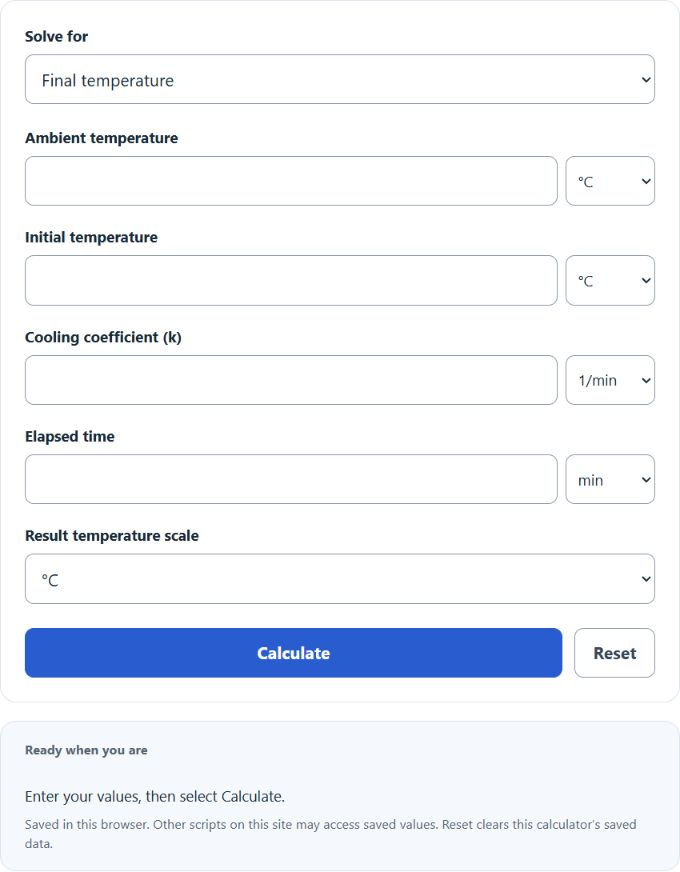
Calculate any missing value in Newton's law of cooling from ambient, initial and final temperatures, cooling coefficient, and time.
- All Physics Calculators
- Carnot Efficiency Calculator
- Heat of Fusion Calculator
- Cooling Capacity Calculator
- Subcooling Calculator
- Injection Molding Cooling Time Calculator
Newton’s Law of Cooling Formula
Newton’s law of cooling models how an object’s temperature approaches the surrounding temperature over time. It is most useful when the environment stays fairly constant and the object cools or warms in a smooth, exponential way.
- Tf = final temperature
- Ta = ambient temperature
- Ti = initial temperature
- c = cooling coefficient
- t = elapsed time
This relationship does not only apply to cooling. If an object starts colder than its surroundings, the same equation describes warming toward the ambient temperature.
Rearranged Forms
Choose the unknown in the calculator to solve it using the matching form below.
| Unknown | Equation |
|---|---|
| Final temperature | Tf = Tₐ + (Tᵢ - Tₐ)e - ct |
| Initial temperature | Tᵢ = Tₐ + (Tf - Tₐ)ect |
| Ambient temperature | Tₐ = (Tf - Tᵢ e - ct) / (1 - e - ct) |
| Cooling coefficient | c = - (1) / (t)ln((Tf - Tₐ) / (Tᵢ - Tₐ)) |
| Time | t = - (1) / (c)ln((Tf - Tₐ) / (Tᵢ - Tₐ)) |
How to Use the Calculator
- Enter the ambient temperature and the object’s initial temperature.
- Choose a cooling coefficient in units that match your time scale, such as per second, per minute, or per hour.
- Choose the target variable, then enter the displayed known values.
- Choose the unit beside each temperature; the calculator converts mixed Celsius and Fahrenheit inputs.
Units and Interpretation
- Temperature scale: Celsius and Fahrenheit both work as long as all temperatures use the same scale.
- Cooling coefficient: The coefficient c has units of inverse time, such as 1/s, 1/min, or 1/hr.
- Larger coefficient: A larger value of c means the object approaches ambient temperature faster.
- Direction of change: For positive time, the temperature moves toward ambient, not away from it.
Two useful benchmarks for interpreting the coefficient are the time constant and half-time:
After one time constant, about 36.8% of the original temperature difference remains. After one half-time, the temperature difference has been reduced by 50%.
Example
A cup of coffee starts at 90°C in a room at 22°C, and the cooling coefficient is 0.05 per minute. After 10 minutes:
The coffee is still warmer than the room, but it has moved significantly closer to ambient temperature. This is the typical exponential pattern: fast change at first, slower change later.
When Newton’s Law of Cooling Works Best
- The surrounding temperature stays nearly constant.
- The object’s temperature is reasonably uniform throughout.
- The cooling coefficient does not change much during the process.
- Heat transfer is dominated by ordinary convection rather than strong evaporation, phase change, or rapidly changing airflow.
The model may be less accurate when the environment changes quickly, the object has large internal temperature gradients, or the heat transfer mechanism changes over time.
Common Input Checks
- Make sure the time unit matches the cooling coefficient unit.
- If you are solving for time or the coefficient, the final temperature should lie between the initial and ambient temperatures for a physically realistic result.
- If the initial temperature equals the ambient temperature, no temperature change occurs.
- If your measured data shows the object crossing past the ambient temperature, the simple model is not a good fit for that interval.
FAQ
Does this equation only apply to cooling?
No. It also models warming when the object starts below the ambient temperature.
What does the cooling coefficient mean physically?
It is the rate constant that controls how quickly the temperature gap shrinks. Bigger values mean a faster thermal response.
Can I estimate the cooling coefficient from measurements?
Yes. If you know the initial temperature, ambient temperature, later temperature, and elapsed time, you can solve for c directly using the rearranged equation above.
What happens as time becomes very large?
The exponential term becomes very small, so the object temperature approaches the ambient temperature.