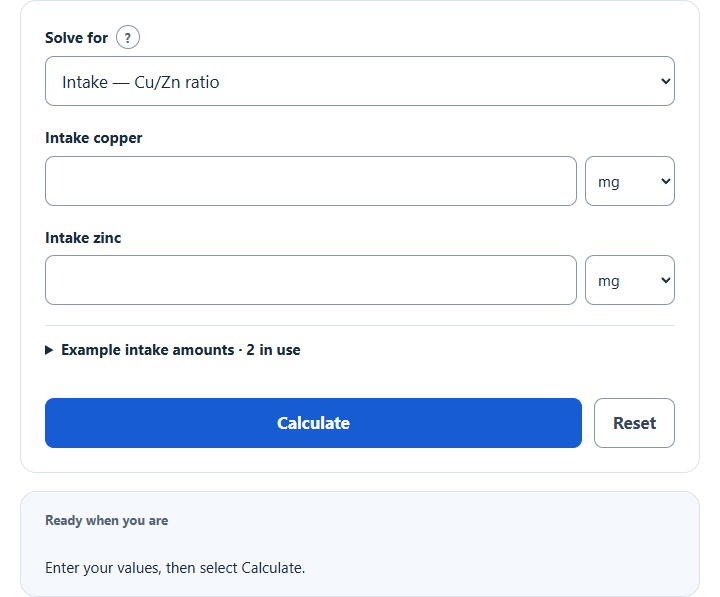
Calculate the copper to zinc ratio from copper and zinc intake, serum or hair values, or solve for copper or zinc from a known Cu/Zn ratio.
- All Chemistry Calculators
- Calcium Phosphorus Ratio Calculator
- Sodium to Potassium Ratio Calculator
- Magnesium Repletion Calculator
- Potassium Replacement Calculator
Calculator Functions
| Function | What it does | What it requires |
|---|---|---|
| Intake — Cu/Zn ratio | Finds the copper to zinc ratio of a diet or supplement | Requires the copper and zinc intake for the same period |
| Intake — copper | Finds the copper intake that matches a chosen ratio | Requires the zinc intake and the Cu/Zn ratio |
| Intake — zinc | Finds the zinc intake that matches a chosen ratio | Requires the copper intake and the Cu/Zn ratio |
| Serum/plasma — Cu/Zn ratio | Finds the copper to zinc ratio of a blood test | Requires serum or plasma copper and zinc from the same sample |
| Serum/plasma — copper | Finds the copper concentration that matches a chosen ratio | Requires the serum or plasma zinc and the Cu/Zn ratio |
| Serum/plasma — zinc | Finds the zinc concentration that matches a chosen ratio | Requires the serum or plasma copper and the Cu/Zn ratio |
| Hair — Cu/Zn ratio | Finds the copper to zinc ratio of a hair mineral report | Requires the hair copper and hair zinc values |
| Hair — copper | Finds the hair copper value that matches a chosen ratio | Requires the hair zinc and the Cu/Zn ratio |
| Hair — zinc | Finds the hair zinc value that matches a chosen ratio | Requires the hair copper and the Cu/Zn ratio |
Intake is entered in mg, g or µg. Serum and plasma values are entered in µg/dL, mg/dL, mg/L, µg/mL or µmol/L, and hair values in µg/g, mg/100 g or mg/g. Copper and zinc can use different units, because both are converted before dividing. The intake functions offer optional example amounts that fill in the copper or zinc field. Ratio results also show the inverse, zinc to copper.
Copper Zinc Ratio Formulas
| R | Cu/Zn ratio, the copper to zinc mass ratio, with no unit |
| C | Copper amount or concentration |
| Z | Zinc amount or concentration, in the same unit as copper |
The ratio is copper divided by zinc, not zinc divided by copper. The other two rearrangements are C = Z × R and Z = C ÷ R.
Intake — Cu/Zn ratio
For a supplement, the amounts to enter are the elemental copper and elemental zinc on the label. An intake of 2 mg of copper and 15 mg of zinc gives 2 ÷ 15 = 0.1333, and the inverse is 7.5 parts zinc to 1 part copper. Units are matched first, so 900 µg of copper with 11 mg of zinc is 0.9 ÷ 11 = 0.0818. For scale, the adult recommended intake is 900 µg of copper a day [1] and 8 to 12 mg of zinc [2], as of November 2026.
The food examples are rounded from published values: pan-fried beef liver has 12,400 µg of copper in 3 ounces, about 4.13 mg per ounce, and dry-roasted cashews have 629 µg per ounce [1].
Intake — copper
With 15 mg of zinc and a ratio of 0.1, the matching copper intake is 15 × 0.1 = 1.5 mg.
Intake — zinc
With 2 mg of copper and a ratio of 0.1, the matching zinc intake is 2 ÷ 0.1 = 20 mg.
Serum/plasma — Cu/Zn ratio
63.546 ÷ 65.38 [3]
Serum copper of 110 µg/dL and zinc of 90 µg/dL give 110 ÷ 90 = 1.2222. Results in µmol/L are converted to mass with the atomic weights of copper, 63.546, and zinc, 65.38 [3], so the mass ratio is about 3% lower than the molar ratio. Copper of 17.3 µmol/L and zinc of 13.8 µmol/L give 1.2185. Serum or plasma zinc in healthy people is typically 80 to 120 µg/dL [2].
Serum/plasma — copper
With zinc at 90 µg/dL and a ratio of 1.2, the matching copper concentration is 90 × 1.2 = 108 µg/dL.
Serum/plasma — zinc
With copper at 110 µg/dL and a ratio of 1.1, the matching zinc concentration is 110 ÷ 1.1 = 100 µg/dL.
Hair — Cu/Zn ratio
Hair copper of 20 µg/g and hair zinc of 180 µg/g give 20 ÷ 180 = 0.1111. A value in mg/100 g is ten times the same value in µg/g.
Hair — copper
With hair zinc at 180 µg/g and a ratio of 0.1, the matching hair copper is 180 × 0.1 = 18 µg/g.
Hair — zinc
With hair copper at 20 µg/g and a ratio of 0.125, the matching hair zinc is 20 ÷ 0.125 = 160 µg/g.
Limits of This Estimate
- The result is arithmetic. No ratio here is labeled healthy or unhealthy, and a ratio is neither a diagnosis nor a supplement dose. Lab values need the laboratory’s own reference ranges and a clinician’s reading.
- Intake, serum and hair ratios measure different things and cannot stand in for one another. Serum zinc shifts with age, sex and time of day and does not always follow intake [2].
- High zinc intake can interfere with copper absorption and lead to copper deficiency [1]. Zinc doses of 50 mg or more taken for weeks can inhibit copper absorption, and the adult upper limit is 40 mg of zinc a day [2] and 10,000 µg of copper a day [1], as of November 2026.
Sources
- NIH Office of Dietary Supplements, Copper: Fact Sheet for Health Professionals (updated October 18, 2022): copper recommended intake and upper limit, copper content of foods and the effect of zinc on copper
- NIH Office of Dietary Supplements, Zinc: Fact Sheet for Health Professionals (updated January 6, 2026): zinc recommended intake and upper limit, serum zinc range and the effect of zinc on copper
- IUPAC Commission on Isotopic Abundances and Atomic Weights, Standard Atomic Weights: atomic weights of copper and zinc