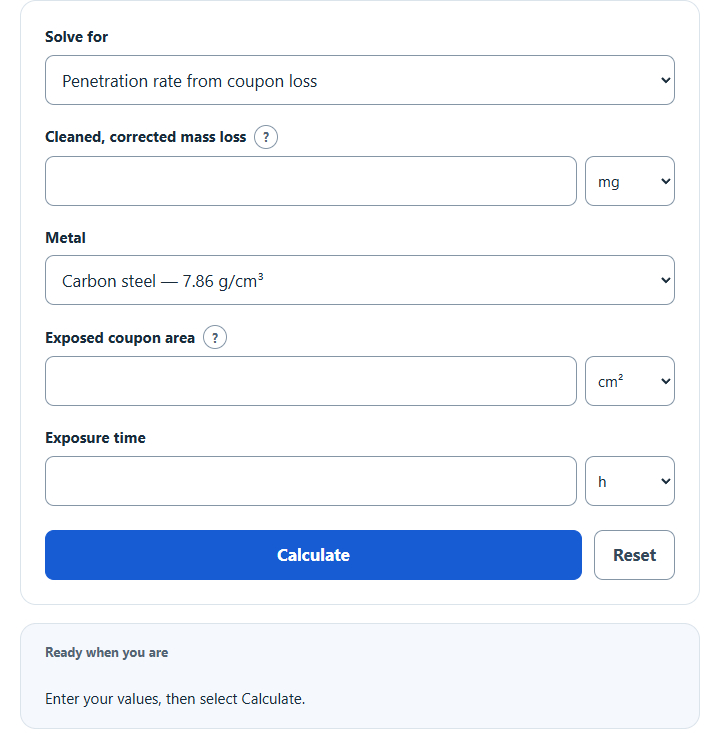
Calculate corrosion rate in mm/year and mpy from coupon mass loss, metal type or density, area and exposure time, or estimate mass loss or allowance life.
- All Chemistry Calculators
- All Rate Calculators
- Anodizing Amperage Calculator
- Drain Flow Rate Calculator
Calculator Functions
| Function | What it does | What it requires |
|---|---|---|
| Penetration rate from coupon loss | Finds the corrosion rate in mm/year, µm/year and mpy from the weight a test coupon lost | Requires the cleaned mass loss, the metal, the exposed coupon area and the exposure time |
| Expected coupon mass loss | Finds the weight a coupon would lose at a given corrosion rate | Requires the penetration rate, the metal, the exposed coupon area and the exposure time |
| Uniform allowance consumption time | Finds how long a thickness allowance lasts at a constant corrosion rate | Requires the remaining usable thickness allowance and the penetration rate |
The metal list sets the density in g/cm³: carbon steel 7.86, stainless steel 304 7.94, stainless steel 316 7.98, aluminum 1100 2.71, copper 8.94, cartridge brass 8.53, zinc 7.13, titanium 4.54 and nickel 8.89, or a custom density. Mass loss can be entered in mg or g, area in cm² or in², time in hours or days, and rate in mm/year, µm/year or mpy.
Corrosion Rate Formulas
(D × A × T) [1]
| CR | Corrosion rate (mm/year) |
| W | Mass loss of the cleaned coupon (mg) |
| D | Density of the metal (g/cm³) |
| A | Exposed area of the coupon (cm²) |
| T | Exposure time (hours) |
This is the mass-loss equation of ASTM G1, corrosion rate = K × W ÷ (A × T × D) [1]. The constant K is 8.76 × 10⁴ for mm/year when the mass loss is in grams [2], which becomes 87.6 with the mass loss in milligrams. It spreads the lost metal evenly over the exposed area and scales the exposure to a year of 8,760 hours.
Penetration rate from coupon loss
A carbon steel coupon with 20 cm² exposed that loses 50 mg in 720 hours has a rate of 87.6 × 50 ÷ (7.86 × 20 × 720) = 0.0387 mm/year, which is 38.7 µm/year or 1.52 mpy. Use the mass loss after the corrosion products are cleaned off, and count every exposed face and edge in the area.
Corrosion Rate in MPY
(D × A × T) [2]
Mils per year uses the same equation with the area in square inches: K is 5.34 × 10⁵ for grams [2], or 534 for milligrams. One mil is 0.001 inch, so 1 mpy = 0.0254 mm/year and 10 mpy = 0.254 mm/year. The calculator finds mm/year first and converts it, so its mpy figure can differ from a hand calculation with the rounded 534 by about 0.1%.
Expected coupon mass loss
This is the rate formula solved for mass loss. A carbon steel coupon of 20 cm² in service for 720 hours at 0.1 mm/year should lose 0.1 × 7.86 × 20 × 720 ÷ 87.6 = 129.2 mg.
Uniform allowance consumption time
A 3 mm corrosion allowance at a steady 0.125 mm/year lasts 3 ÷ 0.125 = 24 years. A rate in mpy and an allowance in inches are converted to mm first.
Limits of This Estimate
- The result is an average that assumes perfectly even metal loss. Pitting, weld attack and other local corrosion can go much deeper, and need the coupon examined under magnification [2].
- Cleaning removes some sound metal along with the corrosion products. ASTM G1 has the mass loss plotted against the number of cleaning cycles to separate the two [1].
- The listed densities are typical values for each metal. Enter the alloy's own density when it is known. These estimates are based on the best available data and estimations.
- The allowance time assumes the rate never changes. It is not a fitness-for-service assessment or a remaining-life calculation under an inspection code.
Sources
- Savannah River National Laboratory, E-Area Corrosion Coupon Recovery and Evaluation (SRNL-STI-2018-00038, Rev. 1): the ASTM G1 mass-loss equation, its units and the cleaning correction
- Metal Samples Company, Technical Information Regarding Coupon Testing: the K constants for mm/year and mpy, and the limits of an average rate