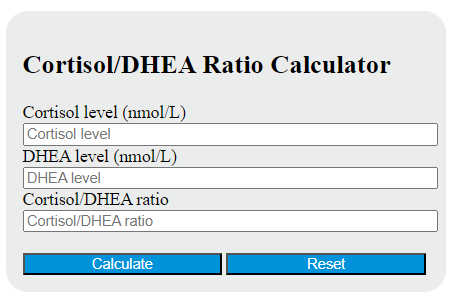
Enter your lab-measured Cortisol and DHEA values into the calculator to compute the Cortisol/DHEA ratio. If you already have any 2 of the 3 values (Cortisol, DHEA, or the ratio), the calculator can compute the missing value mathematically; back-calculating a hormone value does not replace lab testing and should not be used to set dosing or “optimal” targets.

Cortisol/DHEA Ratio Calculator

Enter any 2 values to calculate the missing variable (use values from the same test report/time point).

For serum/plasma cortisol. Do not use saliva cortisol or urinary free cortisol results.
For DHEA (dehydroepiandrosterone) only. Do not enter DHEA-S (DHEA sulfate) results.
Unitless. The calculator converts both hormones to the same molar units before computing the ratio.

Medical disclaimer: Educational use only; not medical advice and not for diagnosis. Do not start, stop, or change medications or supplements (including DHEA) based on this result. Discuss hormone results with a licensed clinician, especially if you are pregnant, under 18, have adrenal/pituitary disorders, or take glucocorticoids/steroid medications. Seek urgent care for severe or rapidly worsening symptoms.

About this calculator: Unit conversions used: cortisol 1 μg/dL = 27.59 nmol/L; DHEA 1 ng/dL = 0.03467 nmol/L (derived from molecular-weight conversion). To verify constants and molecular weights, check authoritative chemical references (for example, NIH PubChem entries for cortisol and DHEA) and confirm units/specimen type on your lab report. Last updated: 2026-01-01.

Cortisol/DHEA Ratio Formula

The following formula is used to calculate the Cortisol/DHEA ratio.

R = C / D

Variables:

  • R is the Cortisol/DHEA ratio (unitless)
  • C is the cortisol concentration (in the same units as D, e.g., nmol/L)
  • D is the DHEA concentration (in the same units as C, e.g., nmol/L)

To calculate the Cortisol/DHEA ratio, divide the cortisol concentration by the DHEA concentration after converting both to the same molar units. Both hormones must come from the same specimen type (serum or saliva) drawn at the same time point, because cortisol follows a steep circadian curve that peaks within 30 to 60 minutes of waking and drops by roughly 80% by midnight.

What Is the Cortisol/DHEA Ratio?

The Cortisol/DHEA ratio quantifies the balance between cortisol (the primary glucocorticoid produced by the adrenal zona fasciculata) and dehydroepiandrosterone (DHEA, an androgen precursor secreted by the zona reticularis). Both hormones are released in response to adrenocorticotropic hormone (ACTH) from the pituitary, but their production trajectories diverge sharply across the lifespan. Cortisol output remains relatively stable from early adulthood through old age, while DHEA and its sulfated storage form DHEA-S peak near age 20 and then decline to only 10 to 20 percent of that peak by age 70. This progressive divergence causes the cortisol/DHEA ratio to rise with age, a shift that has been linked to immunosenescence, increased oxidative stress, reduced cognitive performance, and higher all-cause mortality in prospective cohort data.

DHEA vs. DHEA-S: A Critical Distinction

Most commercial blood panels report DHEA-S (dehydroepiandrosterone sulfate), not unconjugated DHEA. These are related but distinct analytes. DHEA-S circulates at concentrations roughly 250 to 500 times higher than free DHEA, has a much longer serum half-life (10 to 20 hours vs. 15 to 30 minutes for DHEA), and shows minimal diurnal variation. Because of these pharmacokinetic differences, a Cortisol/DHEA ratio and a Cortisol/DHEA-S ratio produce numerically different results and use different reference ranges. Published research sometimes conflates the two, so always confirm which analyte your lab measured before interpreting any ratio.

Clinical Significance of a High Ratio

An elevated cortisol/DHEA ratio reflects either excess cortisol production or insufficient DHEA output (or both). The physiological consequences are broad. Cortisol at sustained high levels promotes visceral fat deposition, insulin resistance, elevated blood pressure, suppression of T-cell and lymphocyte function, slowed wound healing, and accelerated bone resorption. DHEA partially opposes these effects by enhancing IL-2 release from CD4+ cells, supporting neutrophil superoxide production, and exerting anti-glucocorticoid activity in neural tissue.

In a study of 108 diabetic patients aged 65 and older, a serum cortisol/DHEA-S ratio of 0.2 or above was identified as the strongest independent risk factor for sarcopenia, and the ratio values tracked with sarcopenia severity on a graded scale. Separately, a prospective cohort analysis of 4,255 Vietnam-era veterans found that a higher cortisol/DHEA-S ratio was significantly associated with increased all-cause mortality, including death from cancer and infectious disease, though not cardiovascular disease specifically. In psychiatric populations, patients with treatment-resistant major depressive disorder consistently show elevated cortisol/DHEA ratios, and MRI data has correlated higher ratios with reduced hippocampal volume, a brain region central to memory consolidation.

Clinical Significance of a Low Ratio

A low cortisol/DHEA ratio indicates relatively suppressed cortisol or relatively elevated DHEA. In adolescent and adult behavioral research, lower ratios have been associated with conduct disorders, aggression, and antisocial behavior, potentially reflecting a blunted capacity to mount appropriate stress responses. In women, a low ratio driven by high DHEA-S may correlate with acne, hirsutism, or irregular menstrual cycles due to excess androgenic activity. Some data from panic disorder patients show an increased DHEA-S/cortisol ratio during acute episodes, suggesting a shift in adrenal steroidogenesis toward DHEA at the expense of cortisol under certain stress conditions.

Age-Related Changes and Immunosenescence

The age-driven rise in the cortisol/DHEA ratio is one of the most reproducible findings in adrenal endocrinology. DHEA-S production begins declining around age 25 to 30 at a rate of approximately 2 to 5 percent per year, a process sometimes called "adrenopause." By the seventh decade, circulating DHEA-S may be only 10 to 20 percent of its youthful peak. Since cortisol secretion does not decline in parallel, the molar ratio increases substantially.

This shift has direct immunological consequences. Research on elderly bereaved subjects found significantly higher cortisol/DHEA-S ratios alongside suppressed neutrophil superoxide production compared to age-matched controls, with a corresponding increase in clinical infections. DHEA supplementation studies in older adults have shown partial restoration of immune parameters, including improved vaccine response and natural killer cell activity, though results vary across trials. Regular moderate exercise appears to be one of the most consistent modulators: 16 weeks of structured physical activity reduced the cortisol/DHEA ratio by approximately 30% in one intervention study, and athletes with the highest training volumes tend to maintain the lowest ratios.

Sampling and Interpretation Considerations

Cortisol follows a pronounced circadian rhythm with a morning peak (typically 250 to 750 nmol/L in serum) and an evening nadir. DHEA has a weaker diurnal pattern, and DHEA-S is nearly flat throughout the day. For this reason, the ratio is most reproducible and comparable across studies when calculated from an early morning fasting blood draw, ideally collected between 7:00 and 9:00 AM. Saliva-based testing captures free (unbound) hormone and uses its own reference ranges; salivary cortisol/DHEA ratios of roughly 5:1 to 6:1 have been cited as indicators of normal stress adaptation, though these figures should be interpreted within the context of each laboratory's validated ranges.

Several factors can shift the ratio independently of true adrenal pathology: oral contraceptives increase cortisol-binding globulin and thus total (but not free) cortisol; exogenous glucocorticoids suppress both ACTH and DHEA while raising measured cortisol; pregnancy physiologically elevates cortisol two- to threefold by the third trimester; and acute illness or critical care admission can transiently spike cortisol while suppressing DHEA conversion. Trends measured over multiple time points are generally more informative than any single reading.

Modifiable Factors That Influence the Ratio

Beyond aging, several lifestyle and clinical variables affect the cortisol/DHEA balance. Chronic psychological stress activates the HPA axis and can lead to sustained cortisol elevation with concurrent DHEA suppression, a pattern sometimes described as HPA axis dysregulation or "exhaustion phase" physiology. Conversely, regular moderate-intensity exercise, adequate sleep (7 to 9 hours per night), and stress-reduction practices such as mindfulness-based interventions have each been shown to lower cortisol or raise DHEA in controlled studies. Excessive high-intensity training without adequate recovery can have the opposite effect, chronically elevating cortisol and worsening the ratio. Alcohol and tobacco use both independently raise cortisol levels. Obesity is associated with altered cortisol metabolism through increased activity of 11-beta-hydroxysteroid dehydrogenase type 1 in visceral adipose tissue, which regenerates active cortisol from inactive cortisone locally.