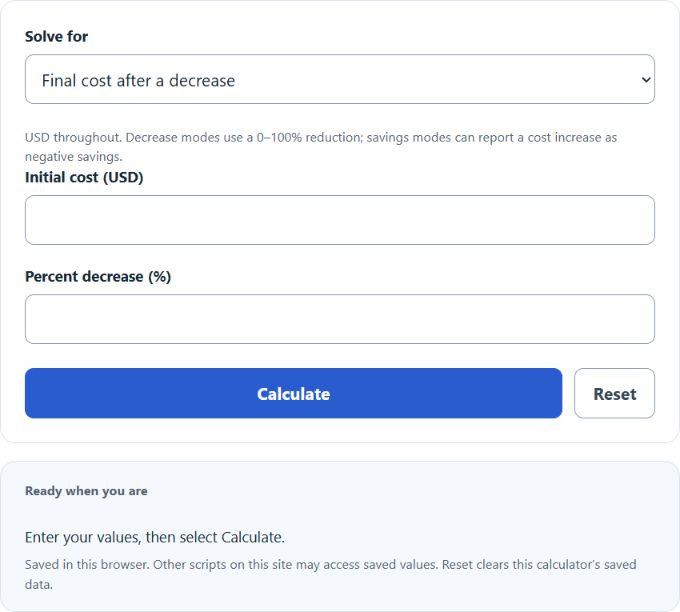
Calculate initial cost, percent decrease, or final cost from any two values with this cost decrease calculator for price reductions.
Related Calculators
- Cost Ratio Calculator
- Process Cost Calculator
- Operating Expense Calculator
- CPS (cost per sale) Calculator
- All Business Calculators
Cost Decrease Formula
The cost decrease calculation compares an initial cost to a lower final cost. You can use the same relationship to solve for the final cost, the percent decrease, or the original initial cost.
- FC = final cost after the decrease
- IC = initial cost before the decrease
- PD = percent decrease in cost
To calculate the percent decrease when you know the initial and final costs, use:
To calculate the initial cost when you know the final cost and the percent decrease, use:
- Final cost function: enter the initial cost and percent decrease to find the new lower cost.
- Percent decrease function: enter the initial cost and final cost to find the percentage drop.
- Initial cost function: enter the final cost and percent decrease to find the cost before the decrease.
Common Cost Decrease Multipliers
The multiplier is the decimal factor you multiply the initial cost by to get the final cost.
| Percent Decrease | Multiplier | Example on $100 |
|---|---|---|
| 5% | 0.95 | $95.00 |
| 10% | 0.90 | $90.00 |
| 20% | 0.80 | $80.00 |
| 25% | 0.75 | $75.00 |
| 50% | 0.50 | $50.00 |
Cost Decrease Result Checks
| Situation | What It Means | Valid for a Decrease? |
|---|---|---|
| Final cost is less than initial cost | The cost went down. | Yes |
| Final cost equals initial cost | There was no decrease. | Yes, as 0% |
| Final cost is greater than initial cost | The cost increased instead. | No |
| Percent decrease is 100% | The final cost is $0. | Yes, unless solving backward for initial cost from a final cost |
Example Problems
Example 1: Calculate the final cost
You have an initial cost of $80 and the cost decreases by 15%.
The final cost is $68.00.
Example 2: Calculate the percent decrease
An item drops from $120 to $90.
The percent decrease is 25%.
FAQ
How do you calculate a cost decrease?
Subtract the final cost from the initial cost to find the amount of decrease. Then divide that amount by the initial cost and multiply by 100 to convert it to a percent.
Can the percent decrease be more than 100%?
No. A cost decrease cannot be more than 100% because a 100% decrease reduces the cost to $0. A decrease greater than 100% would create a negative final cost, which is not valid for normal cost calculations.
What is the difference between percent decrease and dollar decrease?
The dollar decrease is the actual amount the cost dropped, such as $30. The percent decrease shows that drop relative to the initial cost, such as 25%. The same dollar decrease can be a different percent depending on the starting cost.