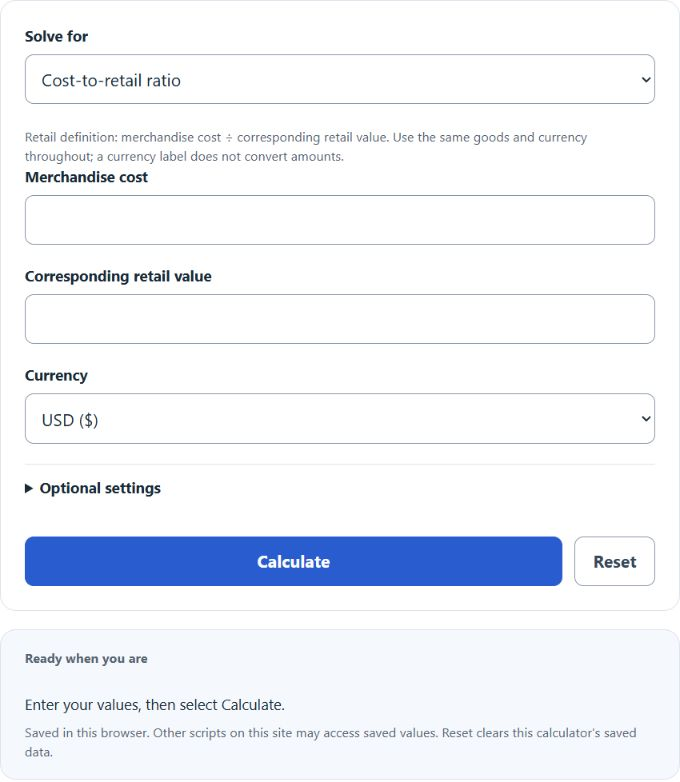
Calculate or reverse-solve the retail cost ratio, cost, or retail value, then compare gross margin, markup, profit, and retail-inventory estimates.
Related Calculators
- G&A Rate Calculator
- Efficiency Ratio Calculator
- Cost Per Equivalent Unit Calculator
- Cost Variance Calculator
- All Business Calculators
Cost Ratio Formula
The cost ratio compares merchandise cost to corresponding retail value and expresses the result as a percentage. A lower cost ratio generally means a smaller share of retail value is being used to cover costs.
To solve for merchandise cost:
To solve for corresponding retail value:
- CR = cost ratio, expressed as a percentage
- BC = merchandise cost, in dollars
- TR = corresponding retail value, in dollars
The calculator can solve for any one missing value when you enter the other two. If you enter merchandise cost and corresponding retail value, it calculates the cost ratio. If you enter cost ratio and corresponding retail value, it calculates the merchandise cost. If you enter merchandise cost and cost ratio, it calculates the corresponding retail value.
Cost Ratio Interpretation
The retail cost ratio describes merchandise cost as a share of the matching retail value. The ranges below are descriptive examples, not industry benchmarks or profitability ratings.
| Cost Ratio | General Meaning | Example Interpretation |
|---|---|---|
| Under 40% | Low cost share | Costs use less than 40 cents of each retail value dollar. |
| 40% to 70% | Moderate cost share | The selected cost is between40% and70% of the matching retail value. This range alone does not establish financial health. |
| 70% to 100% | High cost share | Most retail value is being used to cover costs. |
| Over 100% | Costs exceed retail value | The merchandise cost is greater than the retail value for the period. |
Common Cost Ratio Inputs
| Input | What to Include | Important Note |
|---|---|---|
| Merchandise Cost | Acquisition cost of the merchandise represented by the retail value | Use the same cost definition when comparing periods. |
| Retail Value | Corresponding retail selling value for the same merchandise | Retail value must correspond to the same merchandise as the cost. |
| Cost Ratio | The percentage of retail value used by the cost | Enter as a percent, not a decimal. For 25%, enter 25. |
Example Problems
Example 1: Calculate cost ratio
You have a merchandise cost of $30,000 and corresponding retail value of $120,000.
The cost ratio is 25%. This means 25 cents of each retail value dollar is used for the selected merchandise cost.
Example 2: Calculate merchandise cost
You know the cost ratio is 35% and corresponding retail value is $80,000.
The merchandise cost is $28,000.
FAQ
What is a good cost ratio?
There is no universal good retail cost ratio. Compare the same goods, pricing basis and cost definition; merchandise mix and excluded expenses affect interpretation. A lower ratio alone does not establish net profitability.
Can the cost ratio be over 100%?
Yes. A cost ratio over 100% means the merchandise cost is greater than corresponding retail value for the period. For example, if costs are $110,000 and retail value is $100,000, the cost ratio is 110%.
Which retail value should I use?
Use the retail selling value corresponding to the merchandise cost entered, on a consistent pricing basis. For the optional inventory estimate, use a representative cost-to-retail ratio for that inventory. Formal inventory valuation requires additional adjustments and accounting rules; the calculator is a simple planning estimate.