Calculate cost variance and earned value metrics from cumulative EV, PV, AC, and BAC for the same project baseline and status date. The EAC forecast assumes current cost efficiency continues; it is an estimate, not a known final cost.
- All Business Calculators
- All Cost Calculators
- Fixed Cost Calculator
- Cost of Sales Calculator
- Cost Function Calculator
- Budget Variance Calculator
Cost Variance Formula
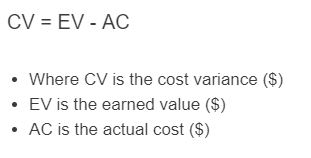
The following formula is used to calculate a cost variance.
- Where CV is the cost variance ($)
- EV is the earned value ($)
- AC is the actual cost ($)
To calculate the cost variance, subtract actual cost from earned value. CPI = EV / AC, SPI = EV / PV, and VAC = BAC − EAC. The CPI-only forecast uses EAC = BAC / CPI. A ratio with a zero denominator is undefined; the forecast needs a positive defined CPI. Schedule variance is measured in budget dollars and does not determine a completion date.
Cost Variance Definition
Cost variance (CV) is defined as the difference between earned value (EV)—the budgeted value of the work actually performed—and the actual cost (AC) incurred for that work as of a given date.
Cost Variance Example
How to calculate cost variance?
- First, determine the earned value (EV).
Determine the budgeted value of the work actually completed as of the status date (for example, percent complete × BAC, or by summing the budgeted values of completed work packages).
- Next, determine the actual cost (AC).
As of the same status date, calculate the total actual cost incurred for the work performed.
- Finally, calculate the cost variance (CV).
Subtract the actual cost from the earned value (CV = EV − AC).
FAQ
In Earned Value Management (EVM), cost variance (CV) is the difference between earned value and actual cost (CV = EV − AC). It can be calculated at any point in the project; a positive CV indicates under budget and a negative CV indicates over budget.
Earned value (EV) is the budgeted cost/value of the work actually performed (often called BCWP). In practice it is commonly determined from percent complete applied to the budget baseline or from completed work packages.