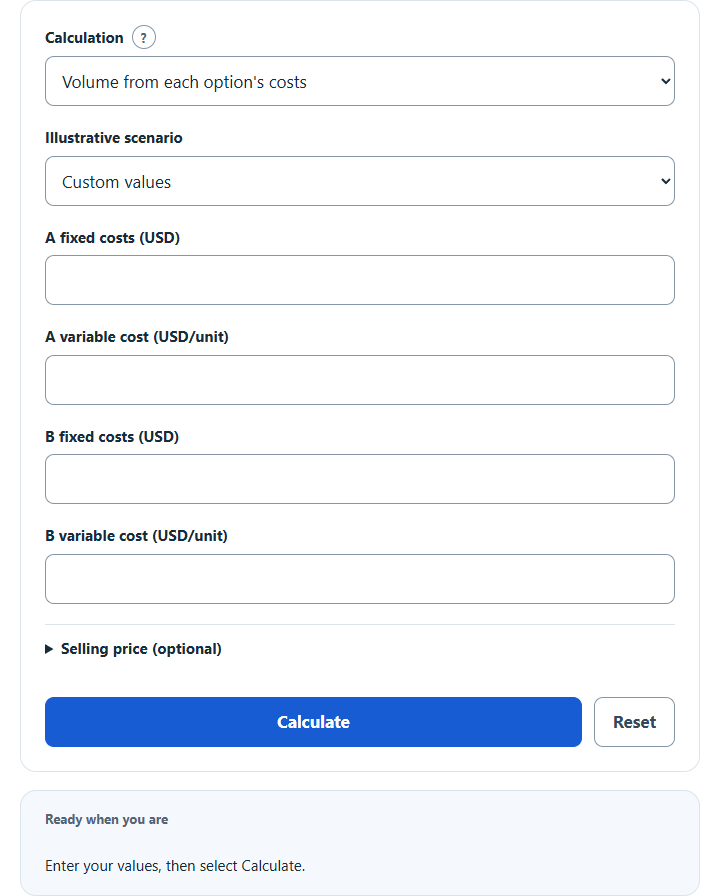
Calculate the cost indifference point: enter each option’s fixed and variable costs to find the volume where both alternatives have equal total cost.
Cost Indifference Point Formula
The following formula is used to calculate a cost indifference point.
- Where CIP is the cost indifference point
- DFC is the fixed-cost difference, B minus A
- DVCU is the unit variable-cost difference, A minus B
To calculate the Cost Indifference Point, divide the differential fixed costs by the differential variable costs per unit.
What is a Cost Indifference Point?
Definition:
A cost indifference point is the volume where two alternatives have equal total cost under the model F + V × Q. It is not necessarily a profit break-even point. Equal unit costs give either identical total costs at every volume or no intersection; a negative intersection lies outside nonnegative production.
How to calculate a Cost Indifference Point?
Example Problem:
The following example outlines how to calculate a Cost Indifference Point.
First, determine the differential fixed costs. In this example, the differential fixed costs are calculated to be $10,000.00.
Next, determine the differential variable costs per unit. In this case, the differential variable costs per unit are equal to $500.00.
Finally, calculate the Cost Indifference Point using the formula above:
CIP = DFC / DVCU
CIP = 10,000 /500
CIP = 20 units