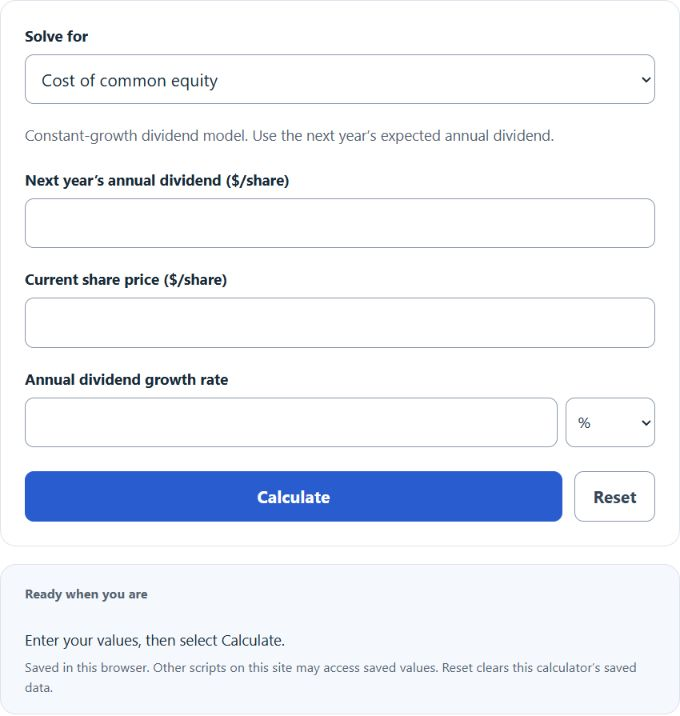
Choose the value to solve for, then enter the three displayed inputs. This constant-growth dividend model uses the next year’s expected annual dividend.
Related Calculators
- Total Equity Calculator
- PVIFA Calculator
- Net Distribution Calculator
- Basis Points Commission Calculator
- All Business Calculators
Cost of Common Equity Formula
The calculator uses the dividend growth model, also called the Gordon growth model. The main formula is:
- re = cost of common equity as a decimal
- D1 = expected annual dividends per share one year from now
- P0 = current market price per share
- g = dividend growth rate as a decimal
Because the calculator displays cost of common equity as a percent, it converts the decimal result by multiplying by 100:
The same relationship can be rearranged to solve for any missing input:
- Cost of common equity: enter dividends, market price, and growth rate to estimate the required return on common stock.
- Expected dividends: enter market price, growth rate, and cost of equity to solve for the dividend per share implied by those assumptions.
- Market price: enter dividends, growth rate, and cost of equity to estimate the stock price supported by the dividend growth model.
- Growth rate: enter dividends, market price, and cost of equity to solve for the implied dividend growth rate.
Common Input Formats and Result Interpretation
Both rate fields default to percentages: enter 5 for 5%. You can select decimal units and enter 0.05 instead; switching units converts the entered rate.
| Value | Enter as | Meaning |
|---|---|---|
| 5% dividend growth | 5 in % units, or 0.05 in decimal units | Dividends are expected to grow 5% per year. |
| 8% cost of equity | 8 | Investors require an 8% annual return. |
| $2.50 dividend | 2.50 | Expected annual dividend per share one year from now. |
| Result | General interpretation |
|---|---|
| Lower cost of equity | The stock may be viewed as less risky or supported by a higher current price relative to dividends. |
| Higher cost of equity | Investors require a higher return, often because of higher perceived risk or a lower price relative to dividends. |
| Growth rate near or above cost of equity | The model becomes very sensitive or invalid for solving price, because the denominator re – g becomes too small or negative. |
Example Problems
Example 1: Calculate cost of common equity
You have an expected annual dividend of $3.00 per share, a current market price of $50.00, and a dividend growth rate of 4%.
The cost of common equity is 10%.
Example 2: Calculate market price
You have an expected annual dividend of $2.40 per share, a cost of common equity of 9%, and a dividend growth rate of 3%.
The implied market price is $40.00 per share.
FAQ
What does cost of common equity mean?
Cost of common equity is the return common shareholders require for investing in a company’s stock. In the dividend growth model, it equals the dividend yield plus the expected dividend growth rate.
How do I enter the dividend growth rate?
The growth and cost rates default to percentage units, so enter 5 for 5% or 10 for 10%. Decimal units are also available. The calculator converts rates to decimals internally. Use the next year’s dividend D₁; if you have the last dividend D₀, first calculate D₁ = D₀ × (1 + g), using decimal g.
When should you not use this formula?
This formula is not a good fit for companies that do not pay dividends, have unstable dividends, or have a dividend growth rate that is not expected to continue. The continuing positive-dividend model requires a positive dividend and share price, growth above −100%, and a cost rate greater than growth. Equal or lower cost rates cannot produce a finite positive model price. Negative growth above −100% is allowed.