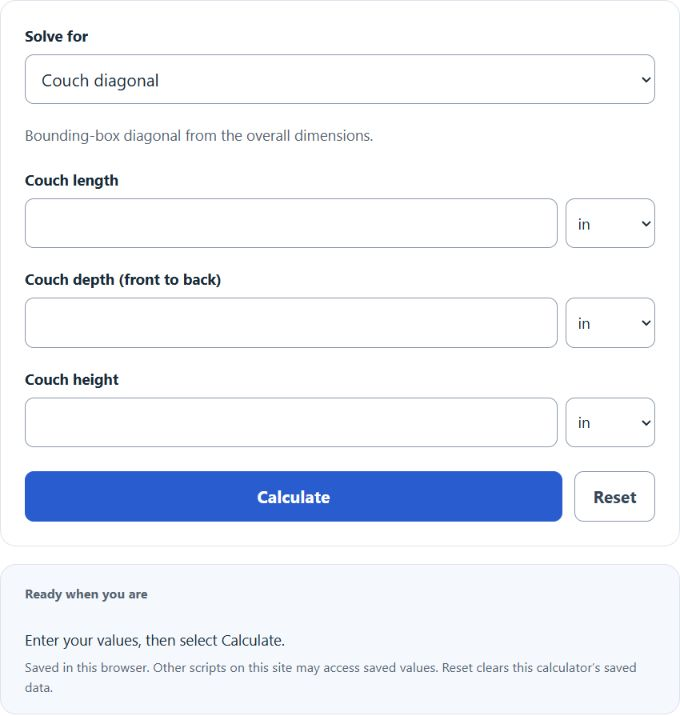
Calculate a couch’s 3D bounding-box diagonal from length, depth, and height, or compare a couch measurement with a doorway diagonal. This comparison alone cannot determine whether the couch fits.
Couch Diagonal Measurement Formula
The couch diagonal mode uses the 3D diagonal of a rectangular shape. This estimates the longest corner-to-corner measurement of the couch based on length, depth, and height.
- C = couch diagonal
- L = couch length
- D = couch depth, measured front to back
- H = couch height
The “Doorway diagonal comparison” mode compares the couch diagonal, or the largest measurement you enter, with the diagonal opening of the doorway.
- O = doorway diagonal opening
- W = doorway width
- Hd = doorway height
- C = couch diagonal or largest couch measurement entered
- Difference = doorway diagonal minus the entered couch measurement; it is not physical clearance
A favorable diagonal comparison does not establish that the couch fits, and a larger couch space diagonal does not establish that it cannot fit lengthwise. Measure the rigid couch profile and the entire delivery path, including turns, door thickness and nearby walls, with your delivery provider.
Common Doorway Diagonals
These values help you compare a couch diagonal with typical doorway openings. Actual usable space may be smaller if the door is still attached or the frame has trim.
| Doorway size | Doorway diagonal | Typical note |
|---|---|---|
| 30 in × 80 in | 85.44 in | Narrow interior opening |
| 32 in × 80 in | 86.16 in | Common interior door |
| 36 in × 80 in | 87.73 in | Wider entry door |
| 36 in × 84 in | 91.39 in | Taller entry opening |
Diagonal Difference Guide
| Diagonal difference | What the comparison establishes |
|---|---|
| Less than 0 | The entered couch measurement exceeds the doorway diagonal. This alone does not prove the couch cannot pass. |
| 0 to 2 in | The doorway diagonal is equal or slightly longer. This is not a physical-clearance measurement. |
| 2 to 6 in | The doorway diagonal is 2 to 6 in longer. Actual passage depends on the couch profile and delivery path. |
| More than 6 in | The doorway diagonal is more than 6 in longer. A fit verdict still requires the couch profile and delivery path. |
Example Calculations
Example 1: Find the couch diagonal
You have a couch that is 84 in long, 38 in deep, and 34 in high.
The couch diagonal is 98.26 in, or about 8.19 ft.
Example 2: Compare a measurement with a doorway diagonal
You have a couch diagonal of 86 in and a doorway that is 32 in wide by 80 in high.
The doorway diagonal is 86.16 in. The entered couch measurement is 86 in, giving a diagonal difference of about 0.16 in. This is not physical clearance and does not establish that the couch fits.
FAQ
Is the couch diagonal the same as the couch length?
No. Couch length is the side-to-side measurement. Couch diagonal is the corner-to-corner measurement through the full 3D shape, using length, depth, and height. The diagonal is usually larger than the length.
Should you measure with cushions and legs included?
Measure the couch in the condition it will be moved. If the legs, cushions, or back pillows can be removed, measure again without them. A few inches can make a major difference when fitting through a doorway.
Does a positive diagonal difference establish that the couch will go through?
No. It only means the doorway diagonal exceeds the entered couch measurement. Diagonals alone are not a fit test. Measure clear openings, the rigid couch profile, and room to turn throughout the delivery path; consult your delivery provider.