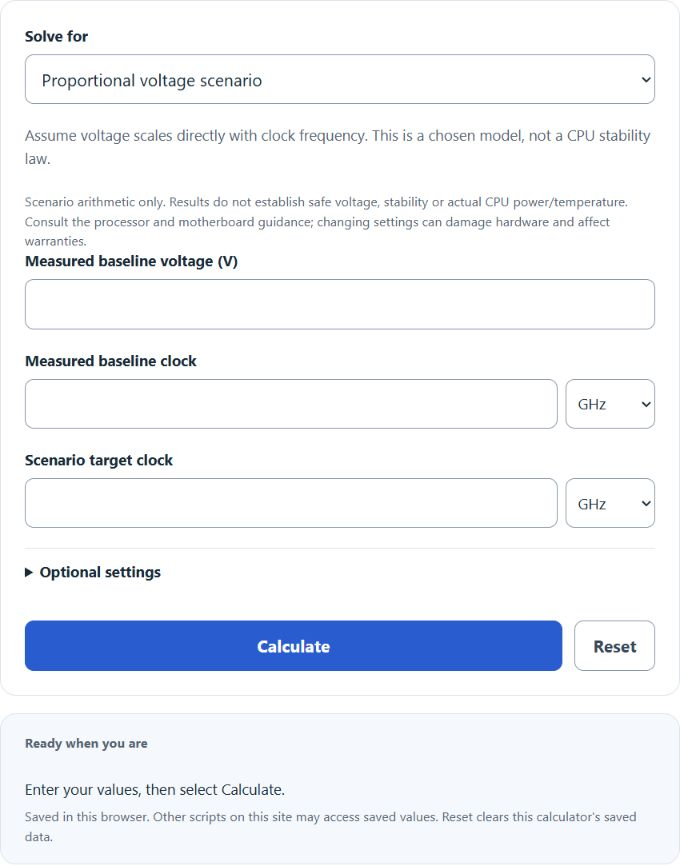
Model a user-defined proportional voltage scenario, VID offset or V²f power change with load-line droop, thermal scaling and personal limits.
CPU Overclock Voltage Formula
The following formula defines a hypothetical proportional voltage scenario. It does not predict the voltage a CPU requires for a stable clock, or a safe setting. Consult processor and motherboard documentation; changing frequency or voltage can damage hardware and affect warranties.
Variables:
- Vnew is the new voltage
- Voriginal is the original voltage
- Cnew is the new clock speed in MHz
- Coriginal is the original clock speed in MHz
For this chosen proportional model only, multiply baseline voltage by the ratio of scenario clock to baseline clock, using the same clock units. The other modes show a load-voltage difference with an assumed percentage drop, or a constant-activity V²f power ratio. A load-voltage difference is not a BIOS VID-offset prescription.
What is CPU Overclocking?
CPU overclocking is the process of increasing the clock speed of a computer’s central processing unit (CPU) beyond the manufacturer’s specified rate. This is done to improve the performance of the CPU, allowing it to handle more tasks or run more demanding applications. Overclocking can lead to higher performance in tasks such as gaming, video editing, and other CPU-intensive activities. However, it also increases the power consumption and heat output of the CPU, which may require additional cooling solutions to prevent overheating and ensure system stability.
How to Calculate CPU Overclock Voltage?
The following steps evaluate the proportional scenario. They do not determine an operating voltage to apply. Power scaling assumes unchanged switching activity and ignores changing leakage and throttling; temperature scaling assumes unchanged steady-state cooling and ambient. Personal limits are comparisons, not manufacturer specifications.
- First, determine the original voltage (Voriginal).
- Next, determine the new clock speed (Cnew).
- Next, determine the original clock speed (Coriginal).
- Finally, calculate the hypothetical scenario voltage using the formula Vnew = Voriginal * (Cnew / Coriginal).
- After inserting the values and calculating the result, check your answer with the calculator above.
Example Problem :
Illustrative arithmetic only: 1.2 × 4000 / 3000 = 1.6 V in the proportional model. This result is not a recommended setting or evidence of safety or stability.
Original Voltage (Voriginal) = 1.2 V
New Clock Speed (Cnew) = 4000 MHz
Original Clock Speed (Coriginal) = 3000 MHz