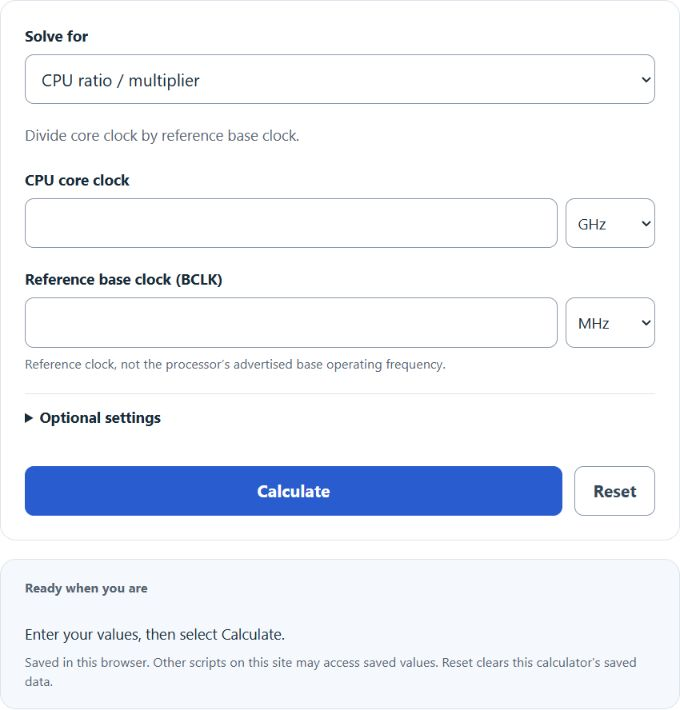
Calculate CPU ratio, core clock, or base clock in MHz or GHz, then compare the multiplier with a stock ratio and view clock period and frequency change.
CPU Ratio Formula
The CPU ratio, also called the CPU multiplier, connects the processor’s final clock speed to the base clock speed. The calculator uses the same relationship in three ways, according to the selected solve mode.
- CPU Ratio: The multiplier applied to the base clock. For example, a ratio of 40 means the CPU runs at 40 times the base clock.
- CPU Clock Speed: The final processor frequency, usually shown in GHz.
- Base Clock Speed: The reference clock used before the multiplier is applied. Many modern desktop CPUs use a base clock near 100 MHz, which is 0.1 GHz.
If you enter CPU clock speed and base clock speed, the calculator finds the CPU ratio. If you enter the CPU ratio and base clock speed, it finds the CPU clock speed. If you enter CPU clock speed and CPU ratio, it finds the base clock speed. Select the unit beside each clock input; the calculator converts them to a common unit.
Common Base Clock and Multiplier Values
The table below shows common relationships between base clock, multiplier, and final CPU clock speed.
| Base Clock | CPU Ratio | Final CPU Clock Speed |
|---|---|---|
| 100 MHz, or 0.1 GHz | 30 | 3.0 GHz |
| 100 MHz, or 0.1 GHz | 36 | 3.6 GHz |
| 100 MHz, or 0.1 GHz | 42 | 4.2 GHz |
| 100 MHz, or 0.1 GHz | 50 | 5.0 GHz |
Unit Conversions for Clock Speed
Select MHz or GHz independently for each clock input. The calculator converts units internally: 1 GHz equals 1,000 MHz. Reference base clock (BCLK) is distinct from the processor’s advertised base operating frequency.
| MHz | GHz | Typical Use |
|---|---|---|
| 100 MHz | 0.1 GHz | Common CPU base clock |
| 3200 MHz | 3.2 GHz | CPU clock speed example |
| 4500 MHz | 4.5 GHz | Boost or overclock example |
Example Calculations
Example 1: Calculate CPU ratio
You have a CPU clock speed of 4.2 GHz and a base clock speed of 0.1 GHz.
The CPU ratio is 42.
Example 2: Calculate CPU clock speed
You have a CPU ratio of 46 and a base clock speed of 0.1 GHz.
The CPU clock speed is 4.6 GHz.
FAQ
What is a CPU ratio?
A CPU ratio is the multiplier applied to the base clock speed to get the processor’s final clock speed. For example, if the base clock is 0.1 GHz and the CPU ratio is 40, the final CPU clock speed is 4.0 GHz.
Is CPU ratio the same as CPU multiplier?
Yes. CPU ratio and CPU multiplier usually mean the same thing. Both describe how many times the base clock is multiplied to produce the CPU’s operating frequency.
Why should the base clock be entered as 0.1 GHz instead of 100 MHz?
Enter 100 with MHz selected, or 0.1 with GHz selected; these are the same reference clock. Changing the unit converts an entered value. Ratio comparisons assume unchanged BCLK and do not predict benchmark gains. Calculated settings do not establish hardware support, safety or stability.