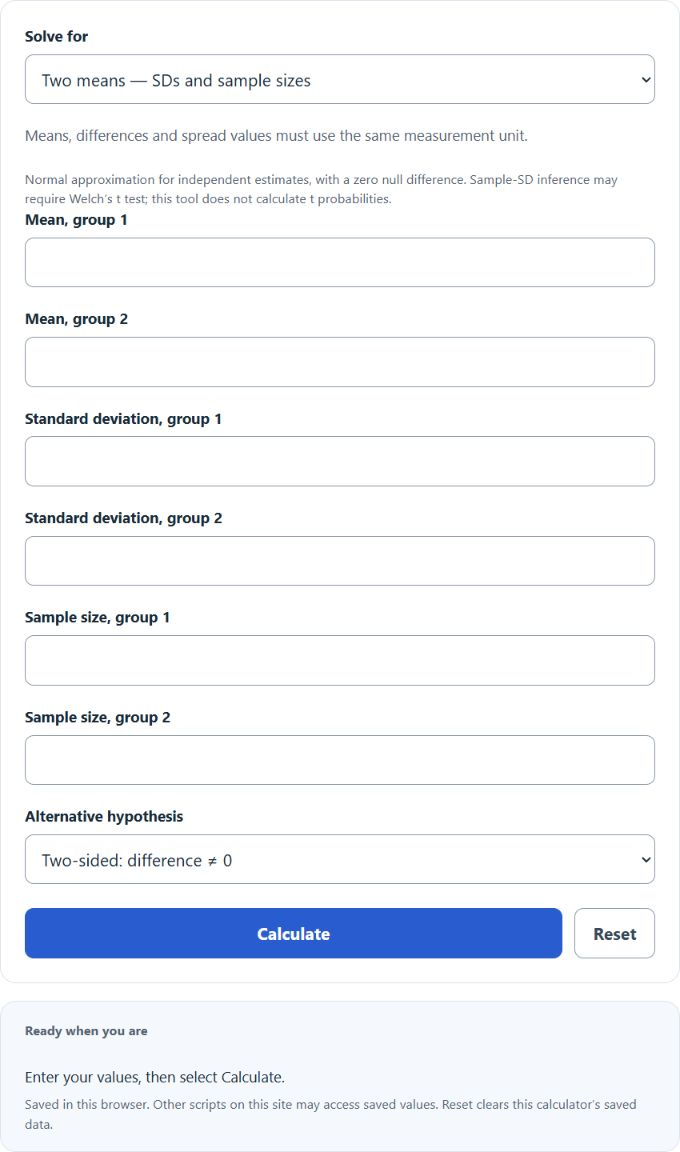
Calculate the critical ratio from two sample means or a direct difference and standard error, with p-value and 95% confidence interval.
- All Business Calculators
- All Ratio Calculators
- Relative Error Calculator
- T Statistic Calculator (T-Value)
Critical Ratio Formula
The standard error of the difference (SED) depends on which spread values you have:
- CR — critical ratio (also called the z-score for the difference)
- M1, M2 — sample means of group 1 and group 2
- SD1, SD2 — sample standard deviations
- n1, n2 — sample sizes
- SE1, SE2 — standard errors of each mean
- SED — standard error of the difference between means
The two-mean modes assume independent estimates. The p-values and two-sided 95% interval use a normal approximation with a zero null difference. When population variances are estimated, Welch’s t test uses appropriate degrees of freedom; there is no universal sample-size cutoff that makes normal inference exact.
Reference Values
For two-sided tests, compare |CR| with the two-sided thresholds. For one-sided tests, use the signed CR in the direction specified before inspecting the data:
| Significance level | Two-tailed |CR| | One-tailed CR |
|---|---|---|
| 0.10 | 1.645 | 1.282 |
| 0.05 | 1.960 | 1.645 |
| 0.01 | 2.576 | 2.326 |
| 0.001 | 3.291 | 3.090 |
Quick interpretation of the result:
| |CR| | Approx. two-tailed p | Verdict |
|---|---|---|
| < 1.00 | > 0.32 | p > 0.32 under the normal model |
| 1.00 – 1.96 | 0.05 – 0.32 | p ≥ 0.05 under the normal model |
| 1.96 – 2.58 | 0.01 – 0.05 | Significant at 0.05 |
| > 2.58 | < 0.01 | Significant at 0.01 |
Example
Group 1: M1 = 82, SD1 = 10, n1 = 50. Group 2: M2 = 78, SD2 = 12, n2 = 60.
SED = sqrt(10²/50 + 12²/60) = sqrt(2 + 2.4) = sqrt(4.4) = 2.098
CR = (82 − 78) / 2.098 = 1.906
|CR| = 1.91 falls just under the 1.96 cutoff, so the difference is not significant at the two-tailed 0.05 level (p ≈ 0.057).
FAQ
Is the critical ratio the same as a z-score? Yes. CR is a z-score applied to the difference between two estimates.
When should you use a t-test instead? Use a t-test when estimating population variances and the t-model assumptions apply. This calculator reports approximate standard-normal probabilities; a large sample alone does not validate independence, sampling, or distribution assumptions.
Can CR be negative? Yes. The sign tells you which group is higher. For two-tailed tests, only the magnitude matters.
What if the two groups have very different variances? The unpooled SED used here is √(SD1²/n1 + SD2²/n2). It allows unequal spreads for independent groups, but the reported probabilities remain normal approximations and do not use Welch degrees of freedom.