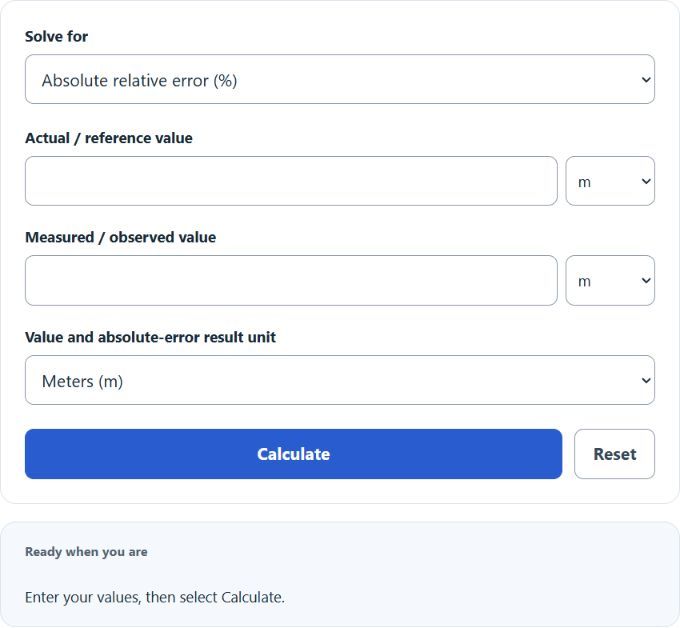
Calculate relative error, absolute error and percent error from measured and actual values, or find the missing variable from any two inputs.
Related Calculators
- Relative Accuracy Calculator
- Percentage Accuracy Calculator
- Percent Deviation Calculator
- Absolute Uncertainty Calculator
- Average Error Calculator
- All Math and Numbers Calculators
Relative Error Formula
- Where RE is the relative error (%)
- AV is the actual value
- MV is the measured value
To calculate absolute relative error, take the absolute difference between the measured and actual values, divide by the absolute actual value, then multiply by 100. The actual value must be nonzero. The signed mode instead uses (MV − AV)/AV ×100 and supports solving either missing value.
What is Relative Error?
Relative error compares a measurement discrepancy with the magnitude of a nonzero reference value. Standard error is a different statistic describing the sampling variability of an estimator.
In the case of chemistry, this could be the measured mass of the actual mass of a reaction.
How to calculate relative error?
The following is an example problem for calculating the relative error in an experiment or set of data.
First, determine the theoretical value the experiment should yield. For this example, we are going to assume that we are analyzing a chemical reaction that is supposed to yield a certain mass of a product.
In this case, the expected mass yield is 20 grams.
Next, perform the chemical process, and measure the actual mass that was yielded from the reaction.
For this problem, the actual mass is measured to be 19 grams.
Finally, calculate the relative error using the formula above.
RE = |AV – MV|/ |AV| *100
RE = |20 – 19 |/ 20 *100
RE = 5%
Relative vs Absolute Error
Relative and absolute errors are both measures of the variation in a set of data between an expected value and the actual outcome.
In the case of absolute error, this is simply a measure of the absolute difference between the expected value and the measured value.
In the case of relative error, that absolute difference is compared to the expected value in terms of a percentage of variation.
Relative Error Properties
There are several properties of relative error that are used to better understand the variation in data.
Absolute relative error is nonnegative, including zero for an exact match, because it uses the absolute difference divided by the absolute reference value.
Signed relative error can be positive, negative or zero. This calculator labels that convention separately.
Terminology varies: percent error may mean either an absolute or signed percentage. Here, absolute relative error is |MV − AV|/|AV| ×100; signed relative error is (MV − AV)/AV ×100.
Can relative error be greater than 100%?
In some instances, a relative error can be greater than 100%.
For example, if you have a theoretical value of 10 but the measured value comes out to be 25, the formula calculates the relative error as |10-25| / 10 *100 = 150%.
FAQ
The relative error is a measure the difference between an expected or theoretical outcome and the actual outcome that occurred.