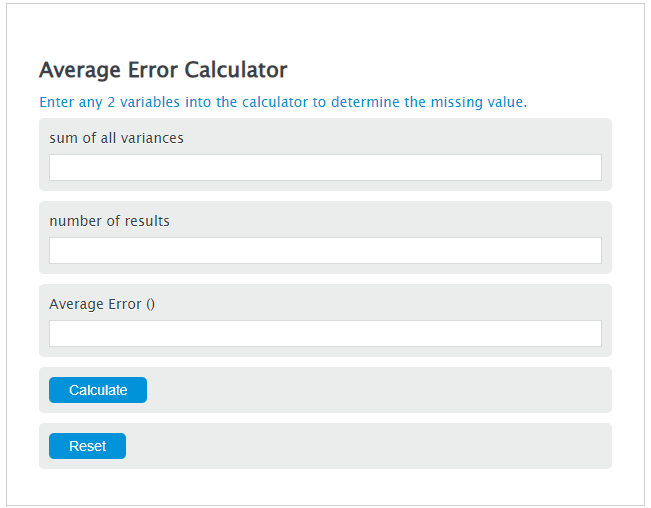
Calculate mean error, MAE, MSE, RMSE, and MAPE from error values, measured vs true data, or a single measured-versus-true percent error.
Related Calculators
- Constant Error Calculator
- Systematic Error Calculator
- Relative Accuracy Calculator
- Percentage Accuracy Calculator
- All Statistics Calculators
Average Error (MAE) Formula
Variables:
- AE is the Average Error (mean absolute error, MAE)
- SAE is the sum of absolute errors
- n is the number of results
To calculate Average Error (MAE), divide the sum of the absolute errors by the number of results.
How to Calculate Average Error?
The following steps outline how to calculate the Average Error (MAE).
- First, determine the sum of the absolute errors.
- Next, determine the number of results.
- Next, gather the formula from above = AE = SAE / n.
- Finally, calculate the Average Error.
- After inserting the variables and calculating the result, check your answer with the calculator above.
Example Problem :
Use the following variables as an example problem to test your knowledge.
sum of absolute errors = 575
number of results = 30
Average Error = 575 / 30 = 19.1667
FAQ
What is an “error” (residual) in statistics/forecasting?
An error (often called a residual) is the difference between an observed/actual value and a predicted or estimated value.
Why is calculating average error important?
Calculating average error helps summarize how accurate estimates or predictions are. It is commonly used to compare models and track performance over time.
Can average error be negative?
It depends on the metric. Absolute-based metrics like MAE, MAPE, RMSE, and MSE are always non-negative. Signed metrics like ME (mean error) or MPE (mean percentage error) can be negative.
How does the number of results (n) affect the average error?
Increasing the number of results usually makes the computed average error more stable (less sensitive to any single observation). However, it does not guarantee that the average error value will decrease.