Calculate relative and absolute uncertainty from two values, or combine measurement uncertainties for add, subtract, multiply, and divide.
Absolute Uncertainty Formula
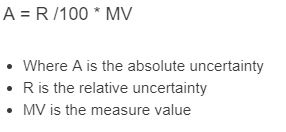
The following formula is used to calculate absolute uncertainty.
- Where A is the absolute uncertainty
- R is the relative uncertainty
- MV is the measured value
To calculate absolute uncertainty, divide the relative uncertainty by 100, then multiply by the magnitude of the measured value.
Absolute Uncertainty Definition
Absolute uncertainty is the uncertainty of a measurement expressed in the same units as that measurement. Choose the result under Solve for; inverse solving determines the measured-value magnitude, not its sign. The combine modes use root-sum-of-squares propagation for uncorrelated standard uncertainties, with up to five measurements. They do not calculate worst-case tolerances or account for correlation.
Absolute Uncertainty Example
How to calculate absolute uncertainty?
- First, determine the relative uncertainty.
Calculate the relative uncertainty.
- Next, determine the measured value.
Calculate the measured or reported value.
- Finally, calculate the absolute uncertainty.
Calculate the absolute uncertainty using the formula above.
FAQ
How do you calculate relative uncertainty?
Relative uncertainty can be calculated by dividing the absolute uncertainty by the magnitude of a nonzero measured value, then multiplying the result by 100 to get it in percentage form.
Why is it important to calculate absolute uncertainty?
Calculating absolute uncertainty is crucial in scientific measurements as it provides a quantitative measure of the precision of an experiment or measurement, indicating how much the measured value could vary.
Can absolute uncertainty be negative?
No, absolute uncertainty cannot be negative. Uncertainty represents a range of possible values around a measurement and is nonnegative.
How does the measured value affect the absolute uncertainty?
The measured value directly affects the absolute uncertainty since the absolute uncertainty is calculated by multiplying the relative uncertainty (a percentage) by the magnitude of the measured value. A larger magnitude with the same relative uncertainty will result in a larger absolute uncertainty.