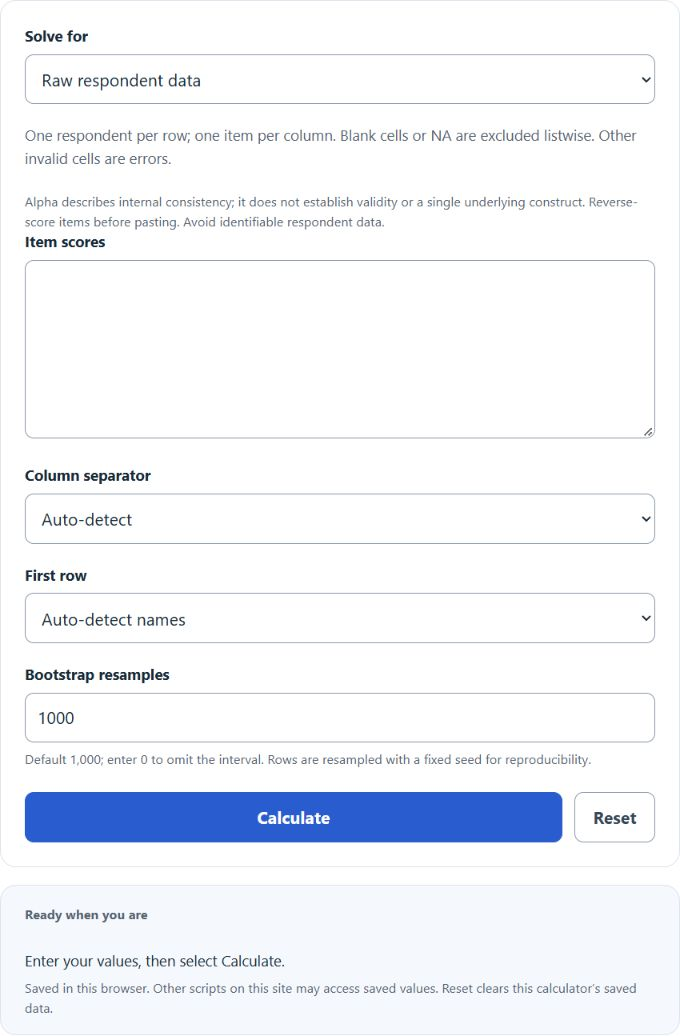
Calculate Cronbach’s alpha from raw item scores or summary statistics, with standardized alpha, item analysis, and bootstrap confidence intervals.
Related Calculators
- Discrimination Index Calculator
- Cutoff Score Calculator
- Systematic Error Calculator
- Coefficient Of Dispersion Calculator
- All Statistics Calculators
Cronbach Alpha Formula
The following formula is used to calculate Cronbach’s alpha when using the average item variance and the average covariance between item pairs.
- Where α is the coefficient alpha (Cronbach’s alpha)
- N is the number of items
- c̄ is the average covariance between item pairs
- v̄ is the average variance of the items
To calculate Cronbach’s alpha using this form, multiply the number of items by the average covariance between item pairs, then divide by the average item variance plus (N − 1) times the average covariance.
Cronbach Alpha Definition
Cronbach’s alpha, also known as coefficient alpha, is a measure of internal consistency (how closely related a set of items are as a group). It is commonly used as an estimate of the reliability of a multi-item scale.
Example
How to calculate Cronbach’s alpha?
- First, determine the number of items.
This is typically the total number of questions on the test.
- Next, determine the average covariance between items.
Calculate the covariance for each item pair, then take the average (mean) of those covariances.
- Next, determine the average item variance.
Calculate each item’s variance, then take the average (mean) across items.
- Finally, calculate the alpha coefficient.
Calculate Cronbach’s alpha using the formula above.
FAQ
Internal consistency is the extent to which items on a test or scale measure the same underlying construct and therefore tend to be correlated with one another (often assessed using Cronbach’s alpha).