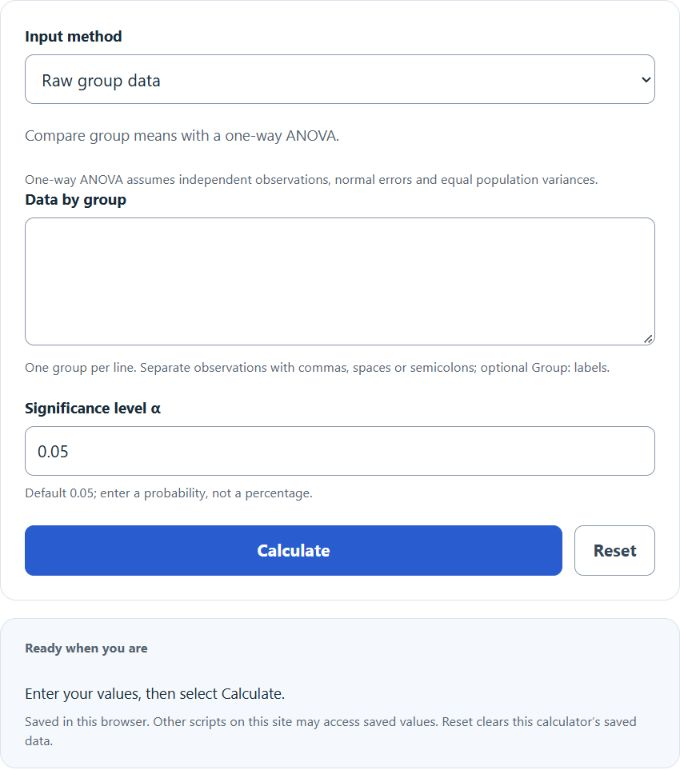
Calculate the F ratio for one-way ANOVA from raw data, ANOVA table values, or mean squares, with p-value, F critical, and significance.
- All Statistics Calculators
- T Statistic Calculator (T-Value)
- MSR (Mean Square of Regression) Calculator
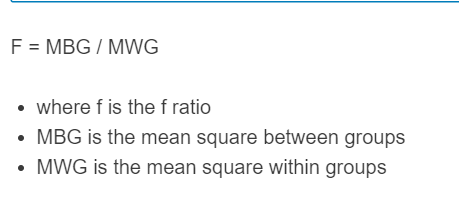
F Ratio Formula
- F: F ratio (test statistic)
- MSbetween: mean square between groups
- MSwithin: mean square within groups (error)
- SSbetween: sum of squared deviations of group means from the grand mean, weighted by group size
- SSwithin: sum of squared deviations of each observation from its own group mean
- dfbetween: k − 1, where k is the number of groups
- dfwithin: N − k, where N is the total number of observations
The F ratio assumes independent samples, approximately normal group distributions, and roughly equal group variances. F is always non-negative. A value near 1 suggests the group means do not differ more than expected from random variation.
Reference Tables
Critical F values for the right tail at α = 0.05. Use dfbetween across the top and dfwithin down the side.
| dfwithin \ dfbetween | 1 | 2 | 3 | 4 | 5 |
|---|---|---|---|---|---|
| 5 | 6.61 | 5.79 | 5.41 | 5.19 | 5.05 |
| 10 | 4.96 | 4.10 | 3.71 | 3.48 | 3.33 |
| 15 | 4.54 | 3.68 | 3.29 | 3.06 | 2.90 |
| 20 | 4.35 | 3.49 | 3.10 | 2.87 | 2.71 |
| 30 | 4.17 | 3.32 | 2.92 | 2.69 | 2.53 |
| 60 | 4.00 | 3.15 | 2.76 | 2.53 | 2.37 |
| 120 | 3.92 | 3.07 | 2.68 | 2.45 | 2.29 |
How to interpret the F ratio you get:
| F value | What it suggests |
|---|---|
| F < 1 | Group mean-square variation is below within-group noise. Assess significance from p and the chosen α. |
| F ≈ 1 | Consistent with the null hypothesis of equal means. |
| F > Fcritical | Reject H₀. At least one group mean differs. |
| p ≤ α | Statistically significant at the chosen α level. |
Worked Example
Three groups, each with three observations: (7, 8, 9), (5, 7, 6), (10, 9, 11).
- Group means: 8, 6, 10. Grand mean: 8.
- SSbetween = 3(8−8)² + 3(6−8)² + 3(10−8)² = 24
- SSwithin = 2 + 2 + 2 = 6
- dfbetween = 2, dfwithin = 6
- MSbetween = 12, MSwithin = 1
- F = 12 / 1 = 12.0, p ≈ 0.008
At α = 0.05, Fcritical(2, 6) ≈ 5.14. Since 12.0 > 5.14, reject H₀.
FAQ
Can F be negative? No. Both mean squares are sums of squared values divided by positive degrees of freedom.
Why is the test one-tailed? Only large F values indicate that group means differ more than within-group variability. A small F does not establish that the population means are equal.
What if my variances are unequal? Standard ANOVA assumes equal variances. For unequal variances, use Welch's ANOVA instead.
F ratio vs. F statistic? Same thing. "Ratio" emphasizes the construction; "statistic" emphasizes its use in hypothesis testing.