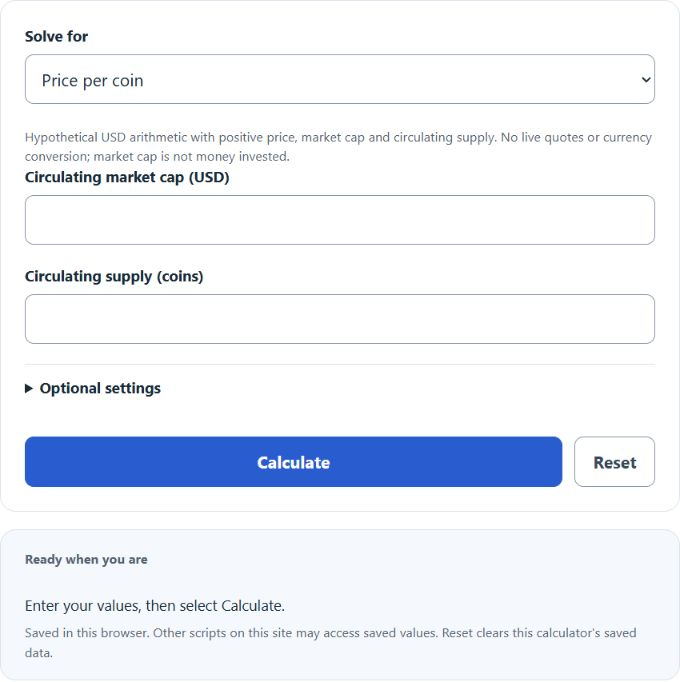
Calculate crypto price from market cap and circulating supply, reverse-solve market cap or supply, and estimate holdings, ROI, targets, and fully diluted value.
Crypto Price Calculator Formula
Choose one of three valuation solve modes. The optional holdings and budget scenarios use the following related identities, with all monetary values in USD.
- Price: dollar value of one coin
- Market Cap: total dollar value of all circulating coins
- Circulating Supply: coins currently in public hands
- Max Supply: total coins that will ever exist (used for fully diluted value)
- Coins Owned: your balance of the coin
- Buy Price: the price you paid per coin
- Target Price: the price you are testing
Only the explicitly entered entry charge is deducted from a new-purchase budget. Owned-position cost uses the entered all-in acquisition cost. Results exclude exit charges, taxes and slippage. Target calculations hold circulating supply fixed as a hypothetical assumption, not a forecast. For FDV at the same price, multiply price by assumed fully diluted supply.
Reference Tables
These are informal illustrative size bands and arithmetic scenarios, not official classifications or predictions. Market cap alone does not establish liquidity or risk; it is price times circulating supply, not capital invested.
| Market Cap Range | Tier | Interpretation limit |
|---|---|---|
| Under $100M | Micro | Size alone does not establish liquidity |
| $100M – $1B | Small | Size alone does not establish volatility |
| $1B – $10B | Mid | Market depth requires separate evidence |
| $10B – $100B | Large | Liquidity and listings are not guaranteed |
| Over $100B | Mega | No current asset ranking is implied |
| Price Move | Return | $1,000 Becomes |
|---|---|---|
| 2x | +100% | $2,000 |
| 5x | +400% | $5,000 |
| 10x | +900% | $10,000 |
| 100x | +9,900% | $100,000 |
| 0.5x | -50% | $500 |
Example and FAQ
Example. A coin has a circulating supply of 250 million coins. You want to know the price if it reaches a $5 billion market cap.
Price = $5,000,000,000 / 250,000,000 = $20 per coin. If you hold 1,000 coins, that position would be worth $20,000.
Why does the same coin show two different market caps online? One possible reason is that one uses circulating supply and another uses an assumed fully diluted supply. Providers may also use different prices or supply estimates. FDV values the assumed future supply at the same scenario price; it does not assert that those coins already exist.
Can a small coin really hit Bitcoin's price? Price alone is meaningless without supply. A coin with 1 trillion tokens reaching $1 each would need a $1 trillion market cap, a valuation identity that does not establish feasibility, liquidity or the amount of new money required.
Why is my projected value off from the exchange? Live prices change every second, and exchanges charge fees and spreads. The calculator gives a clean math result, not a quote.