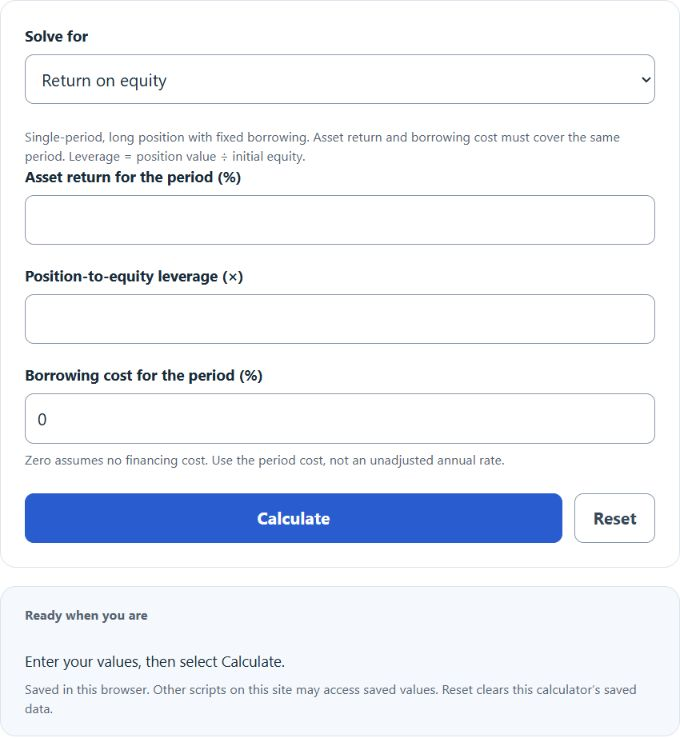
Calculate leveraged return on your equity from the asset return, leverage ratio and borrowing cost, or the dollar profit or loss on your capital.
Leveraged Returns Formula
The following formula is used to calculate the leveraged returns for a given return on investment, leverage ratio, and cost of borrowing.
Variables:
- RL is the return on initial equity (%)
- ROI is the return on investment
- L is initial position value divided by initial equity (at least 1)
- CB is the cost of borrowing
To calculate the leveraged returns, multiply the return on investment by the leverage ratio. Then, subtract the product of the leverage ratio minus one and the cost of borrowing.
What are Leveraged Returns?
Leveraged returns refer to the amplified returns on an investment achieved by using borrowed capital. By leveraging, investors can increase their potential returns, but this also comes with increased risk. Here, leverage is total initial position value divided by the investor’s initial equity; borrowed principal is equity multiplied by L − 1. Asset return and borrowing cost must cover the same period. The model assumes a long position and fixed debt, and excludes margin calls, liquidation and daily rebalancing. The cost of borrowing is the interest or other costs associated with borrowing the capital. Leveraged returns are calculated by taking into account the return on investment, the leverage ratio, and the cost of borrowing.
How to Calculate Leveraged Returns?
The following steps outline how to calculate the Leveraged Returns.
- First, determine the return on investment (ROI).
- Next, determine position-to-equity leverage (L).
- Next, determine the cost of borrowing (CB).
- Finally, calculate the Leveraged Returns using the formula RL = (ROI * L) – ((L – 1) * CB).
- After inserting the values and calculating the result, check your answer with the calculator above.
Example Problem :
Use the following variables as an example problem to test your knowledge.
Return on Investment (ROI) = 10%
Leverage Ratio (L) = 2
Cost of Borrowing (CB) = 3%