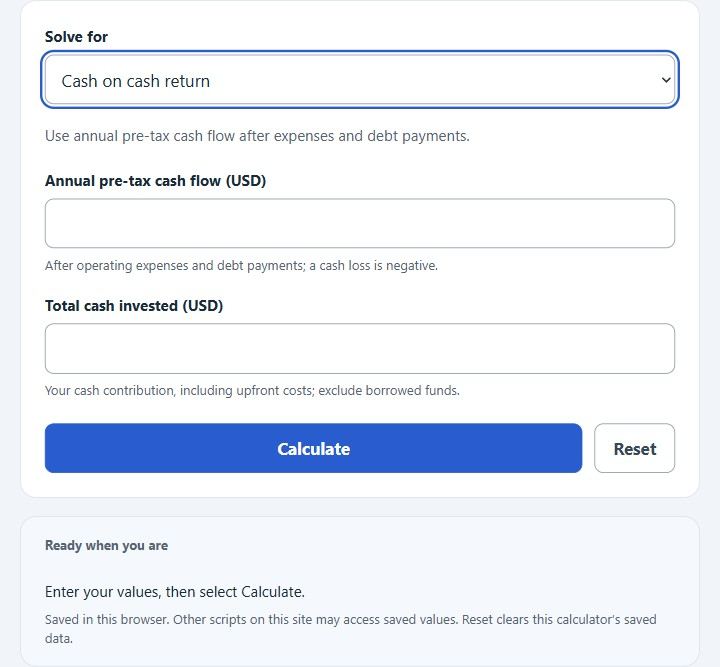
Choose cash on cash return, annual pre-tax cash flow, or total cash invested, then enter the other two values.
- All Business Calculators
- Cash Coverage Ratio Calculator
- Internal Rate of Return Calculator
- Cash Conversion Cycle Calculator
- Cash Back Calculator
Cash on Cash Return Formula
The cash on cash return calculator uses the relationship between annual pre-tax cash flow, total cash invested, and the return percentage. Select the value to solve for and enter the other two. Cash invested must be positive.
- CoC = cash on cash return, as a percentage
- ACF = annual pre-tax cash flow after operating expenses and debt payments, in USD
- TI = total cash personally invested, excluding borrowed funds, in USD
To calculate annual cash flow, the formula is rearranged as:
To calculate total investment, the formula is rearranged as:
The selected mode computes the return, annual pre-tax cash flow, or cash invested using the formulas above. If return and cash flow are both zero, cash invested cannot be uniquely inferred; opposite signs cannot imply a positive investment.
Cash on Cash Return Scale
Cash on cash return is often used for rental properties and other cash-flowing investments. The ranges below illustrate the arithmetic scale only; they are not market benchmarks, investment targets, or risk ratings.
| Cash on Cash Return | Annual cash flow per $1,000 cash invested |
|---|---|
| Below 4% | Below $40 (negative returns represent a cash loss) |
| 4% to below 8% | $40 to below $80 |
| 8% to 12% | $80 to $120 |
| Above 12% | Above $120; the percentage alone does not measure risk |
Example Calculations
Example 1: Calculate cash on cash return
You invest $80,000 and receive $7,200 in annual pre-tax cash flow.
The cash on cash return is 9%.
Example 2: Calculate annual cash flow
You want a 10% cash on cash return on a $65,000 total investment.
You need $6,500 in annual pre-tax cash flow to earn a 10% cash on cash return.
FAQ
What counts as annual cash flow?
Annual pre-tax cash flow is the money left over during one year after operating expenses and debt payments, before income tax. For a rental property, this usually means rental income minus expenses such as mortgage payments, property taxes, insurance, maintenance, management fees, and vacancy allowance.
What counts as total investment?
Total investment is the amount of cash you personally put into the investment. For real estate, this can include the down payment, closing costs, initial repairs, inspection fees, and other upfront cash costs. It usually does not include the full property purchase price if you used financing.
Is cash on cash return the same as ROI?
No. Cash on cash return focuses on annual cash flow compared with the cash you invested. ROI can include a broader set of gains, such as appreciation, loan paydown, tax effects, and sale proceeds. Cash on cash return is best for measuring yearly cash yield, not total long-term profit.