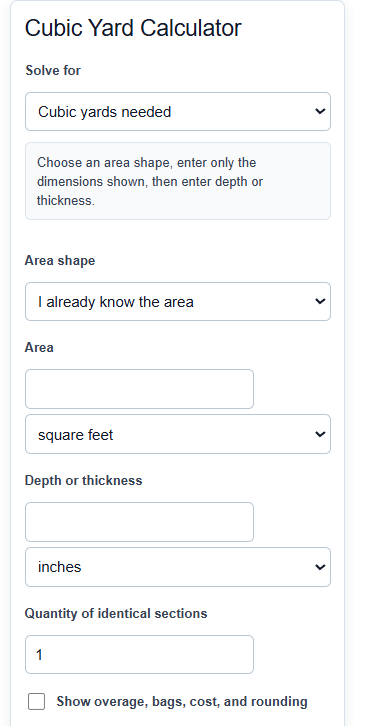
Calculate cubic yards from the length, width, and depth of the area you are filling.
- All Construction Calculators
- Yard Calculator | Cubic Yards for Soil, Mulch, Gravel
- Rock Calculator | Tons, Cubic Yards & Coverage
Cubic Yard Formula
For a rectangle or slab, multiply the three dimensions in feet and divide by 27, since one cubic yard equals 27 cubic feet (3 ft by 3 ft by 3 ft):
CY = (L * W * D) / 27
If you measure depth in inches instead of feet, divide by 324 to convert and reduce in one step:
CY = (L * W * D_in) / 324
For a circular area, replace length and width with the area of the circle, then divide by 27:
CY = (pi * r^2 * D) / 27
When you already know the area, the volume comes straight from area times depth:
CY = (A * D) / 27
- CY = volume in cubic yards
- L = length in feet
- W = width in feet
- D = depth in feet
- D_in = depth in inches
- A = surface area in square feet
- r = radius in feet (half the diameter)
- pi = 3.14159
The calculator runs these formulas in either direction. In the standard mode it takes your measurements and returns the cubic yards needed. The depth mode rearranges the slab formula to D = (CY * 27) / A so you can see how deep a known amount of material will spread over a set area. The area mode solves A = (CY * 27) / D to show how much ground a delivered load will cover at a chosen depth. The cost mode multiplies the cubic yards by your price per unit, Cost = CY * price, and can also divide the volume into bags when you enter a bag size. Shape options for circle, triangle, trapezoid, and ring swap in the matching area formula before the divide by 27 step, so every shape ends in the same cubic yard result.
Material Depths and Weights
Depth choice drives the volume more than any other input, so it helps to start from a common depth for your material and adjust from there. The table below lists typical depths and approximate weights, which matter if a supplier sells or limits delivery by the ton.
| Material | Typical Depth | Approx. Weight per Cubic Yard |
|---|---|---|
| Mulch | 2 to 3 in | 400 to 800 lb |
| Topsoil | 4 to 6 in | 2,000 to 2,700 lb |
| Gravel | 2 to 4 in | 2,400 to 2,900 lb |
| Sand | 1 to 2 in | 2,600 to 3,000 lb |
| Concrete | 4 to 6 in | 3,700 to 4,000 lb |
The next table converts a few common inch depths into the fraction of a foot the formula uses, so you can sanity check the depth field.
| Depth in Inches | Depth in Feet |
|---|---|
| 1 in | 0.083 ft |
| 2 in | 0.167 ft |
| 3 in | 0.250 ft |
| 4 in | 0.333 ft |
| 6 in | 0.500 ft |
Examples
Example 1: You are spreading topsoil over a rectangular bed that is 20 feet long and 10 feet wide at a depth of 6 inches. First convert the depth: 6 inches is 0.5 feet. The volume is (20 * 10 * 0.5) / 27 = 100 / 27 = 3.70 cubic yards. Order 4 cubic yards to allow for settling and spillage.
Example 2: A round patio base is 12 feet across, so the radius is 6 feet, and you want a 4 inch gravel layer, which is 0.333 feet. The circle area is 3.14159 * 6^2 = 113.1 square feet. The volume is (113.1 * 0.333) / 27 = 37.66 / 27 = 1.39 cubic yards. At 40 dollars per cubic yard the cost is 1.39 * 40 = about 56 dollars.
FAQ
Why divide by 27? A cubic yard is a cube measuring one yard, or 3 feet, on every side. Multiplying 3 by 3 by 3 gives 27 cubic feet in a single cubic yard. When your measurements are in feet, the length times width times depth gives cubic feet, so dividing by 27 converts that total into cubic yards.
How do I handle a depth measured in inches? Convert the depth to feet by dividing the inches by 12 before you apply the formula, or use the combined divisor of 324, which is 12 times 27. Both give the same result. The calculator does this for you when you set the depth unit to inches.
How much extra should I order? Loose materials settle and some is lost during spreading, so adding about 5 to 10 percent to the calculated amount is common. Rounding up to the next whole or half cubic yard is usually enough for a small project, since most suppliers sell in those increments.