Calculate cubic yards of soil, mulch, gravel, sand, or concrete from your area and depth, with material cost and weight estimates.
- All Construction Calculators
- Soil Volume Calculator
- Fill Dirt Calculator
- Paver Base Calculator
- Paver Calculator – How Many Pavers Do I Need?
- Gravel Calculator
- Cubic Yard Calculator
- Cubic Inch Calculator (L x W x H + Converter)
Yard Calculator Formula
The calculator works in three modes. Each mode uses one of the formulas below.
To find the cubic yards of material needed for an area and depth:
CY = (A * D) / 27 * (1 + W / 100)
To find how much area a known amount of material will cover:
A = (CY * 27) / D
To convert any volume to cubic yards:
CY = V_cuft / 27
- CY: volume in cubic yards
- A: project area in square feet
- D: material depth in feet
- W: waste or settling allowance as a percent
- V_cuft: a volume that has already been converted to cubic feet
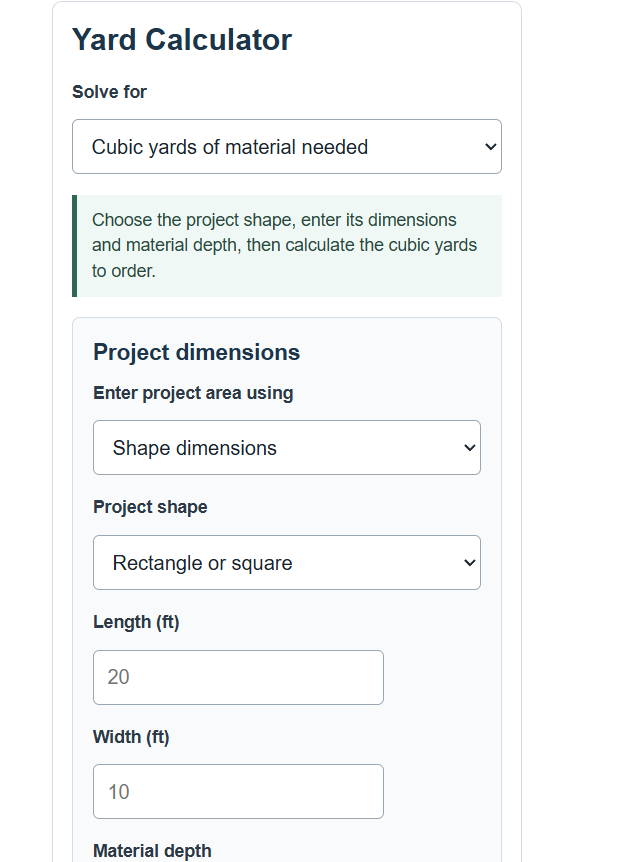
One cubic yard is 3 ft by 3 ft by 3 ft, which equals 27 cubic feet, so every formula divides cubic feet by 27 to reach cubic yards. In the first mode you enter the shape and size of your project, set the depth, and the calculator multiplies area by depth and divides by 27. The waste allowance adds a percent on top for spillage, compaction, or uneven ground. The coverage mode reverses the math so you can see how far a delivered amount will spread at a chosen depth. The conversion mode takes a volume in other units, converts it to cubic feet, and then to cubic yards. Optional inputs let you add a price per cubic yard for a cost estimate and a material density to estimate weight in tons.
Recommended Depths and Material Weights
Use the depth table to pick a working depth before you calculate, and the weight table to check delivery weight and ordering limits.
| Material | Typical Depth | Common Use |
|---|---|---|
| Bark or wood mulch | 3 to 4 in | Beds, around trees |
| Topsoil | 2 to 6 in | New lawns, raised beds |
| Gravel | 2 to 3 in | Paths, driveways |
| Sand | 1 to 2 in | Paver base, leveling |
| Material | Approx. Weight per Cubic Yard | Approx. Tons per Cubic Yard |
|---|---|---|
| Bark mulch | 800 lb | 0.4 |
| Topsoil | 2,100 lb | 1.05 |
| Sand | 2,400 lb | 1.2 |
| Gravel | 2,800 lb | 1.4 |
| Concrete | 4,050 lb | 2.03 |
Example Problems
Example 1. You are mulching a rectangular bed that is 20 ft long and 10 ft wide at a 3 in depth. The area is 20 times 10, which is 200 sq ft. A 3 in depth is 0.25 ft. Multiply 200 by 0.25 to get 50 cubic feet, then divide by 27 to get about 1.85 cubic yards. With no waste allowance you would order 2 cubic yards.
Example 2. You have 4 cubic yards of gravel and want to know the coverage at a 2 in depth. A 2 in depth is 0.1667 ft. Multiply 4 by 27 to get 108 cubic feet, then divide by 0.1667 to get about 648 sq ft of coverage.
Frequently Asked Questions
How many cubic feet are in a cubic yard? There are 27 cubic feet in one cubic yard, because a cubic yard is 3 ft on each side and 3 times 3 times 3 equals 27.
Why should I add a waste allowance? Bulk materials settle, compact, and spill during spreading, and the ground is rarely perfectly flat. Adding 5 to 10 percent gives you enough to finish the job without a second delivery. Mulch and soil that will compact often use the higher end of that range.
How do I turn cubic yards into tons? Multiply the cubic yards by the material weight per cubic yard, then divide by 2,000. For example, 3 cubic yards of gravel at 2,800 lb per yard is 8,400 lb, which is 4.2 tons.