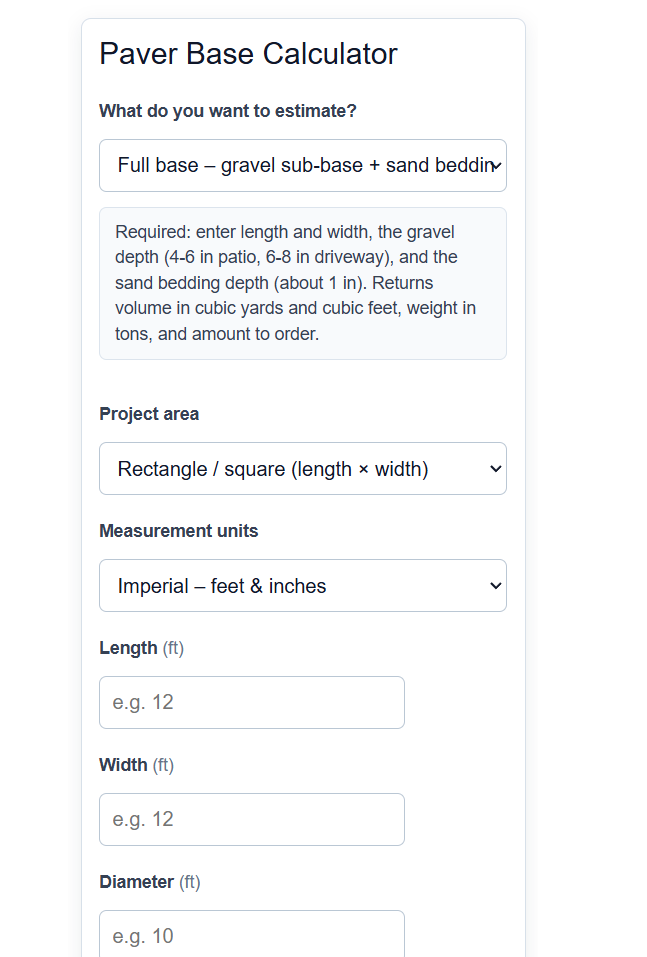
Calculate how much gravel sub-base and sand bedding you need for a paver patio, walkway, or driveway, including tons, cubic yards, bags, and total material cost.
Paver Base Formula
A paver base has two layers: a compacted gravel sub-base and a thin sand bedding. The calculator works out the volume of each layer, then converts that volume into weight and cost.
Gravel volume (yd3) = Area (ft2) * Gravel depth (in) / 324 * Compaction * (1 + Waste/100)
Sand volume (yd3) = Area (ft2) * Sand depth (in) / 324 * (1 + Waste/100)
Weight (tons) = Volume (yd3) * Density (tons/yd3)
- Area is the surface of your project. For a rectangle it is length times width; for a circle it is pi times the radius squared. You can also enter a known area directly.
- Gravel depth is the finished thickness of the crushed stone sub-base, usually 4 to 6 inches for a patio or walkway and 6 to 8 inches for a driveway.
- Sand depth is the bedding layer the pavers sit on, normally about 1 inch.
- Compaction is the factor that accounts for gravel shrinking as it is tamped down. A factor of 1.2 means you order 20 percent extra so the layer reaches full depth after compacting.
- Waste is the overage percentage added for spillage, uneven sub-grade, and trimming. 10 percent is a common default.
- Density converts cubic yards into tons. Crushed gravel runs about 1.4 tons per cubic yard and paver sand about 1.35 tons per cubic yard.
Dividing by 324 is the shortcut for area in square feet times depth in inches: it converts inches to feet (divide by 12) and cubic feet to cubic yards (divide by 27) in a single step. Choosing “gravel sub-base only” or “sand bedding only” runs just that layer, while “full base” returns both plus a combined total. If you enter a bag size or a price per ton, the calculator also reports the number of bags and the material cost.
Recommended Base Depths and Material Weights
Use these typical values when you are unsure what to enter. Depths are the compacted finished thickness.
| Project | Gravel base | Sand bedding |
|---|---|---|
| Walkway / light patio | 4 in | 1 in |
| Standard patio | 4 to 6 in | 1 in |
| Driveway / heavy load | 6 to 8 in | 1 in |
| Material | Typical density | Coverage per ton (at 1 in) |
|---|---|---|
| Crushed gravel base | ~1.4 tons/yd3 | ~240 sq ft |
| Paver / bedding sand | ~1.35 tons/yd3 | ~250 sq ft |
Example Problems
Example 1: Rectangular patio, full base. You are building a 12 ft by 16 ft patio with a 6 inch gravel base, 1 inch sand bedding, a 1.2 compaction factor, and 10 percent waste. The area is 192 sq ft. Gravel: 192 times 6 divided by 324 equals 3.56 yd3, times 1.2 equals 4.27 yd3, times 1.10 equals about 4.69 yd3 (around 6.6 tons). Sand: 192 times 1 divided by 324 equals 0.59 yd3, times 1.10 equals about 0.65 yd3 (around 0.9 tons).
Example 2: Circular fire-pit pad, gravel only. A round pad 10 ft across needs a 4 inch gravel base with the same 1.2 compaction and 10 percent waste. The area is pi times 5 squared, about 78.5 sq ft. Gravel: 78.5 times 4 divided by 324 equals 0.97 yd3, times 1.2 equals 1.16 yd3, times 1.10 equals about 1.28 yd3 (around 1.8 tons).
Frequently Asked Questions
How deep should a paver base be? For most patios and walkways, plan on 4 to 6 inches of compacted gravel topped with about 1 inch of sand. Driveways and other areas that carry vehicle weight need 6 to 8 inches of gravel. The sand layer stays around 1 inch no matter the use, because its only job is to seat the pavers.
Why does the calculator add a compaction factor? Loose gravel loses volume as it is tamped down, so a layer dumped at 5 inches might settle to 4 inches. A compaction factor of 1.2 orders 20 percent extra material so the finished, compacted layer still reaches your target depth. Sand bedding is not compacted the same way, so the factor is applied only to the gravel.
Should I order by tons or by cubic yards? Bulk suppliers usually sell gravel and sand by the ton, so the weight figure is what you give them when ordering loose material. Cubic yards are useful for checking how much space the material will take in a truck or bin. If you are buying bagged material instead, enter the bag size and the calculator converts the volume into the number of bags.