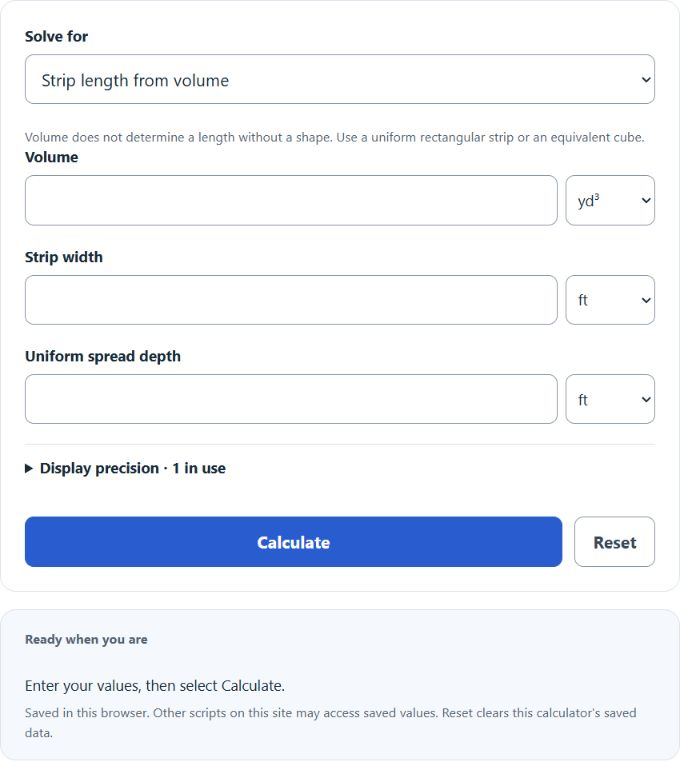
Calculate linear yards from cubic yards using a strip width and depth, or find the side of a cube from its volume, or calculate cube volume from its side length.
- All Unit Converters
- Cubic Feet To Cubic Inches Converter Calculator
- Cubic Feet To Cubic Yards Converter Calculator
- Cubic Feet To Feet Converter Calculator
- Cubic Feet To Gallons Converter Calculator
- Cubic Inches To Inches Converter Calculator
- Cubic Inches To Liters Converter Calculator
- Cubic Inches To Square Inches Converter Calculator
- Cubic Yards To Square Feet Converter Calculator
- Cubic Yards To Square Yards Converter Calculator
- Cubic Yards To Tons Converter Calculator
Cubic Yards to Yards Formula
Cubic yards measure volume and plain yards measure length, so the two are not the same unit. The calculator handles the conversion in the three ways people actually mean it: spreading a volume of material into a strip, finding the side of a cube, or going the other way from a cube side back to volume.
LY = 9 * CY / (W * D)
S = cube_root(CY)
CY = S^3
- LY = length of the strip in linear yards
- CY = volume in cubic yards (yd^3)
- W = strip width in feet
- D = spread depth in feet
- S = side length of a cube in yards
The first formula is the practical one for landscaping and bulk material. One cubic yard equals 27 cubic feet, so a volume of CY cubic yards is 27 times CY in cubic feet. Dividing that by the cross section of the strip (width times depth in feet) gives the run in feet, and dividing by 3 turns feet into yards. Combined, those steps reduce to LY = 9 * CY / (W * D).
The second and third formulas treat the conversion as a cube. If you want the edge length of a cube that holds a given volume, take the cube root of the cubic yards. To reverse it, cube the side length to get the volume back. The solve-for selector picks which of these the calculator returns, and it hides the inputs you do not need for that mode.
Strip Length per Cubic Yard at Common Depths
The first table shows how far one cubic yard stretches as a 1-foot wide strip at typical depths. The second shows the cube side and cube root relationship for round volumes.
| Depth (1 ft wide strip) | Linear yards per 1 cubic yard |
|---|---|
| 2 inches (0.167 ft) | 54 yd |
| 3 inches (0.25 ft) | 36 yd |
| 6 inches (0.5 ft) | 18 yd |
| 12 inches (1 ft) | 9 yd |
| Cubic yards | Cube side (yards) |
|---|---|
| 1 | 1.00 |
| 8 | 2.00 |
| 10 | 2.15 |
| 27 | 3.00 |
Example Problems
Example 1. You have 5 cubic yards of mulch and want to lay it in a bed 3 feet wide at a depth of 6 inches (0.5 ft). Using LY = 9 * CY / (W * D), you get 9 * 5 / (3 * 0.5) = 45 / 1.5 = 30 linear yards, which is 90 feet of bed.
Example 2. You ordered 8 cubic yards of fill and want to know the side of a cube that would hold it. Using S = cube_root(CY), the cube root of 8 is 2, so the material would fill a cube 2 yards on each side, or 6 feet on each edge.
Frequently Asked Questions
Can you convert cubic yards directly to yards? Not without more information. A cubic yard is a volume and a yard is a length, so you need either a cross section (width and depth) to get linear yards, or you treat the volume as a cube and take the cube root to get the side length. The calculator covers both.
Why do contractors say “a yard” when they mean a cubic yard? In the trade, “a yard” of concrete, gravel, mulch, or topsoil is shorthand for one cubic yard. It is slang, not a unit conversion. Confirm with the supplier whether a quoted yard means a cubic yard of volume.
How do I turn the depth from inches into the formula? The linear yards formula uses depth in feet, so divide inches by 12 first. For example, 4 inches is exactly one-third of a foot. Select inches and enter 4, or enter the equivalent depth with feet selected, to avoid premature rounding.