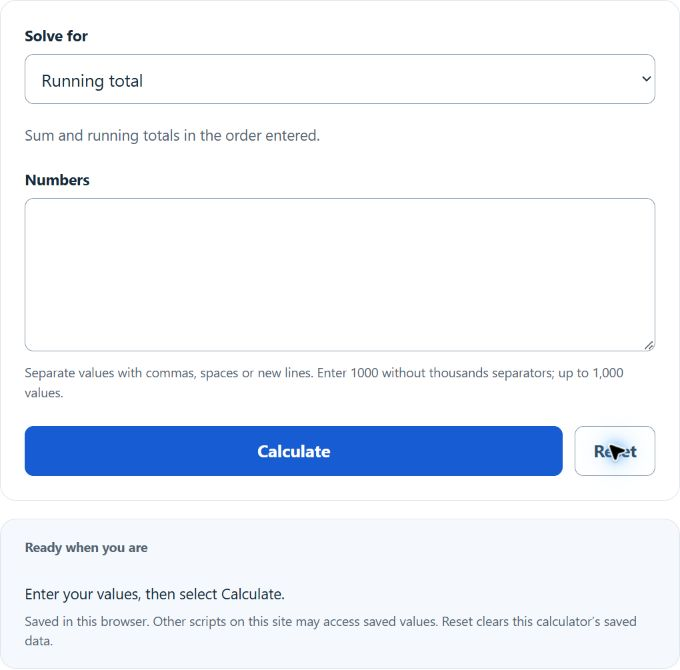
Calculate running totals, averages and cumulative percentages from a list of numbers. Percentage mode supports input order, largest-first or smallest-first sorting. Commas separate values; enter 1000 without thousands separators.
Related Calculators
- Interest Revenue Calculator
- Quarterly Interest Calculator
- Return on Yield Calculator
- Return on ETF Calculator
- All Personal Finance Calculators
Cumulative Value Formula
The following equation is used to calculate the Cumulative Value.
- Where CV is the cumulative value
- Xᵢ represents each individual value
To calculate the cumulative value, sum up all individual contributions one by one.
What is a Cumulative Value?
Definition:
A cumulative value is the total amount generated when adding together multiple individual values over a specific period or event sequence. This calculation is commonly used in finance, analytics, and various practical scenarios where a running total is required.
How to Calculate Cumulative Value?
Example Problem:
The following example outlines the steps and information needed to calculate the Cumulative Value.
First, determine each individual contribution. In this example, the values are 50, 100, and 150.
Next, simply add up each contribution step by step.
Finally, calculate the cumulative value using the formula above:
CV = 50 + 100 + 150
CV = 300
FAQ
What types of values can be used in a cumulative value calculation?
Any numeric inputs can be used to calculate a cumulative value. This could include financial amounts, daily steps walked, production units tallied over time, or any other measured quantity.
How often should I update my cumulative value?
The frequency of updates depends on your specific goals and data tracking needs. Some people prefer daily updates for tasks like budgeting or productivity tracking, whereas others might calculate cumulative totals weekly or monthly.
Can negative numbers be included in a cumulative value calculation?
Yes, negative numbers can represent losses, refunds or deductions, and the total reflects their net effect. In cumulative percentage mode, signed shares may be negative or exceed 100%; a zero net total is undefined, and the 80% Pareto point is reported only for nonnegative values.