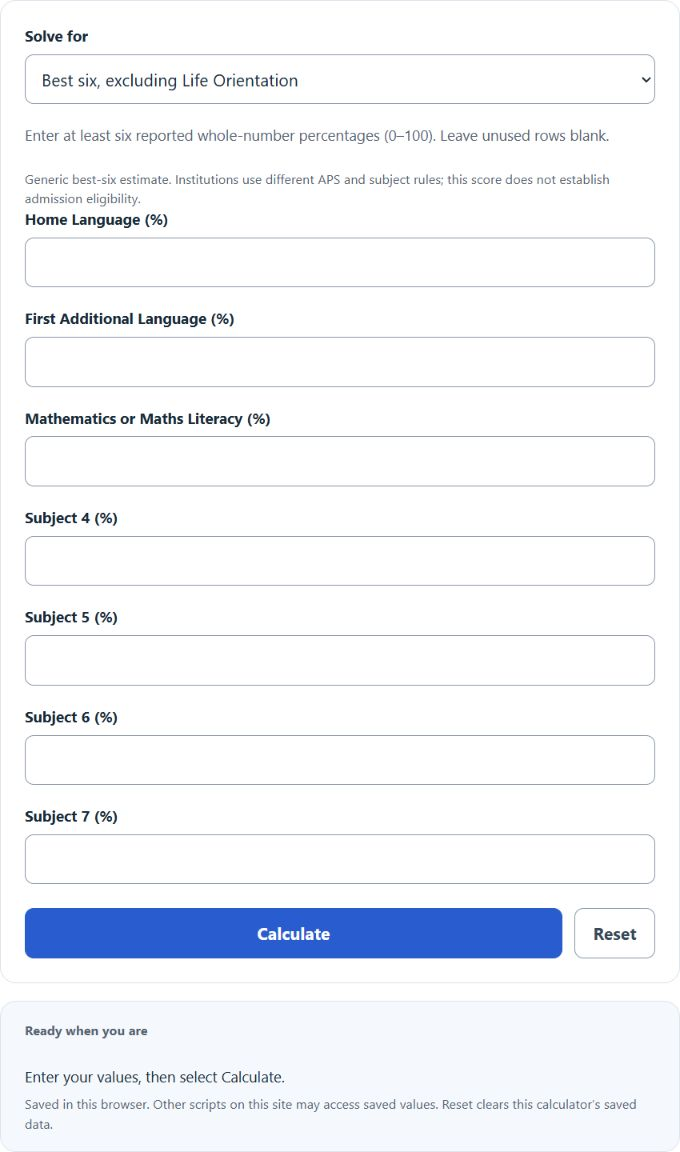
Estimate a generic best-six Admission Point Score (APS) from at least six matric subject percentages. Confirm the institution’s scoring method and programme requirements.
Related Calculators
- Sturges’ Rule Calculator
- Area to Z Score Calculator
- Frequency Percentage Calculator
- 40Th Percentile Calculator
- All Statistics Calculators
APS Formula
APS = L1 + L2 + L3 + L4 + L5 + L6
Where:
- APS is your total Admission Point Score (maximum of 42).
- L1 to L6 are the achievement levels (1 to 7) of your best six subjects.
Each subject level is found by converting your final National Senior Certificate percentage for that subject into the 7-level scale. You convert all of your subjects to levels, then add the six highest. This calculator’s default model excludes Life Orientation; its other mode counts Life Orientation at full weight among the best six. Institutions may use different totals, weights or required subjects, so confirm their current method.
Percentage to Level Conversion and Score Interpretation
Use the first table to convert each subject percentage into an achievement level. The second table shows score bands for this model; none establishes admission eligibility.
| Percentage | Achievement Level | Points |
|---|---|---|
| 80 to 100 | Level 7 | 7 |
| 70 to 79 | Level 6 | 6 |
| 60 to 69 | Level 5 | 5 |
| 50 to 59 | Level 4 | 4 |
| 40 to 49 | Level 3 | 3 |
| 30 to 39 | Level 2 | 2 |
| 0 to 29 | Level 1 | 1 |
| APS Range | Typical Interpretation |
|---|---|
| 35 to 42 | High score in this model; programme cut-offs and subject requirements still apply. |
| 30 to 34 | Compare with the specific programme’s current requirements. |
| 24 to 29 | May be below or above a particular programme’s minimum; confirm its rules. |
| Below 24 | Lower score in this model; check programme-specific requirements and alternatives. |
Example Problems
Example 1. A student scores Home Language 76, First Additional Language 64, Mathematics 71, Physical Science 58, Life Sciences 62, and Geography 55. The levels are 6, 5, 6, 4, 5, and 4. Adding these six levels gives an APS of 30.
Example 2. A student scores Home Language 82, First Additional Language 70, Mathematical Literacy 49, Business Studies 66, Accounting 73, History 60, and Tourism 54. Converting to levels gives 7, 6, 3, 5, 6, 5, and 4. The best six levels are 7, 6, 6, 5, 5, and 4, for an APS of 33. The lowest level, 3 for Mathematical Literacy, is dropped because only the best six count.
FAQ
Does Life Orientation count toward your APS? This calculator can exclude Life Orientation or count it at full weight. Institutions may exclude it, weight it differently or use another scoring method; confirm the current policy.
What is the maximum APS you can get? The maximum is 42, which is six subjects each at Level 7 (80 percent or above).
Is a higher APS always enough to be admitted? No. A high APS helps, but many programmes also require specific subjects at minimum levels, such as a set Mathematics or language level. Meeting the overall APS does not guarantee a place if the subject requirements are not met.