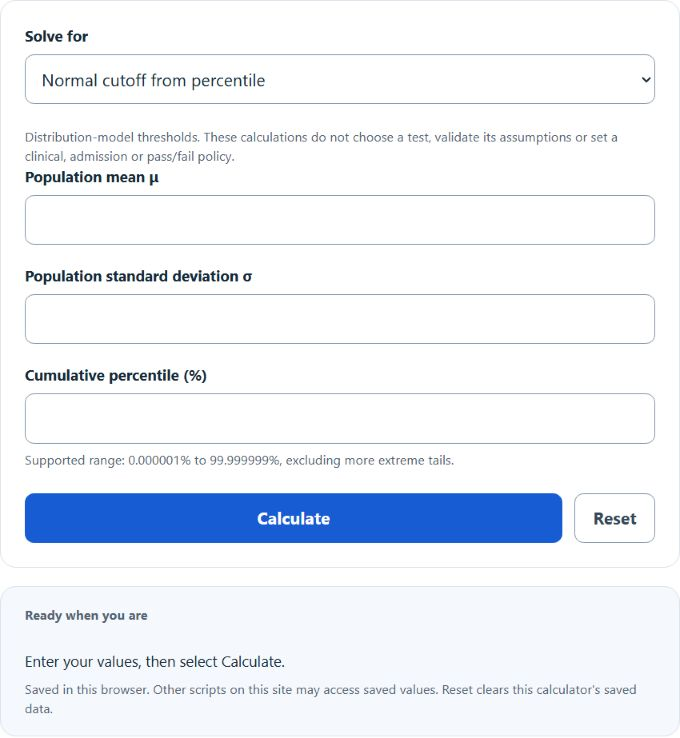
Calculate normal percentile cutoffs or z, t, chi-square, and F critical values with tail-aware rejection regions and step-by-step probability details.
Related Calculators
- Z-Score Calculator
- 40th Percentile Calculator
- Normalized Marks Calculator
- Outlier Calculator
- All Statistics Calculators
Cutoff Value Formula
In statistics, a percentile cutoff is a quantile of the underlying distribution. Normal cutoff and reverse-percentile modes use the normal model. Critical-value modes use standard normal z, Student t, chi-square or F distributions with the selected rejection tails.
Variables:
- CV is the cutoff value (threshold) in the same units as the scores/values
- p is a percentile written as a decimal between 0 and 1 (normal cutoff)
- μ is the population mean (normal cutoff)
- σ is the population standard deviation (normal cutoff)
- zp is the z-score at percentile p, i.e., zp = Φ−1(p) (normal cutoff)
- Q is the quantile function of the selected reference distribution; α is the total rejection probability.
- Student t and chi-square need degrees of freedom; F needs numerator and denominator degrees of freedom.
To calculate a normal cutoff, convert percentile p to zp and compute CV = μ + zpσ. For a reverse percentile, compute z = (CV − μ) / σ and Φ(z). Critical values use the selected distribution’s quantiles and equal probability in each tail for a two-tail region. See the NIST distribution references.
What is a Cutoff Value?
A cutoff value is a predetermined threshold used to divide results into categories (for example, “pass” vs “fail,” or “normal” vs “abnormal”). In many statistical settings, a cutoff tied to a percentile is a quantile of a dataset or an assumed distribution (such as the normal distribution). In applied settings (such as medical tests), the cutoff may also be chosen to balance criteria like sensitivity and specificity, not just a percentile.
How to Calculate Cutoff Value?
The following steps outline common ways to calculate a cutoff value.
- Decide whether you need a normal percentile cutoff, a percentile from a normal score, or a hypothesis-test critical value.
- If using a normal percentile cutoff, determine the mean (μ) and standard deviation (σ).
- In normal-cutoff mode enter the percentile as a percentage (for example, 75 for the 75th percentile). The formula uses p = 0.75.
- Compute zp = Φ−1(p), then compute the cutoff CV = μ + zpσ.
- For a critical value, choose z, t, chi-square or F and a tail type. Enter α as a probability, for example 0.05 for 5%, and any required degrees of freedom. The calculator supports α from 10⁻⁸ to 0.99999999 and df from 0.1 to 10,000.
- Verify your result with the calculator above.
Example Problem :
This example uses Normal cutoff from percentile:
mean (μ) = 85
cumulative percentile = 95% (p = 0.95)
standard deviation (σ) = 4
normal cutoff (CV) ≈ 85 + 1.644853627 × 4 ≈ 91.579415