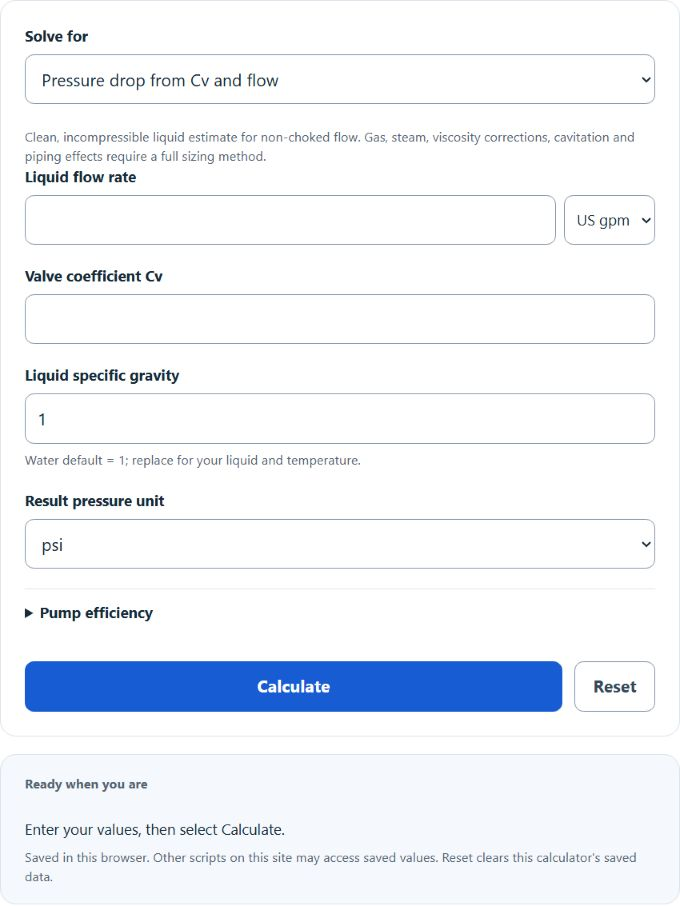
Calculate liquid valve pressure drop from Cv, flow, and specific gravity, or solve Cv and flow with metric units, head loss, and pump-loss power.
Related Calculators
- Water Tower Pressure Calculator
- GPM Per Ton Calculator
- Air Compressor Fill Time Calculator
- Air Usage Calculator
- All Construction Calculators
Cv To Pressure Drop Formula
The following formula is used to calculate the pressure drop for a given flow rate, Cv, and specific gravity (for incompressible liquids, with Q in US GPM and ΔP in psi).
Variables:
- ΔP is the pressure drop
- Q is the flow rate
- Cv is the flow coefficient
- SG is the specific gravity
To calculate the pressure drop, divide the flow rate by Cv, square the result, and then multiply by the specific gravity.
| Cv (unitless) | Pressure Drop (psi) |
|---|---|
| 1 | 100.000 |
| 1.5 | 44.444 |
| 2 | 25.000 |
| 2.5 | 16.000 |
| 3 | 11.111 |
| 4 | 6.250 |
| 5 | 4.000 |
| 7.5 | 1.778 |
| 10 | 1.000 |
| 12 | 0.694 |
| 15 | 0.444 |
| 20 | 0.250 |
| 25 | 0.160 |
| 30 | 0.111 |
| 40 | 0.063 |
| 50 | 0.040 |
| 60 | 0.028 |
| 75 | 0.018 |
| 100 | 0.010 |
| 150 | 0.004 |
| *Assumes flow rate Q = 10 GPM and water (SG = 1.00). Formula: ΔP (psi) = (Q / Cv)² × SG. | |
What is Cv?
Cv, or flow coefficient, is a measure of the capacity of a valve to pass fluid. It is defined as the flow rate of water in gallons per minute (GPM) at 60°F that will pass through a valve with a pressure drop of 1 psi. The higher the Cv, the greater the flow rate through the valve for a given pressure drop.
How to Calculate Pressure Drop?
The following steps outline how to calculate the pressure drop.
- First, determine the flow rate (Q).
- Next, determine the flow coefficient (Cv).
- Next, determine the specific gravity (SG).
- Finally, calculate the pressure drop using the formula ΔP = (Q / Cv)² × SG.
- After inserting the values and calculating the result, check your answer with the calculator above.
Example Problem :
Use the following variables as an example problem to test your knowledge.
Flow rate (Q) = 10 GPM
Flow coefficient (Cv) = 5
Specific gravity (SG) = 1. Thus ΔP = (10/5)² × 1 = 4 psi.