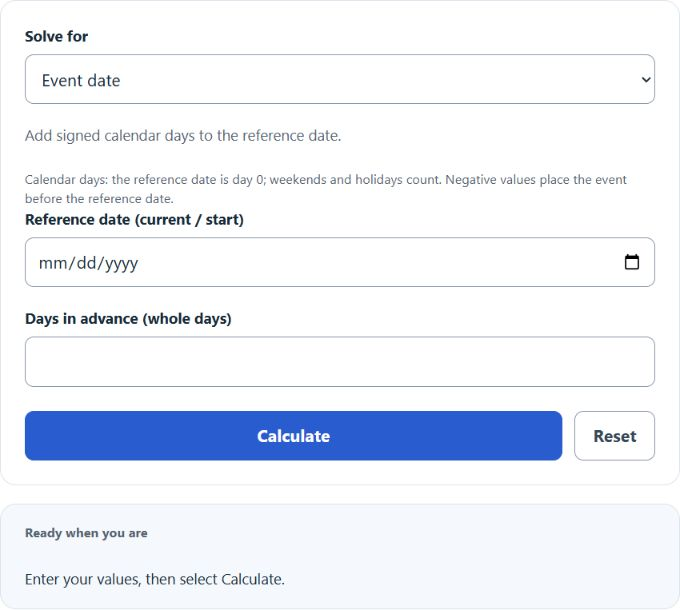
Calculate days in advance, event date, or current date from any two inputs and find the missing value between dates in days quickly.
Related Calculators
- Date Calculator
- 45 Minutes From Now Calculator
- Exam Date Calculator
- Days Of School Left Calculator
- All Everyday Life and Education Calculators
Days In Advance Formula
Days in advance is the signed whole-calendar-day difference between a reference date and an event date. Positive values place the event after the reference date; negative values place it before. Select the value to solve and enter the other two. Fractional days are not supported by this date-only model.
- DIA = days in advance
- ED = event date
- CD = current date, start date, or reference date
If you enter the event date and current date, the calculator subtracts the current date from the event date to find the days in advance.
If you enter the current date and days in advance, the calculator adds the number of days to the current date to find the event date.
If you enter the event date and days in advance, the calculator subtracts the number of days from the event date to find the current date.
Common Days in Advance Reference
Use this table to quickly compare common advance time periods.
| Days in Advance | Approximate Time | Common Use |
|---|---|---|
| 1 day | Tomorrow | Next-day reminders or deadlines |
| 7 days | 1 week | Weekly planning |
| 14 days | 2 weeks | Notice periods or preparation windows |
| 30 days | About 1 month | Monthly deadlines, reservations, notices |
| 60 days | About 2 months | Longer planning periods |
| 90 days | About 3 months | Quarterly planning or advance scheduling |
Example Calculations
Example 1: Find days in advance
You have an event on 2026-04-20, and the current date is 2026-04-05.
The event is 15 days in advance.
Example 2: Find the event date
The current date is 2026-06-10, and the event is 45 days in advance.
The event date is 2026-07-25.
FAQ
Does the calculator count calendar days or business days?
It counts calendar days. Weekends and holidays are included in the total. For example, 7 days in advance means exactly 7 calendar days, not 7 business days.
Is the current date included in the count?
The result is based on the difference between the two dates. If the current date is 2026-01-01 and the event date is 2026-01-02, the result is 1 day in advance. The start date itself is not counted as a full day.
What does a negative days in advance result mean?
A negative result means the event date is before the current date. For example, if the event date was yesterday, the calculator returns -1. This indicates the event has already passed relative to the current date you entered.