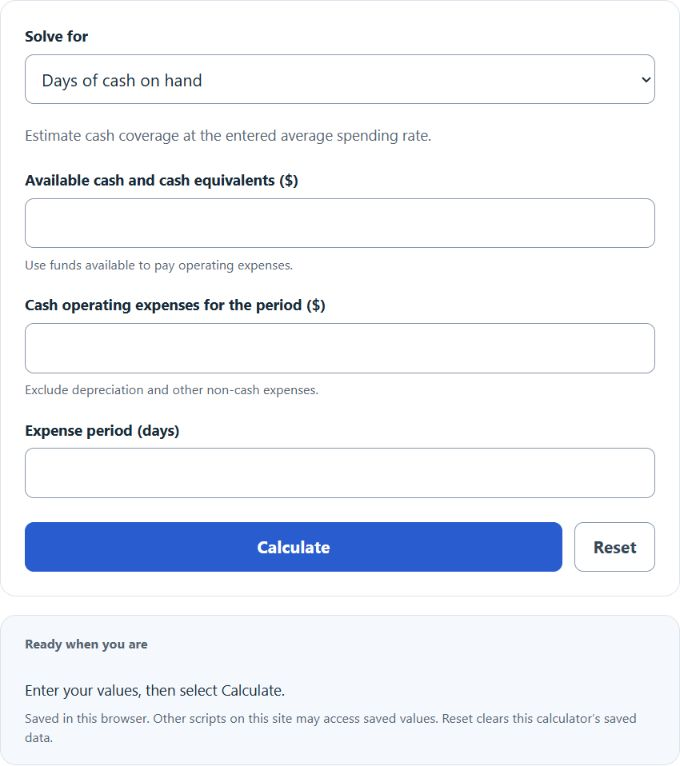
Calculate days of cash on hand, cash and cash equivalents, operating expenses, or period length by selecting the value to solve for and entering the three required values.
Related Calculators
- Operating Ratio Calculator
- Net Profit Margin Calculator
- Percent of Sales Calculator
- Optimal Stock Level Calculator
- All Business Calculators
Days Of Cash On Hand Formula
Days of cash on hand estimates how many days an organization can pay its operating expenses using its available cash and cash equivalents.
To solve for the other fields, the calculator uses these related formulas:
- DCOH = days of cash on hand
- C = cash and cash equivalents
- OE = cash operating expenses for the period, excluding non-cash expenses
- N = number of days in the period
Select the value to solve for, then enter the other three values. Use cash available for operations and cash operating expenses for the matching period. Zero cash gives zero coverage; solving expenses or period length requires positive cash and coverage for a unique positive result.
Common Period Lengths and Operating Expense Inputs
Use a period length that matches the operating expense figure you enter. For example, annual operating expenses should normally be paired with 365 days.
| Expense Period | Typical Number of Days | Use When |
|---|---|---|
| Monthly | 28 to 31 | You are using one month of operating expenses. |
| Quarterly | 90 to 92 | You are using three months of operating expenses. |
| Annual | 365 or 366 | You are using a full year of operating expenses. |
Interpreting Days Of Cash On Hand
The following bands are illustrative, not universal reserve standards. The estimate assumes no new cash inflows and constant average cash spending.
| Days of Cash on Hand | General Meaning |
|---|---|
| Less than 30 days | Low cash cushion. The organization may have limited time to respond to revenue delays or unexpected expenses. |
| 30 to 90 days | Moderate liquidity. This may be acceptable for stable operations, but depends on cash flow timing and risk. |
| More than 90 days | Stronger cash reserve. The organization has more time to cover operations without new cash inflows. |
Example
Example 1: Calculate days of cash on hand
You have $250,000 in cash and cash equivalents, $1,200,000 in annual operating expenses, and a 365-day period.
Example 2: Calculate cash and cash equivalents needed
You want 60 days of cash on hand, annual operating expenses are $900,000, and the period is 365 days.
FAQ
What should be included in cash and cash equivalents?
Cash and cash equivalents usually include cash in bank accounts, petty cash, money market funds, treasury bills, and other highly liquid short-term investments. Do not include inventory, accounts receivable, fixed assets, or restricted funds unless they are actually available for operating expenses.
Should operating expenses include depreciation?
For cash-focused analysis, many users exclude non-cash expenses such as depreciation and amortization. If you include depreciation in operating expenses, your days of cash on hand may look lower because the expense amount is higher even though depreciation does not require a cash payment.
Is a higher number of days of cash on hand always better?
Not always. A higher number usually means stronger liquidity, but too much idle cash may mean funds are not being used for operations, debt reduction, investment, or growth. The right level depends on the organization’s risk, revenue stability, debt obligations, and access to financing.