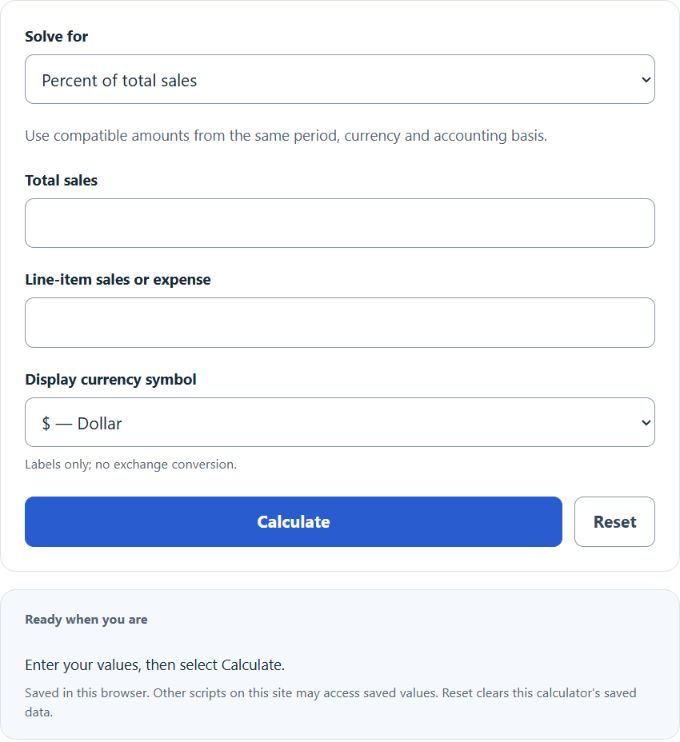
Calculate what percentage a line item is of total sales, find an amount from a sales percentage, or measure sales growth between periods.
- All Business Calculators
- All Sales Calculators
- Maximum Revenue Calculator
- Net Profit Margin Calculator
Percent of Sales Formula
The calculator runs three formulas, one for each mode.
Percent mode finds what share a line item is of total sales:
Amount mode finds the monetary value of a line item from a known percent:
Change mode finds the percent change between two periods:
- Line Item: the sales, expense, or account value you want to measure.
- Total Sales: gross or net revenue for the period.
- Percent: share of total sales, entered as a percentage.
- Previous Sales: revenue from the prior period.
- Current Sales: revenue from the period you are comparing.
The Percent tab divides one figure by total sales to give you a share. The Amount tab reverses that math when you already know the percent and need the dollar figure, useful for forecasting expenses tied to sales. The Change mode measures growth or decline between comparable periods, using positive previous sales as the base. A zero base makes ordinary percentage growth undefined, including zero-to-zero; use the absolute amount change instead. Current as a percent of previous is a separate ratio (120% of previous means 20% growth). Symbols are display labels only, with no exchange conversion. Main money values are rounded to two decimals; per-unit figures retain more precision.
Reference Tables
The first table defines income-statement ratios relative to net sales; it does not supply universal healthy-business benchmarks. Gross and net profit are not expense lines. These items overlap and should not be added together. Appropriate comparisons depend on industry, period and accounting definitions.
| Line Item | Calculation (%) |
|---|---|
| Cost of goods sold | 100 × cost of goods sold / net sales |
| Gross profit | 100 × gross profit / net sales |
| Payroll | 100 × payroll / net sales |
| Rent and utilities | 100 × rent and utilities / net sales |
| Marketing | 100 × marketing / net sales |
| Net profit | 100 × net profit / net sales |
The second table converts common percentages to a per-dollar and per-thousand basis, matching how the calculator reports results.
| Percent | Per $1 of Sales | Per $1,000 of Sales |
|---|---|---|
| 1% | $0.01 | $10 |
| 5% | $0.05 | $50 |
| 10% | $0.10 | $100 |
| 25% | $0.25 | $250 |
| 50% | $0.50 | $500 |
Example Problems
Example 1: Percent of sales. A store had $80,000 in total sales last month. Payroll was $12,500. Divide 12,500 by 80,000 to get 0.15625, then multiply by 100. Payroll was 15.63% of sales, or about $156 per $1,000 of revenue.
Example 2: Sales change. Quarterly sales rose from $65,000 to $80,000. Subtract to get a $15,000 increase. Divide by the previous figure of $65,000 and multiply by 100. The result is a 23.08% increase quarter over quarter.
FAQ
Should I use gross or net sales as the total? Use the sales basis required by the measure and keep it consistent across comparisons. Common-size income statements normally use net sales, which deducts applicable returns, discounts and allowances; a gross-sales measure requires gross sales. Match currency, time period, entity scope and included items.
Can the percent of sales be over 100%? Yes. It means the entered line item exceeds the sales denominator. Its significance depends on the item and accounting scope; it does not alone establish an overall loss or a data-entry error. Sales growth also does not establish profitability.
What is the percent of sales method in forecasting? It projects an amount by applying a supplied historical percentage to forecast sales. Amount mode performs this arithmetic, assuming the relationship remains suitable. Fixed costs, capacity, prices and business changes may require separate adjustments; the result is not a forecast guarantee.
Why does the result show a per-dollar figure? Per-dollar and per-thousand views make it easier to compare line items across businesses of different sizes and to spot small percentages that still represent real money at scale.