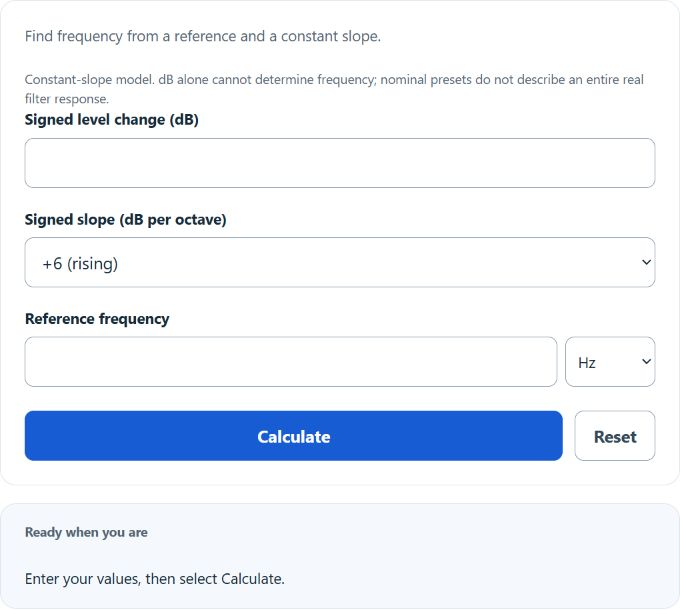
Estimate frequency from a signed dB change, a constant signed dB-per-octave slope and a reference frequency. Results are in Hz; dB alone cannot determine frequency.
- Milliwatt Calculator
- Farads To Ohms Calculator
- Ohms To Kilowatts Calculator
- Battery Capacity Calculator (Amp Hours)
- All Unit Converters
dB to Frequency Formula
The following formula relates level change to frequency in a constant-slope model. The signed slope is given in dB per octave; real filter response varies with frequency.
You can also find the number of octaves first using:
Variables:
- f is the target frequency in hertz
- f₀ is the reference frequency in hertz
- ΔdB is the change in level in decibels
- S is the slope in dB per octave
To calculate the frequency, divide the dB change by the slope to determine the number of octaves, then multiply the reference frequency by 2 raised to that value.
What is dB to Frequency Conversion?
dB to frequency conversion is a way of relating a level change in decibels to a frequency shift when a filter or response is described in dB per octave. Since one octave means doubling or halving the frequency, the slope tells you how many decibels correspond to one octave of movement. This is commonly used in audio engineering, crossovers, signal processing, and filter analysis.
How to Calculate dB to Frequency?
The following steps outline how to calculate frequency from a decibel change.
- First, determine the level change in decibels (ΔdB).
- Next, select the signed slope in dB per octave (S): positive for rising response, negative for falling response.
- Enter the known reference frequency (f₀), in Hz, kHz or MHz.
- Calculate the number of octaves using Octaves = ΔdB / S.
- Calculate the final frequency using f = f₀ × 2^(ΔdB / S).
- Check your answer with the calculator above.
Example Problem:
Use the following values as an example problem to test your knowledge.
Level Change (ΔdB) = 12
Slope (S) = 6 dB/octave
Reference Frequency (f₀) = 1000 Hz
Using the formula, Octaves = 12 / 6 = 2, so f = 1000 × 2² = 4000 Hz.
dB to Frequency Conversion Table
The following table shows example results for a +12 dB change from a 1 kHz reference using different slopes.
| Nominal rising slope profile | Slope (dB/octave) | Resulting Frequency |
|---|---|---|
| +6 dB/octave model | 6 | 4000 Hz |
| +12 dB/octave model | 12 | 2000 Hz |
| +18 dB/octave model | 18 | 1587.40 Hz |
| +24 dB/octave model | 24 | 1414.21 Hz |
This relationship applies only over a range where the assumed slope is constant. The table uses exact nominal 6/12/18/24 slopes; the first-order filter asymptote is about 6.02 dB/octave, and response near cutoff is not constant. It does not convert sound level into pitch or determine a filter cutoff.