Calculate battery capacity in amp-hours from watt-hours and voltage or from current and run time, and convert Ah, mAh, Wh and kWh for a battery or bank.
- All Unit Converters
- Battery Backup Calculator
- kWh Calculator
- Voltage Calculator
- Battery Run Time Calculator
- Battery Charge Calculator
- C Rate Calculator
- Battery Reserve Capacity to Amp Hours Calculator
- Battery Voltage Calculator
- Battery Efficiency Calculator
Battery Capacity Formula
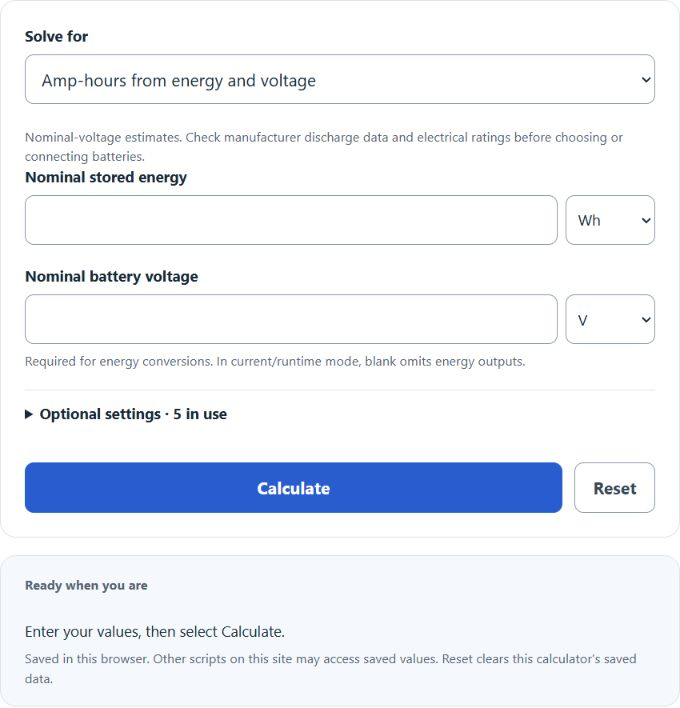
Choose the value to solve for, then enter the required inputs. Energy conversions use nominal voltage. The current/runtime mode gives ideal charge drawn; the bank mode combines matched series and parallel batteries.
- Wh = total energy in watt-hours
- V = battery voltage in volts
- Ah = battery capacity in amp-hours
The calculator also handles common unit conversions before applying the formula:
- To calculate total energy: voltage is multiplied by amp-hours to get watt-hours.
- To calculate amp-hours: total energy in watt-hours is divided by voltage.
- To calculate voltage: total energy in watt-hours is divided by amp-hours.
- For kWh, mAh, or mV: inputs are converted to Wh, Ah, or V first. Outputs show their stated units, with alternate units where useful.
Estimate a battery bank for a daily load
Use Battery bank needed for a load to estimate rated amp-hours for a period without recharging. Enter daily energy in Wh or kWh, or multiply load power by average hours used per day. Enter the bank voltage, days without recharging, usable fraction of rated capacity and energy delivery efficiency. Use appliance-side energy before inverter losses; if the energy already includes all battery-side losses, set delivery efficiency to 100% to avoid counting them twice.
Rated bank Ah = daily load Wh × days / (bank V × usable fraction × delivery efficiency). Percentages are divided by 100 before use. Required nominal energy is rated Ah × bank voltage. For example, a 900 Wh daily load for two days at 12 V, 50% usable capacity and 90% delivery efficiency needs 333.333 Ah, or 4,000 Wh of nominal storage. Four 100 Ah units, each rated at the full 12 V bank voltage, provide a rounded reference bank of 400 Ah.
The reference count rounds up rated Ah / 100. It assumes each 100 Ah unit has the full selected bank voltage; it does not count 12 V batteries wired in series for a 24 V or 48 V bank. Use the existing series and parallel mode for a separate matched-battery configuration. The 50% lead-acid and 80% lithium examples are editable planning fractions, consistent with Victron’s RV battery-sizing guidance. Use the battery and inverter manufacturers’ actual limits and efficiency.
This energy estimate assumes a fully charged bank and no recharging during the selected days. It does not add reserve for aging, temperature or discharge-rate effects, and it does not check peak current, inverter surge capacity or wiring. Those requirements must be considered separately.
Common Battery Voltage and Capacity Reference
These examples show typical battery ratings and the approximate energy they store. Actual usable energy can be lower depending on discharge limits, battery chemistry, age, and load.
| Battery type or use | Typical voltage | Example capacity | Approx. energy |
|---|---|---|---|
| Single lithium-ion cell | 3.7 V | 3000 mAh | 11.1 Wh |
| USB power bank | 3.7 V cell rating | 10000 mAh | 37 Wh |
| Car battery | 12 V | 50 Ah | 600 Wh |
| Small solar battery | 12 V | 100 Ah | 1200 Wh, or 1.2 kWh |
| 48 V battery bank | 48 V | 100 Ah | 4800 Wh, or 4.8 kWh |
Battery Unit Conversions
| Conversion | Use this when |
|---|---|
| mAh ÷ 1000 = Ah | A small battery is rated in milliamp-hours. |
| Ah × 1000 = mAh | You want to express amp-hours as milliamp-hours. |
| kWh × 1000 = Wh | A larger battery is rated in kilowatt-hours. |
| Wh ÷ 1000 = kWh | You want to express watt-hours as kilowatt-hours. |
Example Calculations
Example 1: Calculate watt-hours from volts and amp-hours
You have a 12 V battery rated at 100 Ah.
The battery stores about 1200 Wh, or 1.2 kWh.
Example 2: Calculate amp-hours from watt-hours and voltage
You have a battery rated at 720 Wh and 24 V.
The battery capacity is 30 Ah.
FAQ
What is the difference between amp-hours and watt-hours?
Amp-hours measure electric charge capacity. Watt-hours measure stored energy. Amp-hours alone do not tell you the total energy unless you also know the voltage. For example, a 10 Ah battery at 12 V stores 120 Wh, while a 10 Ah battery at 24 V stores 240 Wh.
How do you convert mAh to Wh?
First convert mAh to Ah by dividing by 1000. Then multiply by voltage.
For example, a 5000 mAh battery at 3.7 V is 5 Ah × 3.7 V = 18.5 Wh.
Does the calculated capacity equal the usable battery capacity?
Not always. The calculation gives the rated or theoretical energy based on voltage and amp-hours. Usable energy can be lower because of inverter losses, voltage cutoff, temperature, battery age, and recommended depth of discharge.